


Disc Filter Gasket
In industrial filtration, the efficiency of a system is often measured by its ability to remove contaminants at a specific micron rating. However, the performance of high-quality Filter Discs & Packs is heavily dependent on the integrity of the seal within the housing. The disc filter gasket serves as this critical interface, ensuring that the process fluid is forced through the filtration media rather than bypassing it through gaps in the assembly. For engineers and procurement specialists, understanding the technical nuances of gasket selection is as vital as selecting the mesh count itself.
A disc filter gasket is more than a simple spacer; it is a precision-engineered component designed to withstand specific thermal, chemical, and mechanical stresses. When a seal fails, the resulting bypass can lead to downstream contamination, equipment damage, and costly production downtime. This guide examines the technical considerations, material properties, and engineering requirements for selecting the correct gasket for industrial filtration applications.
The Function of Gaskets in Filter Discs & Packs
The primary role of a gasket in a filtration assembly is to create a leak-proof seal between the filter element and the sealing surface of the filter holder or housing. In applications involving Filter Discs & Packs, the gasket must compensate for surface irregularities in the metal hardware and maintain that seal under varying pressure loads.
Without a proper disc filter gasket, fluid takes the path of least resistance. Even a microscopic gap can allow unfiltered particles to bypass the multi-layer mesh, rendering the filtration process ineffective. In high-pressure systems, such as hydraulic lines or polymer melt filtration, the gasket also prevents the mesh from shifting or distorting under the force of the flow. By providing a cushioned yet firm boundary, the gasket protects the edges of the wire mesh from fraying and ensures the structural integrity of the entire pack.
Material Selection for Disc Filter Gaskets
Material compatibility is the first hurdle in gasket engineering. The choice of material must be dictated by the chemical nature of the fluid, the operating temperature, and the required sealing pressure. Common materials used in industrial disc filtration include:
Elastomeric Gaskets (EPDM, Nitrile, Viton)
Elastomers are widely used due to their excellent recovery properties and ability to seal with relatively low bolt torque.
* EPDM: Ideal for water treatment and steam applications, offering good resistance to heat and weathering, though poor resistance to petroleum-based oils.
* Nitrile (Buna-N): The standard choice for hydraulic fluids and oils, providing good abrasion resistance and tensile strength.
* Viton (FKM): Specified for high-temperature applications and environments involving aggressive chemicals or fuels. It maintains its mechanical properties where other elastomers would degrade.
Fluoropolymers (PTFE)
PTFE (Polytetrafluoroethylene) is the gold standard for chemical inertness. It is used in pharmaceutical and chemical processing where contamination must be zero and the fluid may be highly corrosive. While PTFE has excellent temperature resistance, engineers must account for "cold flow" or creep, where the material deforms under constant pressure over time.
Metallic and Soft Metal Gaskets
In extreme environments—such as high-pressure polymer extrusion or high-heat petrochemical refining—soft metals like aluminum, copper, or stainless steel are used as gaskets or rims. These materials are often integrated directly into the Filter Discs & Packs through a process called edge-wrapping. The metal rim acts as a gasket, providing a robust, heat-resistant seal that can withstand pressures that would destroy synthetic rubbers.
Engineering Considerations: Pressure, Temperature, and Chemical Compatibility
When specifying a disc filter gasket, engineers must evaluate the "Big Three" variables: pressure, temperature, and media.
Pressure and Compression Set
The gasket must be thick enough to fill the gaps but thin enough to resist extrusion. Under high pressure, a gasket material that is too soft may be pushed out of the sealing seat. Engineers look at the "compression set"—the ability of the material to return to its original thickness after being compressed. A high compression set indicates the material will lose its sealing force over time, leading to leaks.
Thermal Expansion and Degradation
Temperature affects both the chemical resistance and the physical dimensions of the gasket. In high-heat applications, the difference in the coefficient of thermal expansion between the stainless steel filter disc and the gasket material can cause the seal to loosen or over-compress as the system heats up. Furthermore, exceeding the temperature limit of an elastomer leads to hardening and cracking, known as thermal degradation.
Chemical Synergy and Leachables
In food, beverage, and pharmaceutical industries, the gasket must not only resist the process fluid but also ensure that no chemicals leach into the product. This requires FDA-compliant materials. In chemical processing, the gasket must resist swelling; a gasket that swells can restrict flow or make it nearly impossible to remove the filter pack during maintenance.
Types of Gasket Configurations for Multi-Layer Filter Packs
Depending on the application, the gasket may be a separate component or an integrated part of the filter disc. Understanding these configurations helps in optimizing the maintenance cycle.
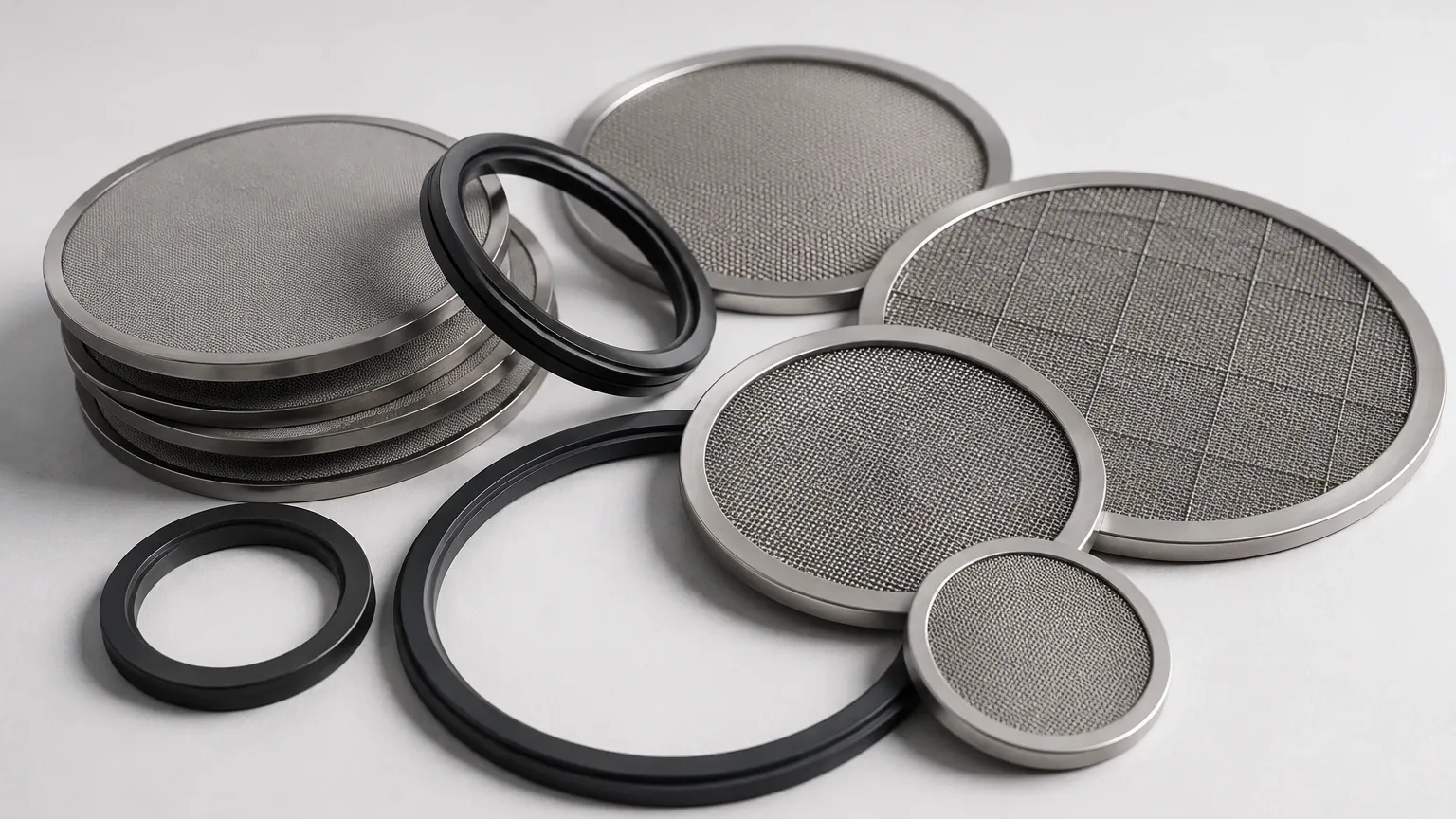
1. Loose-Fit Gaskets: These are separate rings placed on either side of the filter disc during installation. They offer flexibility in material choice but require careful alignment to ensure a proper seal.
2. Bonded Gaskets: Some applications benefit from an elastomer bonded directly to the edge of the wire mesh. This simplifies installation and ensures the gasket cannot be misaligned.
3. Metal Rims (Edge-Wrapping): For multi-layer Filter Discs & Packs, the most common "gasket" is actually a U-shaped metal channel crimped around the circumference. This aluminum or stainless steel rim provides structural rigidity and acts as the sealing surface. This is particularly effective in high-viscosity filtration where synthetic gaskets might fail.
4. Envelope Gaskets: These consist of a PTFE outer shell with an elastomeric core. This provides the chemical resistance of PTFE with the resilience and recovery of an elastomer.
Common Risks of Improper Gasket Selection and Installation
Failure to match the disc filter gasket to the operating environment leads to several predictable industrial risks:
* Bypass Contamination: If the gasket is too thin or the material is incompatible, fluid will bypass the filter. In hydraulic systems, this leads to valve erosion; in food production, it leads to batch contamination.
* Gasket Extrusion: In high-pressure systems, if the gasket material is too soft or the housing tolerances are too wide, the gasket can be forced into the flow stream. This not only breaks the seal but introduces gasket fragments into the filtered fluid.
* Difficulty in Disassembly: A gasket that has chemically bonded to the housing or the filter disc due to heat or chemical reaction can significantly increase the time required for filter changes. In some cases, it can damage the expensive filter housing during removal.
* Uneven Torque: If the bolts on the filter housing are not tightened in the correct sequence or to the correct torque specification, the gasket will be compressed unevenly. This creates a high-pressure point that may fail prematurely while leaving a leak path at the low-pressure point.
Customization and OEM Solutions for Specialized Filtration
Standard off-the-shelf gaskets often fail to meet the rigorous demands of specialized industrial processes. Customization is frequently required to balance filtration accuracy with sealing reliability. When working with a manufacturer like Kaifil, engineers can specify exact dimensions, multi-material laminates, and specialized rim designs for their Filter Discs & Packs.
Customization allows for the engineering of gaskets that account for unique housing geometries or non-standard operating pressures. For instance, in polymer recycling, where temperatures and pressures are extreme, a custom-designed aluminum-rimmed pack serves as both the structural support and the sealing mechanism. In the pharmaceutical sector, custom-molded silicone gaskets can be designed to eliminate "dead zones" where bacteria might grow, ensuring a sanitary filtration environment.
Technical Confirmation Before Procurement
Before finalizing a purchase order for filter discs and their associated gaskets, technical teams should confirm the following data points:
1. Exact Fluid Composition: Include any cleaning chemicals or solvents used in CIP (Clean-In-Place) cycles, as these often differ from the process fluid.
2. Maximum Operating Pressure and Spikes: The gasket must handle the maximum possible pressure, not just the nominal operating pressure.
3. Temperature Range: Define both the minimum and maximum temperatures, including any thermal cycling that occurs during startup or shutdown.
4. Housing Tolerances: Ensure the gasket thickness is compatible with the groove depth and sealing surface finish of the filter holder.
By addressing these factors during the design and selection phase, industrial operations can ensure that their Filter Discs & Packs operate at peak efficiency, protecting downstream equipment and maintaining product purity. The disc filter gasket may be a small component in the overall system, but its role in ensuring filtration integrity is foundational.
