


Disc Filter in Drip Irrigation
In the realm of precision agriculture and industrial-scale landscaping, the efficiency of a drip irrigation system is fundamentally tied to the quality of its filtration. Drip irrigation emitters, designed to deliver water directly to the root zone, possess extremely small orifices—often ranging from 0.5 mm to 1.5 mm. These narrow passages are highly susceptible to clogging from physical debris, organic matter, and chemical precipitates. The disc filter in drip irrigation serves as a critical safeguard, providing a hybrid filtration mechanism that combines the surface-level capture of screen filters with the depth filtration capabilities of media filters.
For engineers and procurement specialists, selecting the appropriate filtration technology is not merely a matter of stopping particles; it is about balancing flow rates, pressure differentials, and maintenance cycles to ensure system longevity. This article examines the technical specifications, engineering considerations, and material advantages of using disc filters within modern irrigation frameworks.
The Mechanics of Disc Filtration
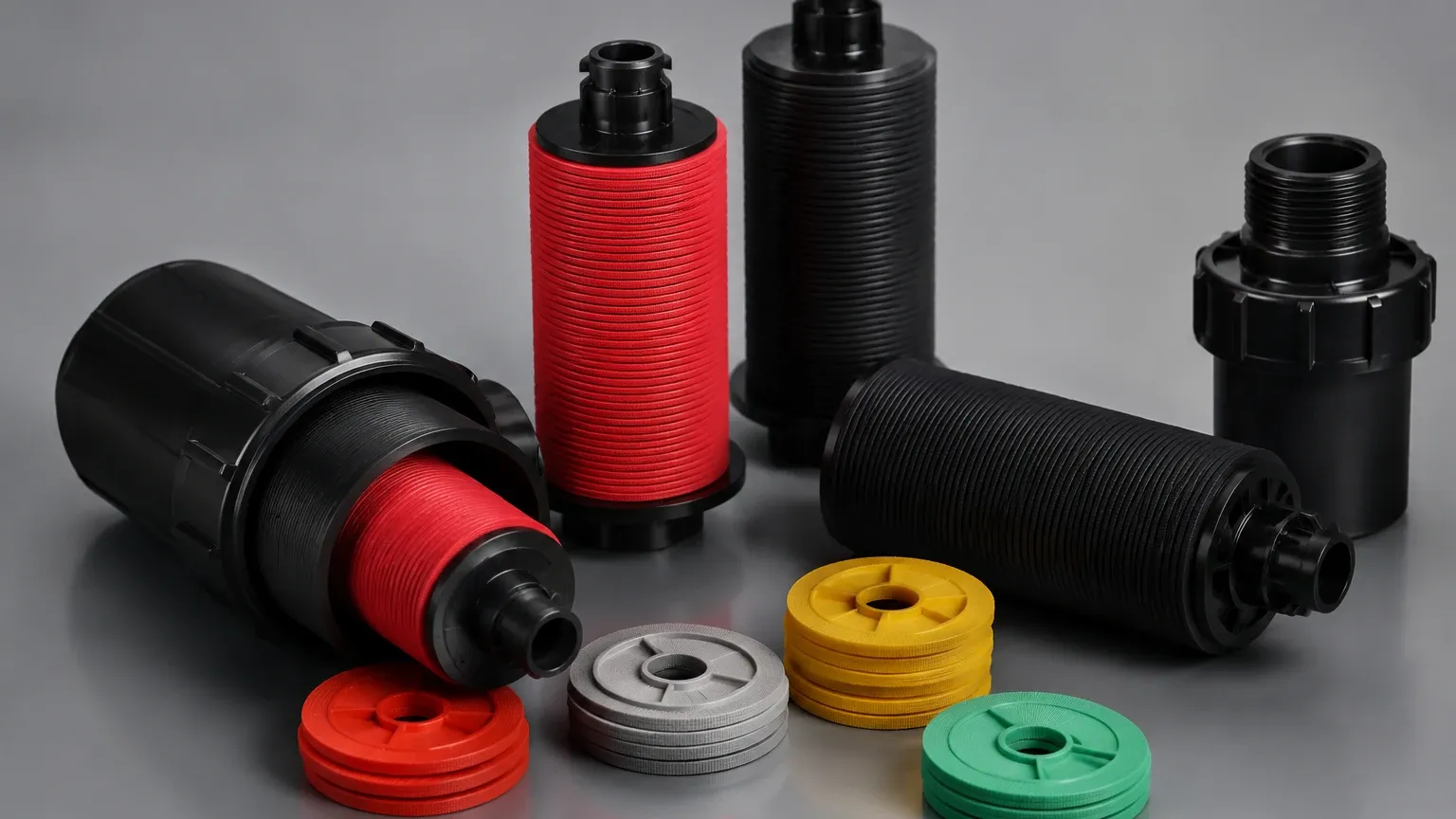
A disc filter consists of a series of thin, grooved plastic or metal discs stacked tightly together on a central telescopic spine. Each disc is etched with microscopic grooves on both sides, typically in a V-shape. When these discs are compressed, the grooves of adjacent discs intersect, creating a complex matrix of intersecting channels.
As water is forced through these channels from the outer diameter to the inner core, the filter performs two distinct functions:
1. Surface Filtration: Larger particles are trapped on the outer surface of the disc stack.
2. Depth Filtration: Smaller particles are captured within the intricate intersections of the grooves throughout the depth of the stack.
This dual-action approach allows a disc filter in drip irrigation to handle a higher load of organic contaminants—such as algae and slime—compared to traditional screen filters, which can become blinded quickly by fibrous materials. When the pressure differential across the stack reaches a predetermined threshold, the discs are decompressed (either manually or via an automated backwash cycle), allowing the trapped debris to be flushed away.
Engineering Criteria for Selection
When specifying a disc filter for an irrigation project, several technical parameters must be evaluated to ensure the filtration system does not become a bottleneck or a point of failure.
Micron Rating and Mesh Equivalency
Filtration accuracy is measured in microns (µm). In the context of drip irrigation, the standard rule is that the filter should remove any particle larger than one-tenth to one-fifth the diameter of the emitter orifice. Most disc filters are categorized by color-coded discs representing specific micron ratings, often ranging from 20 to 400 microns. For standard drip tape and emitters, a 130-micron (120 mesh) rating is the industry benchmark. Using Filter Discs & Packs with precise tolerances ensures that even irregularly shaped particles are effectively sequestered.
Flow Rate and Pressure Drop
Every filter introduces a pressure drop ($ΔP$) into the system. Engineers must calculate the clean pressure drop at the maximum design flow rate. If the initial pressure drop is too high, it reduces the operating pressure available for the emitters, potentially leading to poor water distribution uniformity. A well-sized disc filter should ideally operate with a clean pressure drop of less than 2-3 psi (0.14-0.21 bar). As the filter accumulates debris, the $ΔP$ increases; a backwash cycle is typically triggered when the differential reaches 7-10 psi.
Effective Filtration Area
The total surface area of the disc stack determines how much debris the filter can hold before requiring cleaning. Larger filtration areas lead to longer intervals between backwashes, which reduces water waste and mechanical wear on valves. In industrial or large-scale agricultural applications, manifolding multiple disc filter units in parallel is a common strategy to increase the total effective filtration area while maintaining manageable flow velocities.
Material Science in Irrigation Filtration
While polymer-based discs are common in standard agricultural applications, industrial-grade irrigation systems—especially those involving fertigation (the injection of fertilizers) or the use of reclaimed wastewater—require more robust materials.
Stainless Steel Components
In high-pressure environments or systems where chemical compatibility is a concern, stainless steel components offer superior durability. Stainless steel 304 and 316L are frequently utilized for the housings and, in specialized cases, the filtration media itself. Stainless steel provides excellent resistance to corrosion from nitrogen-based fertilizers and acidic cleaning agents used to dissolve mineral scales. Furthermore, metal components maintain structural integrity under thermal fluctuations that might cause plastics to warp or become brittle over time.
Chemical Resistance and Fertigation
Fertigation introduces salts and chemicals that can accelerate the degradation of standard filtration materials. A disc filter in drip irrigation must be compatible with the specific chemistry of the nutrients being delivered. For instance, phosphorus-based fertilizers can lead to the formation of calcium phosphate precipitates if the water hardness is high. In these scenarios, the depth filtration of the disc stack is essential for capturing these fine precipitates before they reach the emitters.
Comparing Disc Filters to Screen and Media Filters
Understanding where disc filters fit in the hierarchy of filtration technology helps in making an informed purchasing decision.
* Screen Filters: These are best suited for inorganic debris like sand. They are cost-effective but struggle with organic matter, which can "thread" through the mesh or smear across the surface, making cleaning difficult.
* Media (Sand) Filters: These provide excellent depth filtration and are the gold standard for heavy organic loads. However, they have a large footprint, require significant amounts of water for backwashing, and are generally more expensive to install.
* Disc Filters: These offer a compact alternative to media filters with better organic matter handling than screen filters. They are considered a "middle-ground" solution that provides high-efficiency filtration in a smaller physical space with moderate water requirements for cleaning.
For many modern drip systems, the disc filter is the preferred primary filter or a secondary safety filter following a centrifugal sand separator.
Installation and System Integration
The placement of the disc filter in drip irrigation is vital for protecting the most sensitive components of the system.
1. Primary Filtration Point: The filter should be installed downstream of the pump and any primary sand separators, but upstream of the main distribution lines and fertigation injection points (unless the filter is specifically designed to handle the concentrated chemicals).
2. Pressure Manometers: Installing pressure gauges both before and after the filter is mandatory. This allows operators to monitor the pressure differential visually and determine when maintenance is required.
3. Air Release Valves: To prevent water hammer and ensure smooth operation during start-up and backwashing, air release valves should be placed in the manifold near the filter bank.
4. Bypass Lines: In critical industrial applications, a bypass line with a secondary filter allows for continuous operation during manual cleaning or maintenance of the primary unit.
Maintenance, Backwashing, and Durability
The longevity of a disc filter depends on the rigor of its maintenance schedule. There are two primary cleaning methods:
Manual Cleaning
In smaller systems, the filter housing is opened, the spine is decompressed, and the discs are rinsed with high-pressure water. It is important to ensure the discs are free to spin or separate during rinsing so that debris trapped between the grooves is fully dislodged. If mineral scale has built up, the disc stack may need to be soaked in a mild acid solution.
Automatic Backwashing
Automated systems use a hydraulic valve to reverse the flow of water when the pressure differential reaches a set point. During backwash, the stack is decompressed, and nozzles spray water at high velocity from the inside of the stack outward. This causes the discs to spin rapidly, centrifugally shedding the trapped particles. This process typically takes only 20 to 90 seconds per filter pod and consumes a relatively small volume of water.
Replacement Cycles
While the discs themselves are designed for multi-year use, they are subject to wear. Over time, the grooves can become rounded or clogged with permanent deposits, reducing filtration efficiency. Regular inspection of the Filter Discs & Packs is necessary to identify signs of erosion or bypass. Replacing the disc stack is a cost-effective way to restore a filter to its original performance specifications without replacing the entire housing.
Total Cost of Ownership (TCO) Considerations
When evaluating the cost of a disc filter in drip irrigation, engineers should look beyond the initial purchase price. The Total Cost of Ownership (TCO) includes:
* Operational Water Loss: How much water is used during backwashing? Disc filters are generally more efficient than sand media filters in this regard.
* Energy Costs: A higher pressure drop across the filter requires the pump to work harder, increasing electricity consumption. Selecting a filter with a larger surface area can mitigate this.
* Labor Costs: Automated systems have a higher upfront cost but significantly lower labor requirements compared to manual filters, especially in areas with high water turbidity.
* Downtime: The reliability of the filtration system directly impacts the health of the crop or the efficiency of the industrial process. A failure in filtration that leads to clogged emitters can necessitate the replacement of miles of drip tubing, a cost that far outweighs the investment in a high-quality filter.
Conclusion
The disc filter in drip irrigation represents a sophisticated solution to the perennial problem of emitter clogging. By providing three-dimensional filtration in a compact and maintainable format, it addresses the needs of both inorganic and organic contaminant removal. For engineers and technical professionals, the selection process must be guided by a thorough understanding of flow dynamics, micron requirements, and the chemical environment of the irrigation water. Investing in precision-engineered filtration components ensures that the drip system operates at peak efficiency, delivering water and nutrients reliably while minimizing the need for costly manual interventions.
