


Disc Filter in Paper Industry
In the modern pulp and paper industry, water management and fiber recovery are critical components of operational efficiency and environmental compliance. The disc filter in paper industry applications serves as a primary mechanism for white water clarification and fiber reclamation. As paper mills strive for "closed-loop" systems to minimize freshwater consumption and reduce effluent discharge, the technical integrity of filtration components becomes paramount. High-performance Filter Discs & Packs are essential for maintaining the consistency of the pulp stock and ensuring that processed water meets the stringent requirements for reuse in the manufacturing cycle.
Understanding the Function of Disc Filters in Paper Mills
The disc filter is a versatile piece of equipment used primarily for two functions: thickening pulp and recovering fibers from white water (the water drained from the paper machine wire). In the thickening process, the filter increases the consistency of the pulp to prepare it for subsequent stages such as bleaching or storage. In fiber recovery, often referred to as a "save-all" application, the filter captures fine fibers and fillers that would otherwise be lost in the mill's wastewater.
The operation relies on a series of rotating discs mounted on a central shaft. Each disc is composed of multiple sectors covered with a specialized filter medium. As the shaft rotates through a vat of pulp or white water, a vacuum is applied to the interior of the sectors. This vacuum draws liquid through the filter medium, leaving a mat of fiber on the surface. The clarity of the filtrate—the liquid that passes through—depends heavily on the precision and quality of the filter discs used.
Technical Components: Filter Discs & Packs in Stock Preparation
The efficiency of a disc filter is determined by the interaction between the mechanical design of the machine and the technical specifications of the filter media. In the paper industry, where slurry conditions can be abrasive and chemically aggressive, the choice of filter media is a critical engineering decision.
Multi-layer vs. Single-layer Construction
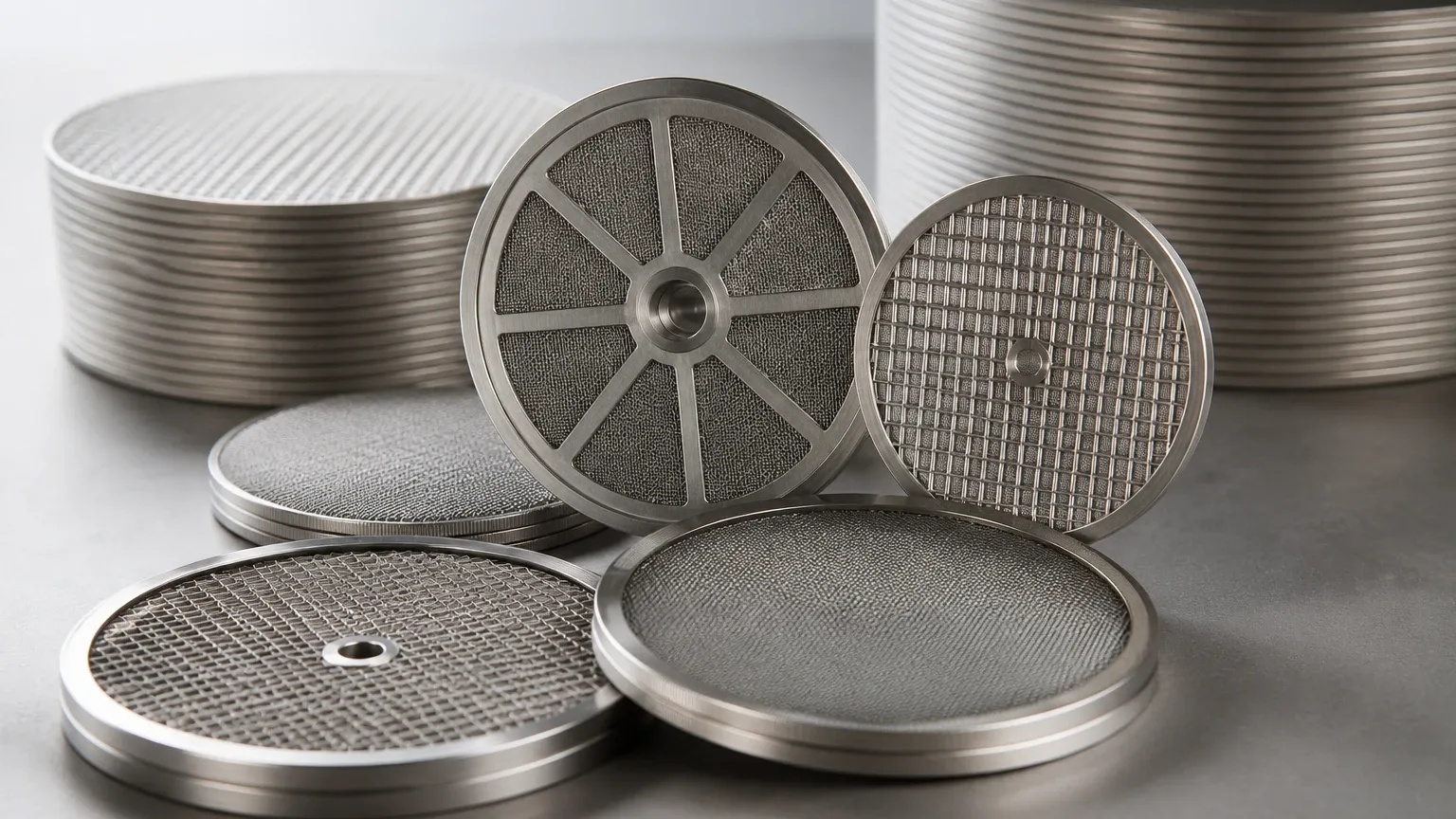
Filter Discs & Packs are often engineered with multiple layers of stainless steel wire mesh to balance filtration fineness with structural rigidity. A typical multi-layer pack might include:
- The Filtration Layer: A fine mesh designed to capture specific particle sizes (microns).
- The Support Layer: A coarser, heavier mesh that provides mechanical strength and prevents the fine mesh from deforming under vacuum pressure.
- The Drainage Layer: A layer designed to facilitate the rapid flow of filtrate toward the central shaft, reducing hydraulic resistance.
For the disc filter in paper industry use, the drainage capacity is just as important as the particle retention. If the filtrate cannot exit the sector quickly, the thickening capacity of the machine is diminished, leading to bottlenecks in production.
Material Engineering for Corrosive Environments
Paper manufacturing involves complex chemistry, including the use of bleaching agents, sizing chemicals, and pH adjusters. Furthermore, the process often operates at elevated temperatures. These factors necessitate the use of high-grade stainless steel alloys for all filtration components.
Stainless Steel 304 vs. 316L
While AISI 304 stainless steel is suitable for some general water treatment applications, the paper industry frequently requires AISI 316L. The addition of molybdenum in 316L provides superior resistance to pitting and crevice corrosion, particularly in the presence of chlorides used in bleaching or in mills using recycled water with high salt concentrations. For specialized applications involving extreme chemical exposure, higher alloys such as 904L or Duplex stainless steels may be specified to ensure the longevity of the Filter Discs & Packs.
Durability and Fatigue Resistance
Disc filters operate in a continuous cycle of immersion and emergence, creating alternating mechanical loads on the filter sectors. This cyclic stress can lead to metal fatigue. Engineering the mesh to withstand these fluctuations requires precise welding techniques and high-quality wire drawing to ensure that the mesh does not fray or detach from the sector frame over time.
Operational Efficiency and Performance Metrics
When evaluating a disc filter in paper industry settings, engineers focus on several key performance indicators (KPIs). These metrics dictate the total cost of ownership and the overall productivity of the mill.
1. Filtrate Clarity: Measured in parts per million (ppm) of suspended solids. High-quality filter packs ensure that the "super-clear" filtrate contains minimal solids, allowing it to be reused in high-pressure showers without clogging nozzles.
2. Specific Loading Rate: The amount of pulp (in tons) that can be processed per square meter of filter area per day. This is influenced by the mesh's open area and its resistance to blinding.
3. Cake Discharge Efficiency: The ease with which the fiber mat (cake) is removed from the disc surface. If the mesh surface is too rough or if the weave pattern is incorrect, fibers can become trapped, leading to "ghosting" and reduced capacity.
4. Energy Consumption: The vacuum required to pull liquid through the filter. Lower hydraulic resistance in the filter pack translates directly to lower energy requirements for vacuum pumps.
Maintenance and Replacement Considerations
Despite the durability of stainless steel, Filter Discs & Packs are considered wear parts that require periodic inspection and replacement. In the paper industry, the primary causes of filter failure include mechanical damage from tramp metal in the stock, chemical scaling, and biological fouling (slime growth).
Preventing Clogging and Blinding
Blinding occurs when fines or chemical additives lodge within the mesh pores. To combat this, disc filters utilize high-pressure spray pipes to clean the mesh during each rotation. However, if the mesh selection is not optimized for the specific fiber type (e.g., long-fiber softwood vs. short-fiber hardwood), cleaning efficiency will drop. Engineers must match the mesh weave—such as plain, twill, or Dutch weave—to the morphological characteristics of the fibers being processed.
Replacement Cycles
A well-maintained stainless steel filter disc can last several years, but performance often degrades gradually. Monitoring the pressure differential across the filter and the clarity of the filtrate provides early warning signs that the filter packs are reaching the end of their effective service life. Timely replacement is essential to prevent fiber loss and protect downstream equipment.
Selection Criteria for Custom Filtration Solutions
Selecting the right Filter Discs & Packs involves more than just matching dimensions. It requires a deep understanding of the mill's specific process conditions. Engineers should confirm the following data points before specifying new or replacement components:
* Slurry Consistency: The percentage of solids in the feed. High-consistency applications require different drainage characteristics than low-consistency white water recovery.
* Particle Size Distribution: A detailed analysis of the fiber and filler sizes helps in selecting the optimal micron rating to maximize recovery without sacrificing flow rate.
* Chemical Profile: pH levels, chloride content, and the presence of oxidizing agents dictate the necessary alloy grade.
* Mechanical Interface: The method of attachment to the sector frame (e.g., bolted, welded, or tensioned) must be compatible with existing hardware to ensure a leak-proof seal.
By addressing these technical variables, paper mills can optimize their disc filter performance, leading to significant savings in fiber costs and water treatment expenses.
The Role of Precision Manufacturing in Filtration
The manufacturing process of filter discs for the paper industry involves advanced wire weaving and fabrication technologies. Precision is required at every step, from the uniformity of the wire diameter to the accuracy of the mesh count. Variations in the mesh can lead to localized high-velocity zones, which accelerate wear and allow solids to bypass the filter.
Customization is a hallmark of effective industrial filtration. Every paper mill has unique challenges based on the grade of paper produced—whether it is tissue, packaging board, or fine writing paper. Custom-engineered Filter Discs & Packs allow for the fine-tuning of filtration parameters, such as adjusting the ratio of open area to mechanical strength, ensuring that the disc filter in paper industry environments operates at peak theoretical efficiency.
Conclusion: Strategic Value of High-Quality Filtration
In the competitive landscape of global paper manufacturing, the disc filter is more than just a piece of utility equipment; it is a strategic asset for resource recovery. Investing in high-quality, stainless steel Filter Discs & Packs provides a reliable defense against fiber loss and environmental non-compliance. By focusing on technical specifications, material durability, and application-specific design, engineers can ensure that their filtration systems contribute to the long-term sustainability and profitability of the mill. For those seeking to optimize their stock preparation or water recovery systems, selecting components that meet the rigorous demands of the paper industry is the first step toward operational excellence.
