


Disc Filter in Water Treatment
In industrial water treatment, the efficiency of a filtration system is often determined by the precision and durability of its internal components. Among the various technologies available, the use of a disc filter in water treatment has become a standard for applications requiring high-volume throughput combined with fine particulate removal. While many general-purpose systems utilize plastic or synthetic media, industrial-grade applications—particularly those involving high temperatures, corrosive chemicals, or high-pressure differentials—rely on metallic Filter Discs & Packs to maintain operational integrity.
For engineers and procurement professionals, selecting the correct filtration media involves balancing micron ratings, flow rates, and material compatibility. This article examines the technical nuances of stainless steel filter discs, their specific roles in water treatment cycles, and the engineering considerations necessary for optimizing industrial filtration performance.
Understanding Filter Discs & Packs in Industrial Systems
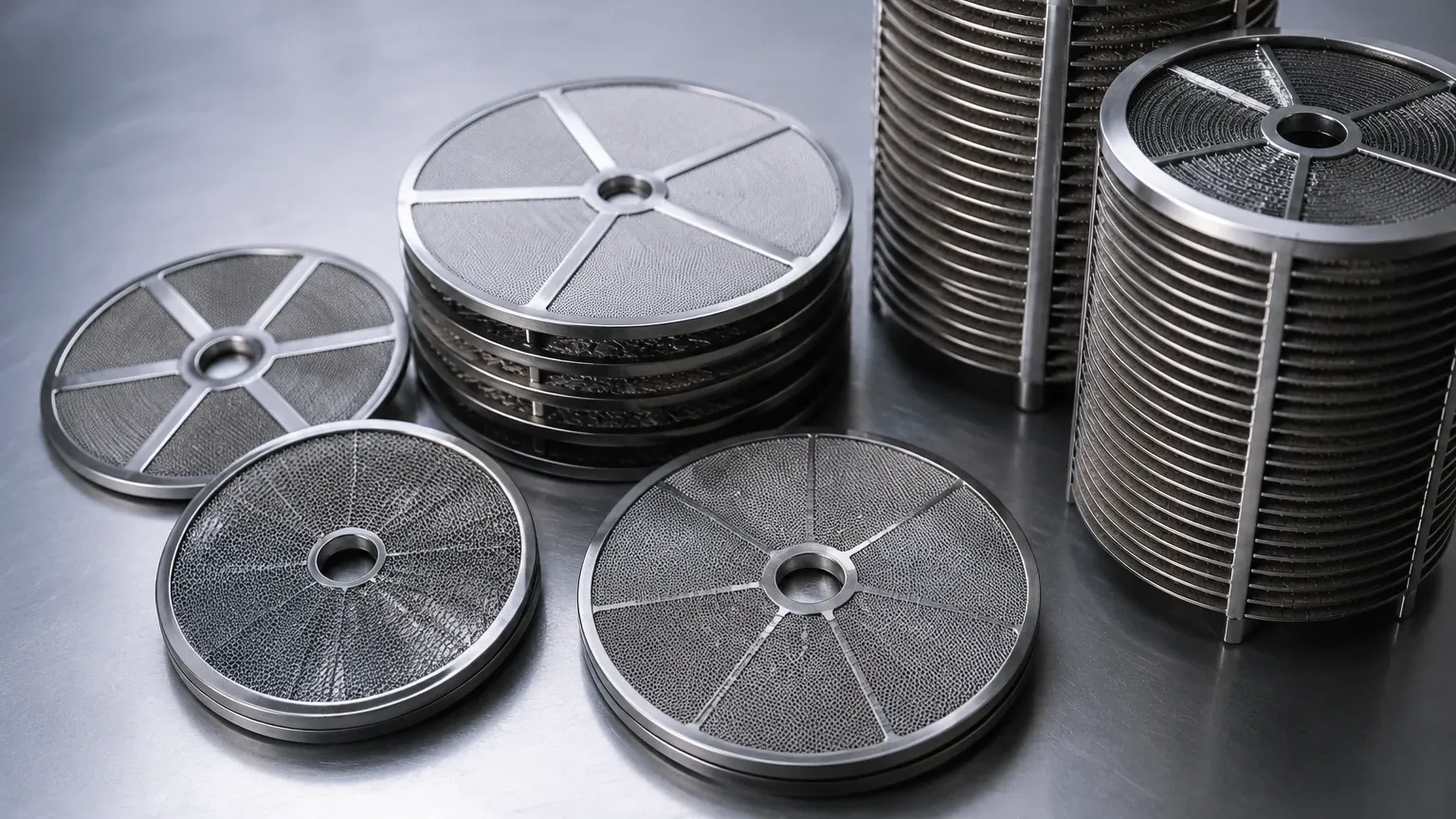
Filter discs and packs are precision-engineered components typically constructed from woven wire mesh, sintered metal fiber, or multi-layer sintered mesh. Unlike bulk media filters, these discs provide a defined surface or depth filtration area that can be precisely controlled during the manufacturing process.
Construction and Geometry
Industrial filter discs are available in various configurations, including single-layer mesh, multi-layer bonded packs, and pleated designs. The choice of construction depends on the required mechanical strength and the nature of the contaminants being filtered.
1. Single-Layer Discs: These are often used for simple straining or as support layers in more complex systems. They are cost-effective but may lack the structural rigidity required for high-pressure backwashing.
2. Multi-Layer Packs: By combining different mesh counts, these packs provide graduated filtration. A coarse outer layer may act as a pre-filter, while a fine inner layer performs the final separation. These layers are often spot-welded or rimmed with a metal binder to ensure they remain a cohesive unit under hydraulic stress.
3. Sintered Mesh Discs: Sintering involves bonding multiple layers of wire mesh through a heat-treatment process without the use of adhesives. This creates a porous metal structure that is exceptionally strong and resistant to delamination, making it ideal for the demanding environment of a disc filter in water treatment.
Mechanism of a Disc Filter in Water Treatment
The primary function of a disc filter in water treatment is the removal of suspended solids (TSS), organic matter, and particulate debris from a liquid stream. The mechanism of action varies slightly depending on the design of the filter housing, but the fundamental physics remain consistent.
Surface vs. Depth Filtration
Most stainless steel filter discs operate on the principle of surface filtration. Particles larger than the mesh opening are trapped on the upstream side of the disc. However, multi-layer sintered packs can provide a degree of depth filtration, where particles are captured within the tortuous paths of the integrated mesh layers. This is particularly useful in water treatment scenarios where the particle size distribution is broad.
Hydraulic Performance
In a water treatment plant, the hydraulic load is a critical metric. A disc filter must allow for maximum flow with minimal pressure drop (ΔP). Stainless steel wire mesh is preferred in these scenarios because it offers a high percentage of open area compared to perforated plates or synthetic membranes. This high porosity ensures that the system can handle high flux rates without requiring excessive pumping energy.
Material Engineering: Why Stainless Steel?
Water treatment environments are often chemically aggressive. Whether dealing with brackish water, industrial effluent, or chemically treated process water, the material of the filter disc must resist corrosion and mechanical wear.
Grade 304 vs. 316L
* Type 304 Stainless Steel: Suitable for general water treatment applications where the chloride content is low. It provides excellent mechanical strength and is a cost-effective solution for many industrial pre-filtration needs.
* Type 316L Stainless Steel: The "L" denotes low carbon, which improves weldability and resistance to intergranular corrosion. 316L contains molybdenum, which significantly enhances its resistance to pitting and crevice corrosion in chloride-rich environments, such as seawater desalination or chemical processing wastewater.
Specialized Alloys
In extreme cases where even 316L might fail—such as in highly acidic or high-temperature steam filtration—manufacturers like Kaifil can utilize specialized alloys like Hastelloy, Monel, or Inconel. These materials ensure that the filter discs do not become a point of failure in the critical infrastructure of a water treatment facility.
Key Performance Indicators for Filtration Selection
When specifying a disc filter in water treatment, engineers must evaluate several key performance indicators (KPIs) to ensure the component meets the application's demands.
Micron Rating (Absolute vs. Nominal)
* Nominal Rating: Refers to the ability of the filter to retain a majority (typically 60% to 90%) of particles of a specific size. It is a useful metric for general-purpose straining.
* Absolute Rating: Refers to the diameter of the largest hard spherical particle that will pass through the filter under specified test conditions. For critical water treatment stages, such as protecting high-pressure pumps or sensitive RO membranes, absolute-rated Filter Discs & Packs are essential.
Structural Integrity and Burst Pressure
In high-pressure water systems, the filter disc must withstand the differential pressure that builds up as the mesh becomes loaded with contaminants. Sintered discs are particularly valued here for their high mechanical strength, preventing the mesh from deforming or "bursting" into the downstream flow.
Cleaning and Regenerability
One of the primary advantages of metallic disc filters over disposable cartridges is their ability to be cleaned and reused. In water treatment, this is often achieved through automated backwashing or ultrasonic cleaning. The ability of a stainless steel disc to withstand repeated cleaning cycles without losing its filtration accuracy is a major factor in reducing the total cost of ownership.
Customization for OEM and Industrial Equipment
No two water treatment applications are identical. Factors such as the concentration of solids, the presence of oils, and the specific flow requirements necessitate customized filtration solutions.
Tailored Mesh Configurations
OEMs often require specific mesh combinations to achieve a target filtration efficiency while maintaining a compact footprint. For example, a disc pack might be designed with a 100-mesh support layer, a 20-micron sintered fiber felt middle layer, and a 40-mesh protective outer layer. This level of customization allows for optimized performance in specialized equipment like centrifugal separators or high-speed water filtration units.
Edge Finishing and Sealing
To prevent bypass—where unfiltered water leaks around the edges of the disc—proper edge finishing is required. Options include:
* Aluminum or Stainless Steel Rimming: A metal U-clip is pressed around the circumference of the disc pack to provide a rigid, leak-proof seal.
* Welded Edges: The layers are plasma or TIG welded together, ensuring a permanent bond that is suitable for high-purity pharmaceutical water systems.
* Rubber or PTFE Gaskets: For applications requiring a soft seal against a housing flange.
Operational Maintenance and Lifecycle Management
While stainless steel filter discs are designed for longevity, their performance is dependent on a proactive maintenance schedule. In the context of a disc filter in water treatment, monitoring the differential pressure is the most effective way to manage the lifecycle of the component.
Monitoring Differential Pressure
As solids accumulate on the disc surface, the resistance to flow increases. Most industrial systems are equipped with ΔP sensors. Once a predetermined threshold is reached, the system must be taken offline for cleaning or the automated backwash cycle must be initiated. Operating a system beyond its recommended pressure drop can lead to particle breakthrough or permanent deformation of the wire mesh.
Cleaning Procedures
Depending on the nature of the foulants, cleaning may involve:
* Backwashing: Reversing the flow of water to dislodge surface particles.
* Chemical Cleaning: Using acids or bases to dissolve mineral scaling or organic biofilms (provided the filter material is compatible).
* Ultrasonic Cleaning: Using high-frequency sound waves in a solvent bath to remove fine particles trapped deep within the mesh layers.
Procurement Considerations and Total Cost of Ownership
When purchasing filter discs, it is tempting to focus solely on the initial unit price. However, for industrial water treatment, the total cost of ownership (TCO) is a more accurate metric. This includes the cost of energy (pumping against pressure), the cost of downtime for replacements, and the lifespan of the filter media.
Evaluating Suppliers
A reliable manufacturer should provide comprehensive technical data, including material certifications (MTRs), bubble point test results, and flow-versus-pressure-drop curves. For OEM applications, the ability of the supplier to provide consistent quality over large production runs is critical to the reliability of the end product.
Total Cost Factors
* Durability: A higher-quality sintered disc may cost more upfront but can last years, whereas a cheaper single-layer disc might require replacement every few months due to mechanical fatigue.
* Efficiency: Precision-engineered discs reduce the risk of downstream equipment damage, such as membrane fouling or pump cavitation, which can be exponentially more expensive than the filter itself.
Conclusion
The role of the disc filter in water treatment is foundational to the stability of industrial processes. By selecting the appropriate Filter Discs & Packs, engineers can ensure that their systems operate with maximum efficiency, minimal downtime, and superior water quality. Whether the application involves simple sediment removal or complex chemical filtration, the technical advantages of stainless steel—strength, temperature resistance, and regenerability—make it the material of choice for demanding industrial environments.
As water treatment standards continue to evolve, the demand for high-precision, customized filtration components will only increase. Working with a specialized manufacturer like Kaifil allows technical teams to develop filtration solutions that are precisely matched to their operational requirements, ensuring long-term performance and reliability in even the most challenging conditions.
