


Disc Filter Revit Family
In the landscape of modern industrial engineering and facility design, Building Information Modeling (BIM) has transitioned from a specialized tool to an industry standard. For engineers designing complex fluid handling systems, chemical processing plants, or hydraulic power units, the integration of precise digital components is essential. A disc filter revit family serves as more than a mere 3D representation; it is a data-rich component that allows designers to simulate spatial requirements, maintenance clearances, and mechanical connections before a single physical part is ordered.
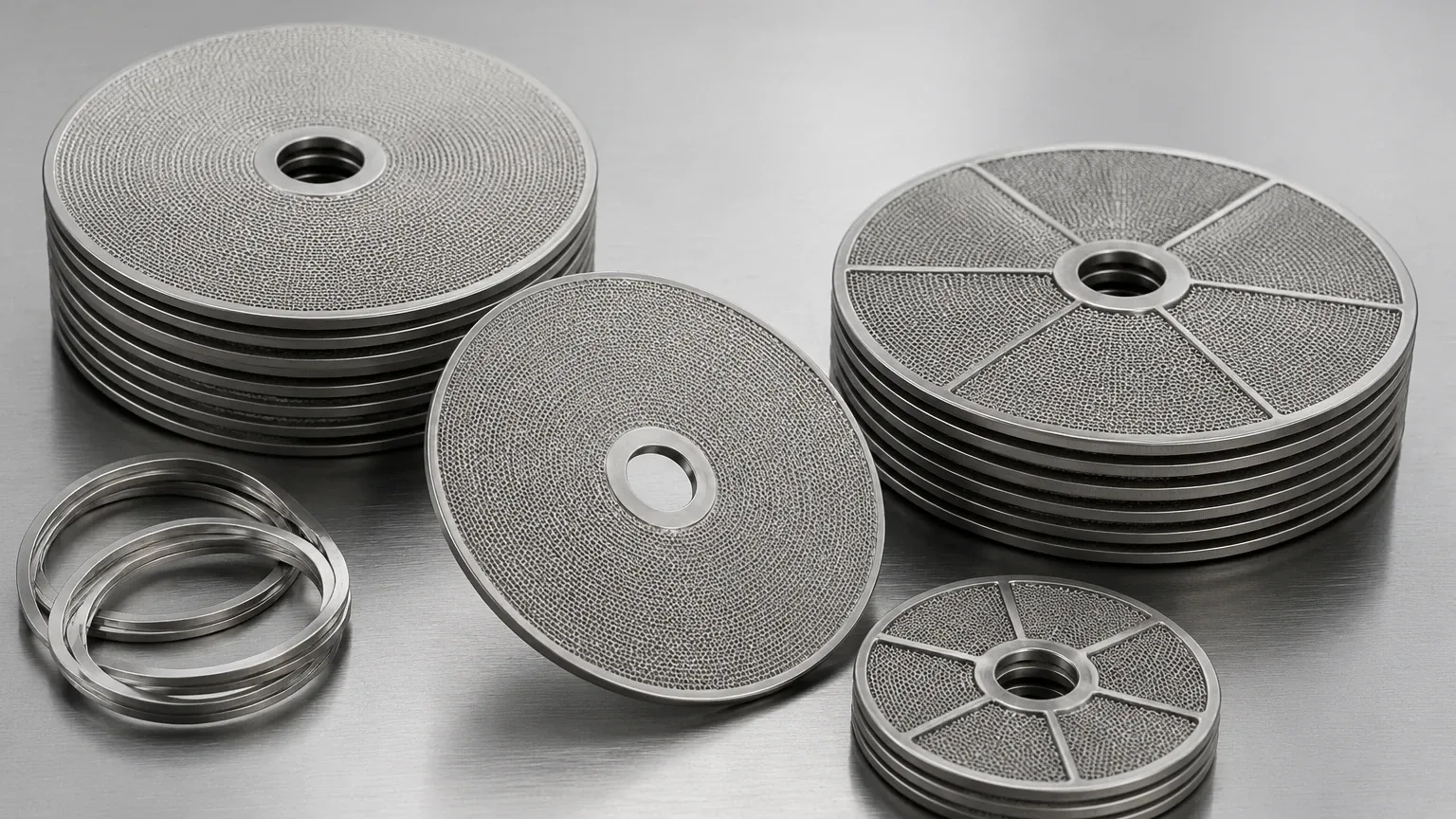
When specifying Filter Discs & Packs for industrial applications, the transition from a digital Revit model to a physical stainless steel component requires a deep understanding of both the software parameters and the metallurgical realities of filtration media. This guide explores the technical considerations for integrating disc filters into BIM workflows and the critical specifications engineers must confirm to ensure system performance.
The Role of BIM in Industrial Filtration Systems
BIM software, specifically Autodesk Revit, allows for the creation of "families"—groups of elements with a common set of properties and a related graphical representation. A disc filter revit family enables mechanical, electrical, and plumbing (MEP) engineers to incorporate filtration stages into larger system assemblies.
In industrial contexts, the accuracy of these families impacts several stages of the project lifecycle:
1. Spatial Coordination: Ensuring that the filter housing and the internal filter packs fit within the allocated footprint, accounting for piping offsets and structural supports.
2. Maintenance Planning: Defining the "service zone" around a filter assembly. Engineers use Revit families to ensure there is sufficient clearance to remove and replace filter discs during scheduled downtime.
3. Flow Analysis: High-quality Revit families include connectors that carry data such as fluid type, flow rate, and pressure drop (delta P). This data is vital for sizing pumps and ensuring the overall hydraulic balance of the system.
For manufacturers like Kaifil, providing accurate dimensional data and material specifications is the foundation upon which these digital families are built. While a generic disc filter revit family might suffice for preliminary layouts, custom industrial applications require specific parameters that reflect the actual performance of stainless steel wire mesh.
Technical Parameters for Filter Discs & Packs
When developing or selecting a disc filter revit family, the parameters must align with the physical capabilities of the filtration media. Industrial filter discs are rarely monolithic; they are often complex assemblies designed for specific pressure and particle retention requirements.
Material Specifications
In Revit, the material parameter should reflect the specific grade of stainless steel required for the application. Common choices include:
* AISI 304: Suitable for general industrial use where basic corrosion resistance is required.
* AISI 316/316L: Preferred for chemical processing, pharmaceutical, and marine environments due to superior resistance to chlorides and acids.
* Specialty Alloys: For high-temperature or highly corrosive environments, materials like Monel or Inconel may be specified.
Filtration Accuracy (Micron Rating)
This is a critical data field within the Revit family. The micron rating determines the size of particles the filter will retain. In a digital model, this is often a text or integer parameter, but in the physical world, it is determined by the mesh count and weave type of the wire cloth. Common weave types include plain weave, twill weave, and Dutch weave, each offering different balances of flow rate and mechanical strength.
Layer Configuration
Industrial Filter Discs & Packs can be single-layer or multi-layer. Multi-layer packs often consist of a fine filtration mesh sandwiched between coarser support meshes. In a Revit family, the "thickness" parameter must accurately reflect the total stack height of these layers, especially when they are bound by a metal rim or spot-welded together.
Engineering Considerations for Disc Filter Selection
Beyond the digital model, engineers must evaluate the physical performance expectations of the filter components. Selecting the right disc filter involves balancing filtration efficiency with structural integrity.
Pressure Drop and Flow Capacity
Every filter introduces a resistance to flow. As particles accumulate on the surface of the disc, the differential pressure increases. When specifying a disc filter revit family, engineers should look for components that allow for the input of loss coefficients or pressure drop curves. This ensures that the simulated system reflects the real-world behavior of the stainless steel mesh under load.
Structural Integrity and Support
Under high-pressure conditions, a single layer of fine wire mesh may deform or rupture. This is why multi-layer packs are frequently used. The outer layers provide the necessary rigidity to withstand the hydraulic force, while the inner layer performs the actual filtration. For Revit modeling, it is important to distinguish between a simple mesh disc and a framed pack, as the frame (or rim) will affect the seating and sealing within the filter housing.
Edge Treatment and Sealing
The method used to finish the edges of a filter disc is vital for both safety and performance. Options include:
* Spot Welding: Multiple layers are welded at specific points to maintain alignment.
* Bound Edges: An aluminum, stainless steel, or copper rim is crimped around the edge. This provides a smooth surface and helps create a mechanical seal within the housing.
* Unbound Edges: Used primarily in applications where the disc is clamped tightly between two flanges.
Customization and OEM Capabilities
One of the primary challenges in using a standard disc filter revit family is that industrial filtration is rarely "off-the-shelf." Most high-performance systems require customized dimensions and configurations.
Kaifil specializes in custom stainless steel filtration solutions, offering the flexibility to manufacture filter discs to precise specifications derived from engineering models. This includes:
* Custom Diameters: Ranging from a few millimeters to over a meter, depending on the housing requirements.
* Variable Shapes: While circular discs are most common, Revit families can be configured for rectangular, oval, or annular (donut-shaped) filters.
* Precision Tooling: Utilizing advanced cutting and stamping technologies to ensure dimensional tolerances align with the digital design.
When an engineer moves from the design phase in Revit to the procurement phase, having a manufacturer that can interpret BIM data or detailed CAD drawings is essential. This reduces the risk of "design-to-manufacturing" errors that can lead to costly delays on-site.
Common Risks in Specifying Filter Discs
Inaccurate specification within a Revit environment or a purchase order can lead to several operational risks. Engineers should be aware of the following pitfalls:
1. Incompatible Material Selection
If the Revit family is labeled generically as "Stainless Steel," but the application involves highly corrosive chemicals, the physical part may fail prematurely. Always confirm the specific alloy (e.g., 316L) in both the digital model and the technical data sheet.
2. Overlooking the "Effective Filtration Area"
In a Revit model, a disc might be shown as 100mm in diameter. However, if that disc is held in place by a 10mm wide flange, the effective filtration area is significantly reduced. This reduction must be accounted for in flow calculations to prevent excessive pressure drop.
3. Neglecting Thermal Expansion
In high-temperature applications, such as steam filtration or hot oil processing, the metal filter disc will expand. If the Revit family does not account for thermal tolerances within the housing, the physical disc may buckle or fail to seal correctly when the system reaches operating temperature.
Integration and Total Cost of Ownership
While the initial focus of a disc filter revit family is often on the design and installation phase, the long-term value of these components is found in their durability and maintainability. Stainless steel filter discs are often preferred over disposable media because they can be cleaned and reused, lowering the total cost of ownership (TCO).
Cleaning Cycles and Longevity
Engineers should consider the cleaning method (ultrasonic cleaning, backwashing, or chemical cleaning) when selecting the mesh type. A robust, multi-layer pack designed in the BIM stage with longevity in mind will ultimately provide better ROI than a cheaper, single-layer alternative that requires frequent replacement.
Verification and Quality Control
Before finalizing a specification based on a Revit model, it is standard practice to confirm the manufacturer’s quality control processes. This includes verifying mesh opening sizes, wire diameters, and the integrity of welds or rims. Reliable manufacturers provide material test reports (MTRs) and certificates of compliance to ensure the physical product matches the engineering requirements defined in the digital model.
Conclusion
The use of a disc filter revit family represents a sophisticated approach to industrial system design, bridging the gap between theoretical engineering and practical application. By accurately defining parameters such as material grade, micron rating, and layer configuration within the BIM environment, engineers can optimize system performance and streamline the procurement process.
As a professional manufacturer of Filter Discs & Packs, Kaifil provides the technical expertise and manufacturing precision required to turn these digital designs into high-performance filtration components. Whether you are designing a new chemical processing line or upgrading a hydraulic system, ensuring that your filtration specifications are grounded in factual engineering data is the key to operational success. For engineers and purchasing teams, the move from a Revit model to a physical installation is a critical path that requires a partner capable of delivering reliable, customized, and durable filtration solutions.
