


Disc Filter Segment
In industrial filtration, the efficiency of a process often hinges on the precision and durability of individual components. The disc filter segment represents a critical modular unit within large-scale rotary disc filters and pressurized filtration systems. These segments are engineered to provide high-surface-area filtration while maintaining structural integrity under significant differential pressures. For engineers and procurement teams, understanding the technical nuances of material selection, weave patterns, and construction methods is essential for optimizing system uptime and filtration accuracy.
As a specialized manufacturer, Kaifil provides high-performance Filter Discs & Packs designed to meet the rigorous demands of chemical, pharmaceutical, and industrial processing. This guide explores the engineering considerations behind the disc filter segment, providing the technical foundation necessary for informed selection and application.
Understanding the Role of the Disc Filter Segment in Industrial Systems
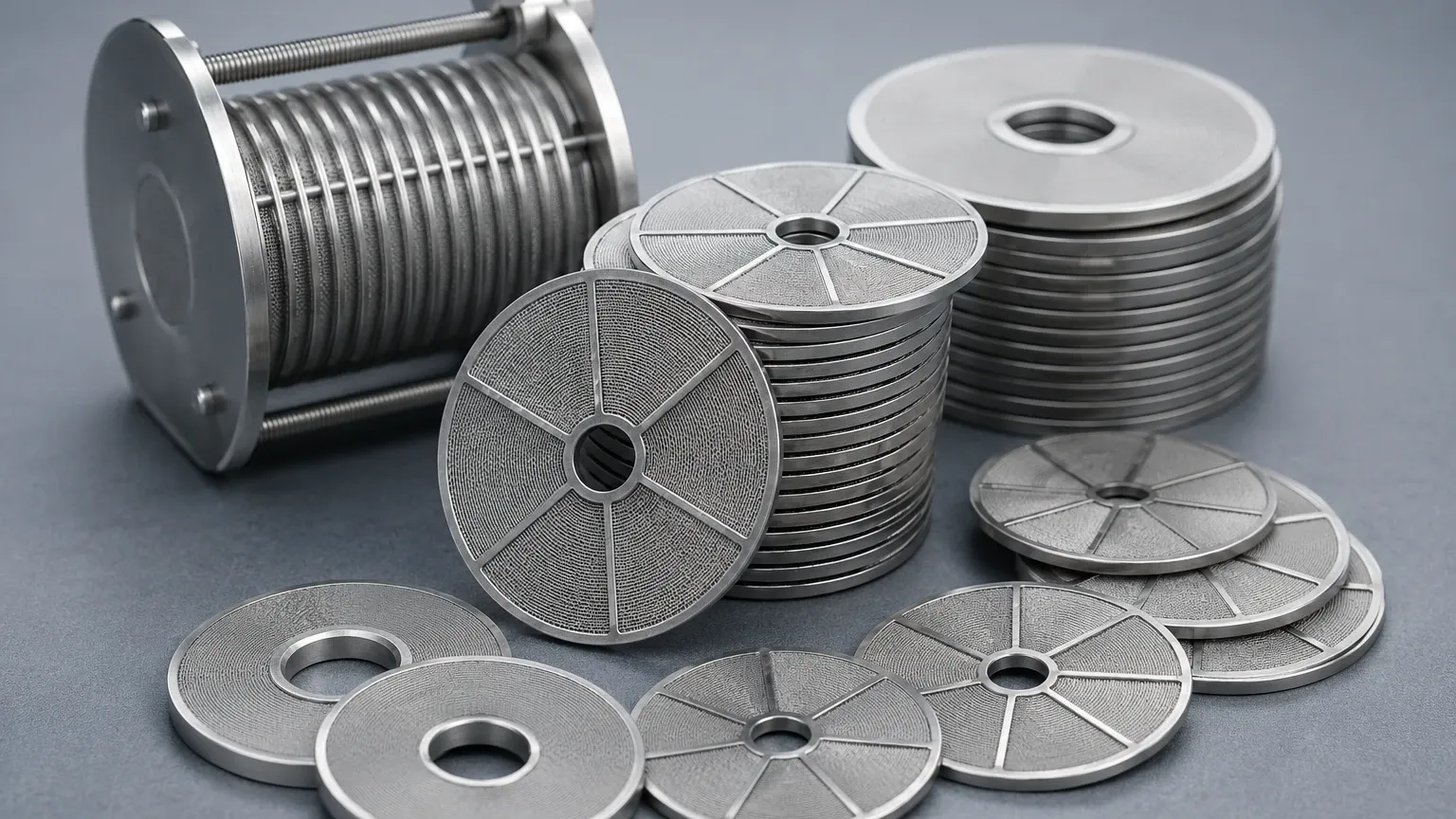
A disc filter segment is essentially a sector-shaped filtration component that, when assembled with other segments, forms a complete circular filter disc. This modular design is prevalent in rotary vacuum filters and disc-type polymer melt filters. The primary advantage of using a segmented approach is ease of maintenance; if one portion of the filter face becomes damaged or blinded, only the specific disc filter segment needs replacement, rather than the entire assembly.
These components are tasked with two primary functions: providing a precise physical barrier to capture contaminants and supporting the hydraulic or mechanical loads of the fluid stream. In applications like polymer extrusion or chemical slurry processing, the segments must withstand high temperatures and corrosive environments without losing their geometric stability. The choice of internal support structures and external mesh layers determines the segment's ability to handle high flow rates while maintaining a low initial pressure drop.
Material Engineering and Construction Standards
The performance of a disc filter segment is fundamentally tied to its metallurgy. Industrial filtration environments are rarely benign, necessitating materials that offer a balance of mechanical strength and chemical resistance.
Stainless Steel Alloys
Stainless steel is the industry standard for most Filter Discs & Packs.
- SS304/304L: Suitable for general industrial applications where moderate corrosion resistance is required. It is often used in food and beverage processing or standard hydraulic systems.
- SS316/316L: The preferred choice for chemical processing and pharmaceutical applications. The addition of molybdenum provides superior resistance to chlorides and organic acids.
- Specialty Alloys: For extreme environments, segments may be fabricated from 904L, Inconel, or Hastelloy. These are reserved for high-temperature applications or highly aggressive chemical baths where standard stainless steels would suffer from pitting or stress corrosion cracking.
Weave Types and Filtration Media
The filtration media applied to the segment frame determines the micron rating and flow characteristics. Common weave patterns include:
- Plain Weave: Offers a straightforward aperture geometry, suitable for high-flow, low-pressure applications.
- Dutch Weave (Plain and Twill): These weaves use larger diameter wires in the warp and smaller wires in the shute, creating a dense, tortuous path for the fluid. This is ideal for fine filtration and high-pressure environments, as it provides greater mechanical strength.
- Sintered Mesh: For the most demanding applications, multiple layers of wire mesh are sintered together. This process fuses the contact points of the wires, creating a rigid, migration-free medium that is exceptionally durable and easy to clean via backwashing.
Key Performance Indicators for Filter Discs & Packs
When evaluating a disc filter segment, engineers must look beyond simple dimensions. Several performance metrics dictate the long-term viability of the component in a production line.
Micron Rating and Capture Efficiency
Filtration accuracy is defined by the micron rating, which can be "absolute" or "nominal." In critical B2B applications, such as pharmaceutical API production or fine chemical synthesis, absolute ratings are required to ensure that 99.9% of particles above a specific size are retained. The segment must be manufactured with uniform pore distribution to prevent "channeling," where fluid bypasses the media through larger-than-specified openings.
Pressure Drop and Flow Capacity
The "clean pressure drop" is the initial resistance the filter offers to the fluid flow. A well-designed disc filter segment maximizes the Effective Filtration Area (EFA) to keep this value low. High EFA reduces the energy requirements for pumps and extend the time between cleaning cycles. If the segment is too restrictive, it can lead to premature system shut-downs or even mechanical failure of the filter media due to excessive differential pressure.
Mechanical Rigidity
In rotary disc filters, the segments are subjected to rotational forces and varying hydraulic loads. The frame of the segment must be robust enough to prevent warping. A warped segment can lead to uneven cake buildup in slurry applications or bypass leaks at the sealing edges. Kaifil’s manufacturing process ensures that each segment maintains its flatness and structural integrity throughout its service life.
Structural Variations and Customization Options
No two industrial processes are identical, which is why customization is a hallmark of high-quality Filter Discs & Packs. The physical construction of a segment can be adapted to specific machinery and operating conditions.
Rimmed vs. Unrimmed Segments
- Rimmed Segments: These feature a metal border (often aluminum or stainless steel) that is crimped or welded around the edges. The rim provides a clean sealing surface and protects the edges of the wire mesh from fraying. This is essential for segments that are frequently handled or subjected to high-velocity fluid bypass.
- Unrimmed/Spot-Welded Segments: In some low-clearance applications, a simple spot-welded edge is preferred to minimize the profile of the segment. This allows for tighter stacking in multi-disc assemblies.
Multi-Layer Configurations
A single layer of mesh is often insufficient for high-pressure applications. Most industrial segments utilize a multi-layer approach:
1. Filtration Layer: The fine mesh that dictates the micron rating.
2. Support Layer: A coarser mesh that provides rigidity to the filtration layer.
3. Drainage Layer: A very coarse mesh or perforated plate that allows the filtered fluid to exit the segment efficiently toward the central shaft or outlet.
Application-Specific Selection Guidance
The choice of a disc filter segment varies significantly across industries. Engineering teams should consider the specific rheology of their process fluid.
Polymer Melt Filtration
In plastic extrusion, the filter must handle high-viscosity fluids at elevated temperatures (often exceeding 300°C). The segments must be able to withstand differential pressures that can reach several hundred bar. Sintered metal fiber or multi-layer sintered mesh segments are typically used here due to their ability to resist compression and provide depth filtration for gel removal.
Chemical and Petrochemical Processing
Corrosion resistance is the primary driver here. Segments used in catalyst recovery or brine filtration must be compatible with the pH levels and chemical constituents of the stream. Engineers often specify SS316L or higher alloys to prevent contamination of the final product with metal ions resulting from corrosion.
Food and Beverage Clarification
For beverage applications, the focus is on hygiene and cleanability. Segments must be designed with minimal "dead zones" where bacteria can proliferate. Smooth surface finishes and ultrasonic cleaning compatibility are standard requirements for segments used in wine, juice, or edible oil filtration.
Operational Maintenance and Lifecycle Management
The total cost of ownership (TCO) of a disc filter segment is determined not just by the purchase price, but by its lifespan and cleanability. Stainless steel segments offer a significant advantage over disposable media because they can be cleaned and reused multiple times.
Cleaning Protocols
Depending on the contaminant, segments can be cleaned using:
- Ultrasonic Cleaning: Highly effective for removing fine particles lodged deep within Dutch weave or sintered media.
- Chemical Cleaning: Using acids or alkalis to dissolve organic or inorganic scaling.
- Pyrolysis/Burn-off: Used primarily in the polymer industry to remove residual plastic from the mesh.
Signs of Wear and Failure
Engineers should monitor for "media migration," where individual wires break and enter the process stream. Additionally, permanent deformation (bellying) of the segment indicates that the operating pressure has exceeded the mechanical limits of the support structure. Regular inspection of the spot welds and rim integrity is necessary to prevent bypass leaks.
Procurement Considerations for Engineering Teams
When sourcing Filter Discs & Packs, providing detailed technical specifications to the manufacturer is vital. To ensure the disc filter segment performs as expected, the following information should be confirmed during the RFQ process:
1. Dimensional Accuracy: Exact outer radius, inner radius, and arc angle are critical for fitment in the filter housing.
2. Operating Environment: Minimum and maximum operating temperatures, as well as the chemical composition of the fluid.
3. Pressure Requirements: Maximum allowable differential pressure (ΔP) before the segment is considered blinded or at risk of structural failure.
4. Sealing Requirements: Whether the segment requires specific gasket materials or specialized rim designs to interface with the central shaft.
By focusing on these technical parameters, procurement teams can move beyond commodity-based purchasing and select filtration components that enhance the reliability and efficiency of their industrial processes. Kaifil’s expertise in custom stainless steel fabrication ensures that every segment is built to the precise tolerances required by modern engineering standards.
