


Disc Filter vs Mesh Filter
In industrial filtration, selecting the correct media and configuration is critical for maintaining process efficiency, protecting downstream equipment, and ensuring product purity. Two terms frequently encountered by procurement teams and engineers are "disc filters" and "mesh filters." While they share common materials—most notably stainless steel wire mesh—their structural designs, performance characteristics, and application suitability differ significantly.
This guide provides a technical comparison of the disc filter vs mesh filter, examining the engineering considerations that dictate their selection in demanding environments such as chemical processing, polymer extrusion, and pharmaceutical manufacturing.
Defining the Technologies
To understand the nuances of the disc filter vs mesh filter debate, one must first define what each term represents in an industrial context.
What is a Mesh Filter?
In a broad sense, a mesh filter refers to any filtration component where the primary medium is a woven wire cloth. This can take many forms, including large screens, cylinders, or pleated cartridges. The term "mesh" specifically refers to the number of openings per linear inch. Industrial mesh filters are typically valued for their high open area, precise pore size, and ability to be fabricated into complex geometries.
What is a Disc Filter?
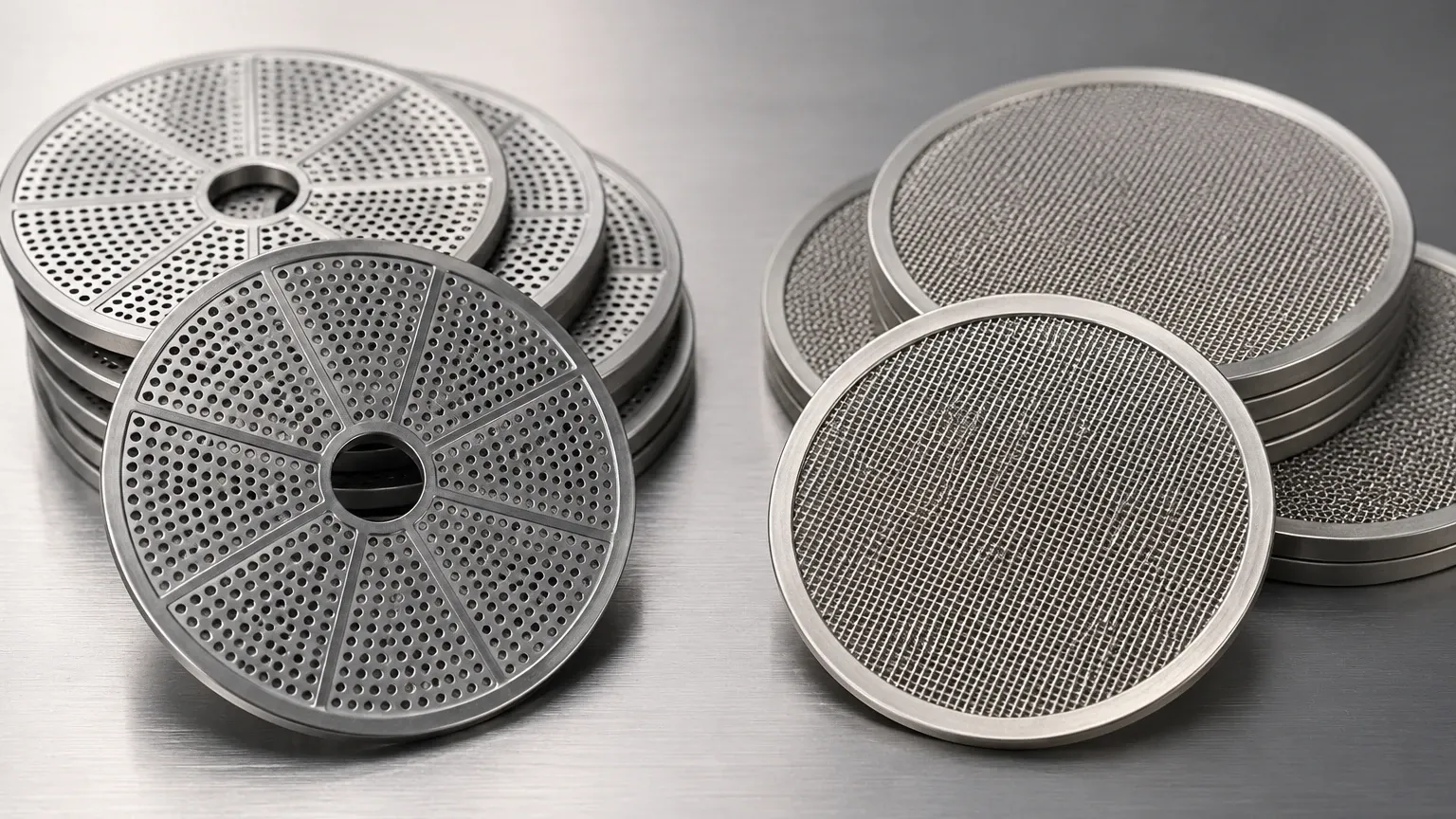
A disc filter is a specific form factor of filtration media, usually circular, designed to fit into recessed housings or plate-and-frame assemblies. While a disc filter often utilizes wire mesh as its functional layer, it is frequently a multi-layered component. These are often referred to as Filter Discs & Packs, which may consist of several layers of different mesh counts bonded together through welding or sintering to provide both fine filtration and structural support.
Structural Differences and Construction
The primary distinction in the disc filter vs mesh filter comparison lies in how the material is layered and finished.
Single-Layer Mesh vs. Multi-Layer Packs
Standard mesh filters are often single-layered. They are excellent for simple straining or as a primary barrier against large particulates. However, single-layer mesh can be fragile under high-pressure conditions.
In contrast, disc filters are frequently engineered as "packs." A typical pack might include:
1. A Filtration Layer: The fine mesh that determines the micron rating.
2. Support Layers: Coarser mesh layers on either side of the filtration layer to prevent deformation under pressure.
3. Drainage Layers: To facilitate even flow across the entire surface of the disc.
Sintering vs. Spot Welding
When comparing a disc filter vs mesh filter in high-pressure applications, the bonding method is vital. Mesh filters are often mechanically held or spot-welded. Disc filters, however, can be sintered—a process where multiple layers of mesh are fused together under heat and pressure without the use of binders. Sintered disc filters offer superior mechanical strength and do not suffer from wire migration, making them ideal for high-viscosity fluids like molten polymers.
Performance Evaluation: Disc Filter vs Mesh Filter
Engineers must evaluate several performance metrics when deciding between these two configurations.
Filtration Accuracy (Micron Rating)
Both types can achieve very fine filtration, often down to 2-5 microns. However, the disc filter (especially in a pack configuration) provides a more stable pore structure. In a single-layer mesh filter, the openings can slightly distort under high differential pressure, potentially allowing larger particles to pass through. The multi-layered nature of Filter Discs & Packs ensures that the filtration rating remains consistent even as pressure builds.
Dirt-Holding Capacity
Mesh filters generally offer a high open area, which is beneficial for high-flow, low-solids applications. However, disc filters, particularly those with depth-loading characteristics or multiple graduated layers, can often hold more contaminants before reaching the terminal pressure drop. This is because the coarser outer layers of a disc pack can capture larger particles, preventing the fine inner layer from blinding prematurely.
Pressure Drop (ΔP)
A single-layer mesh filter typically has a lower initial pressure drop due to its simplicity. However, in applications involving high-viscosity fluids or high flow velocities, the structural integrity of the disc filter becomes more important. While a disc pack might have a slightly higher initial ΔP due to multiple layers, its resistance to deformation ensures a more predictable flow curve over its service life.
Material Selection and Compatibility
Both disc and mesh filters are predominantly manufactured from stainless steel, but the specific grade is a critical engineering choice.
* Grade 304 Stainless Steel: The standard choice for general industrial use, providing good corrosion resistance and durability.
* Grade 316/316L Stainless Steel: Contains molybdenum, which provides superior resistance to chlorides and acids. This is the preferred material for pharmaceutical and marine applications.
* Specialty Alloys: For extreme environments, materials like Inconel, Monel, or Hastelloy may be used in both mesh and disc formats to withstand high temperatures or highly corrosive chemical reagents.
When evaluating the disc filter vs mesh filter for a specific chemical process, the surface area exposed to the fluid must be considered. Sintered disc packs, despite being thicker, offer a robust solution where chemical attack might otherwise weaken a thin, single-layer mesh.
Application Suitability
Understanding where each excels is key to optimizing a filtration system.
When to Choose a Mesh Filter
Mesh filters are the go-to solution for:
* General Water Treatment: Removing sand, grit, or scale from process water.
* Air and Gas Filtration: Where low pressure drop is a primary concern.
* Large-Scale Screening: Where the filter needs to cover a large surface area or be formed into a large basket or cylinder.
* Temporary or Low-Cost Applications: Where the mechanical stresses are minimal.
When to Choose a Disc Filter
Disc filters are preferred for:
* Polymer and Fiber Production: The high pressures of extrusion require the rigidity of sintered or multi-layered Filter Discs & Packs.
* Hydraulic Systems: Protecting sensitive valves from fine metallic particles.
* Pharmaceutical Processing: Where precise, repeatable filtration and the ability to withstand rigorous cleaning (autoclaving) are required.
* Oil and Gas Refineries: Specifically in catalyst recovery or high-temperature gas filtration where structural failure is not an option.
Engineering Considerations for Purchasing
Before finalizing a specification between a disc filter vs mesh filter, engineers should confirm the following technical parameters with their manufacturer.
1. Mechanical Strength and Support
Will the filter be subjected to back-pulsing or high differential pressure? If the ΔP is expected to exceed 50-100 psi, a single-layer mesh filter may require an external support perforated plate. A multi-layered disc filter often has this support built into its structure.
2. Effective Filtration Area (EFA)
In a disc filter, the EFA is straightforward (the area of the circle). However, in mesh filters that are pleated or cylindrical, the EFA can be much higher within the same footprint. Engineers must balance the need for a compact disc design against the high-flow capabilities of a pleated mesh cartridge.
3. Cleaning and Reusability
Stainless steel filters are typically cleanable and reusable, which lowers the total cost of ownership compared to disposable polymer filters. Disc filters, especially sintered ones, are highly resistant to ultrasonic cleaning and chemical stripping. When evaluating disc filter vs mesh filter longevity, consider how many cleaning cycles the mesh can withstand before the wires begin to fray or the weave shifts.
4. Edge Treatment
For disc filters, the edge treatment is a critical detail. Options include:
* Raw Edges: For filters that are clamped tightly in a housing.
* Welded Edges: To prevent any bypass or loose wires.
* Framed/Rimmed Edges: Using an aluminum or stainless steel binder to provide a gasket-like seal and additional rigidity.
Total Cost of Ownership (TCO)
While a single-layer mesh filter might have a lower initial purchase price, the TCO often favors the disc filter in specialized industrial roles. The durability of Filter Discs & Packs reduces the frequency of replacement and minimizes the risk of catastrophic failure, which could lead to downstream equipment damage or contaminated product batches.
In the context of disc filter vs mesh filter, the "cheaper" option often results in higher costs due to increased downtime and labor for frequent filter changes. A robust disc pack, though more expensive upfront, provides a more stable and predictable filtration process.
Customization and OEM Solutions
Industrial filtration is rarely a one-size-fits-all field. Manufacturers like Kaifil specialize in tailoring these components to specific technical requirements. Whether an application requires a specific weaving pattern (such as Plain Dutch Weave for high flow or Twill Dutch Weave for fine filtration) or a unique disc diameter to fit a legacy machine, customization is essential.
When consulting with a supplier, provide the following data points:
* Fluid type and viscosity at operating temperature.
* Target particle size (micron rating).
* Operating and maximum surge pressure.
* Flow rate requirements.
* Housing dimensions and sealing requirements.
Conclusion
The choice between a disc filter vs mesh filter ultimately depends on the mechanical demands of the application and the required precision of the filtration task. Mesh filters offer versatility and high flow for general-purpose screening, while disc filters and multi-layer packs provide the structural integrity and consistency needed for high-pressure, high-precision industrial processes.
By focusing on material grade, layering strategy, and edge construction, engineering teams can select a filtration solution that optimizes performance and longevity. For those requiring precision-engineered components, exploring specialized Filter Discs & Packs is often the most effective route to achieving reliable, long-term filtration success in demanding environments.
