


Filter Disc Price
In industrial filtration, the procurement of components like filter discs and packs is rarely a matter of selecting a stock item from a catalog. For engineers and procurement specialists in sectors such as chemical processing, plastic extrusion, and pharmaceutical manufacturing, understanding the nuances behind a filter disc price is essential for balancing operational efficiency with budgetary constraints. While the initial unit cost is a visible metric, the underlying factors—ranging from metallurgical composition to manufacturing tolerances—dictate the long-term value and performance of the filtration system.
Selecting the right Filter Discs & Packs involves a technical evaluation of the application’s environment. A price quote for these components is not merely a reflection of material weight; it is a calculation of engineering precision, durability, and the specific demands of the media being filtered.
Understanding the Variables in Filter Disc Pricing
The most significant driver of the filter disc price is the raw material. Stainless steel is the industry standard due to its corrosion resistance and mechanical strength, but the specific grade chosen has a direct impact on cost.
Material Grades and Alloy Composition
Stainless steel 304 is often the baseline for general-purpose industrial applications. It provides adequate corrosion resistance for many water treatment and mild chemical processes. However, for environments involving high salinity, acidic solutions, or high temperatures, stainless steel 316 or 316L is required. The addition of molybdenum in 316L enhances its resistance to pitting and crevice corrosion, which typically results in a 10% to 25% price premium over 304, depending on market fluctuations.
In extreme cases, such as highly corrosive chemical processing or aerospace applications, specialized alloys like Monel, Inconel, or Hastelloy may be specified. These materials can increase the price by several orders of magnitude compared to standard stainless steel, but they are necessary to prevent premature failure and system contamination.
Mesh Count and Weave Complexity
The density of the wire mesh, known as the mesh count, also influences the price. A higher mesh count implies finer wires and more intricate weaving processes. For example, a coarse 20-mesh screen is significantly less expensive to produce than a 500-mesh precision screen. Furthermore, the type of weave—Plain, Twill, or Dutch weave—requires different levels of loom setup and production time. Dutch weaves, often used for fine micron filtration, utilize a heavier warp wire and a finer weft wire, creating a dense, high-strength filter medium that naturally commands a higher price point due to the complexity of the weaving process.
Structural Design and Layering Effects on Cost
Filter discs are rarely used as single sheets of mesh in high-pressure industrial environments. Most applications require multi-layer packs to provide both fine filtration and structural support. The complexity of these assemblies is a primary factor in the final filter disc price.
Single Layer vs. Multi-Layer Packs
A single-layer disc is the most economical option, suitable for low-pressure applications where the mesh is not at risk of deformation. However, in plastic extrusion or hydraulic systems, a single layer of fine mesh would collapse under the pressure. Multi-layer packs solve this by sandwiching the fine filtration mesh between coarser support layers.
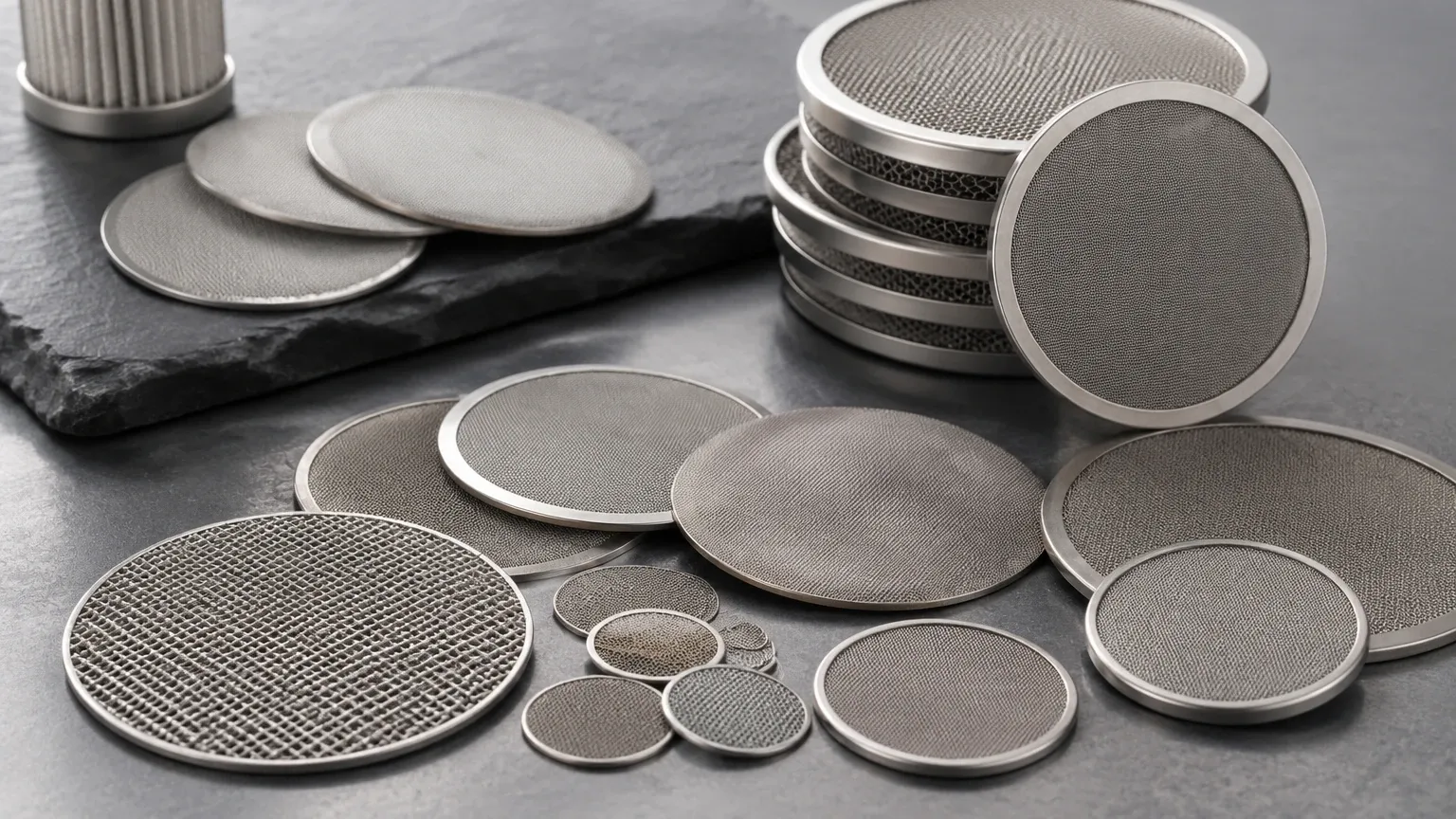
A typical 3-layer or 5-layer pack increases the material cost and the labor required for assembly. Each layer must be precisely aligned and bonded. The method of bonding—whether through spot welding at the perimeter or full sintering—drastically alters the price. Sintered mesh, where layers are diffusion-bonded under heat and pressure, offers the highest durability and no risk of wire migration, but it is the most expensive structural option.
Edge Treatment and Framing
How the edges of the disc are finished affects both the price and the seal integrity within the filter housing.
1. Raw Edges: The most cost-effective method, where discs are simply stamped from a sheet. These are suitable for applications where the disc is held firmly in a recessed groove.
2. Spot Welded Edges: Multiple layers are joined at specific points around the circumference. This is a standard, mid-range cost solution for multi-layer packs.
3. Rimmed or Framed Edges: The disc is enclosed in a metal rim, often made of aluminum, copper, or stainless steel. This provides a superior seal and prevents any loose wires from entering the downstream flow. The additional material and the secondary pressing process required for rimming add to the unit cost.
The Impact of Filtration Precision and Micron Ratings
Filtration precision is defined by the micron rating, which indicates the size of particles the disc is capable of intercepting. Achieving a consistent, high-precision micron rating requires stringent quality control and high-quality wire mesh.
When a project requires a narrow tolerance for filtration accuracy (e.g., a 5-micron absolute rating versus a 20-micron nominal rating), the manufacturing rejection rate can increase. Precision mesh must be inspected for weave defects, wire diameter consistency, and aperture uniformity. Any deviation in the mesh geometry can lead to "bypass," where contaminants pass through enlarged openings.
Suppliers who provide certified micron ratings often perform bubble point tests or glass bead challenges to verify performance. These testing protocols, while ensuring reliability in critical applications like pharmaceutical or food and beverage production, are factored into the professional filter disc price. For non-critical applications, such as basic debris removal in irrigation, a nominal rating without extensive testing documentation can reduce costs.
Customization and Engineering Requirements
One of the most significant advantages of working with a specialized manufacturer like Kaifil is the ability to customize components to fit specific machinery. However, customization introduces variables that affect the price.
Dimensions and Shapes
Standard circular discs are the most economical because they utilize standard tooling. When an application requires oval, rectangular, or complex geometric shapes, new stamping dies must be created. For low-volume orders, the cost of this custom tooling can significantly inflate the per-unit price. For high-volume OEM orders, the tooling cost is amortized over thousands of units, making the custom shape more affordable.
Post-Processing and Cleaning
In industries such as medical device manufacturing or high-purity chemical processing, the discs must be free of all manufacturing oils, burrs, and particulates.
* Ultrasonic Cleaning: This process uses high-frequency sound waves to remove microscopic contaminants from the mesh intersections.
* Passivation: A chemical treatment for stainless steel that removes free iron from the surface and enhances the protective oxide layer, improving corrosion resistance.
* Deburring: Ensuring that the edges of the discs are perfectly smooth to prevent damage to seals or injury to operators during installation.
Each of these secondary processes adds value and ensures the filter disc meets the cleanliness standards of the industry, but they also contribute to a higher initial filter disc price.
Analyzing Total Cost of Ownership (TCO) in Industrial Filtration
For a B2B buyer, the purchase price is only one part of the equation. The Total Cost of Ownership (TCO) considers how long the filter lasts, how easily it can be cleaned, and the cost of the downtime required to replace it.
Durability and Lifespan
A cheaper, lower-quality filter disc may suffer from wire fatigue or corrosion, leading to frequent replacements. If a filter disc in a continuous plastic extrusion line fails, the cost of the resulting downtime and the loss of raw material far outweighs the savings gained by purchasing a lower-priced component. Investing in a high-quality stainless steel pack with reinforced edges may have a higher upfront price but can offer a service life three to four times longer than a budget alternative.
Cleanability and Reusability
Stainless steel filter discs are often chosen because they are cleanable. Unlike polymer or paper filters that are disposed of after a single use, metal discs can be cleaned via backwashing, ultrasonic baths, or chemical solvents. The ability to reuse a disc multiple times reduces the long-term procurement cost. When evaluating the price, engineers should consider whether the mesh structure is robust enough to withstand repeated cleaning cycles without losing its filtration integrity.
Pressure Drop and Energy Efficiency
A poorly designed filter disc can cause an excessive pressure drop across the system. This forces pumps and motors to work harder, increasing energy consumption. A precision-engineered disc with optimized open area ratios ensures efficient flow while maintaining filtration standards, leading to lower energy costs over the life of the system.
Technical Specifications for Accurate Quoting
To receive an accurate and competitive filter disc price, it is vital to provide the manufacturer with a complete technical profile. Vague requests often lead to over-quoting (to cover potential risks) or under-quoting (resulting in a product that does not meet the application's needs).
Before contacting a supplier, confirm the following details:
* Material Grade: (e.g., SS304, SS316L, 904L).
* Disc Diameter/Dimensions: Include tolerances if the fit is tight.
* Mesh Count or Micron Rating: Specify if this is absolute or nominal.
* Layer Configuration: Number of layers and the mesh count of each layer (e.g., 20/100/20).
* Edge Style: Raw, spot-welded, or rimmed (specify rim material).
* Quantity: Pricing is heavily dependent on volume due to setup times.
* Application Environment: Temperature, pressure, and the chemical nature of the fluid.
* Compliance Requirements: (e.g., FDA compliance for food contact, ISO certifications).
By providing these details, you enable manufacturers like Kaifil to provide a quote that reflects the exact engineering requirements of your project. This technical transparency ensures that the filter disc price you pay aligns with the performance and durability your industrial process demands.
In conclusion, while the filter disc price is a necessary consideration in procurement, it should be viewed through the lens of technical suitability and long-term reliability. By understanding the impact of materials, construction, and customization, engineering teams can make informed decisions that optimize both their filtration processes and their maintenance budgets.
