


Filter Discs for Mushrooms
In the specialized field of industrial mycology and commercial mushroom cultivation, maintaining a sterile environment while facilitating gas exchange is a critical engineering challenge. The selection of filtration components directly impacts yield, contamination rates, and the overall efficiency of the cultivation process. While various materials are used for biological filtration, precision-engineered metal filter discs and packs have emerged as a superior solution for large-scale, high-performance operations that require durability and repeatable results.
As a manufacturer of custom stainless steel filtration solutions, Kaifil provides technical insights into the selection, application, and performance of Filter Discs & Packs designed for demanding industrial environments. This guide explores the engineering considerations behind filter discs for mushrooms, focusing on material science, filtration efficiency, and the operational advantages of stainless steel media.
The Role of Filtration in Mushroom Cultivation
Mushroom cultivation, particularly at the spawn production and substrate colonization stages, requires a delicate balance between two competing factors: the need for fresh air (oxygen) and the absolute exclusion of microscopic contaminants such as mold spores, bacteria, and yeast.
Gas Exchange vs. Contaminant Exclusion
Mycelium is a living organism that breathes. During the colonization phase, it consumes oxygen and releases carbon dioxide. If CO2 levels become too high due to inadequate ventilation, mycelial growth can stall or become anaerobic, leading to crop failure. Conversely, if the ventilation ports are not properly filtered, the nutrient-rich substrate becomes a target for airborne contaminants.
Filter discs for mushrooms serve as the primary barrier at these ventilation points. They must possess a pore size small enough to block contaminants—often requiring ratings down to 0.2 to 0.5 microns for absolute sterility—while maintaining high enough air permeability to allow for passive or active gas exchange.
Technical Specifications of Filter Discs & Packs
When evaluating filtration components for industrial mycology, engineers must look beyond basic dimensions and consider the technical attributes of the filter media. The performance of these discs is defined by their material composition, weave type, and structural integrity.
Material Composition
While synthetic materials like PTFE or high-density polyethylene (HDPE) are common in hobbyist applications, industrial-scale operations often utilize stainless steel (Grade 304 or 316L). Stainless steel offers several advantages:
* Thermal Stability: Industrial cultivation involves frequent sterilization cycles in autoclaves or pressure sterilizers, often reaching temperatures of 121°C (250°F) or higher. Stainless steel maintains its structural integrity and filtration accuracy under these conditions indefinitely.
* Chemical Resistance: Stainless steel resists corrosion from moisture and the various cleaning agents used in sterile environments.
* Mechanical Strength: Metal discs do not tear, puncture, or deform easily, ensuring a consistent seal over hundreds of use cycles.
Micron Ratings and Airflow
The "micron rating" refers to the size of particles the filter can effectively trap. For mushroom cultivation, the target is usually the exclusion of bacterial endospores and fungal spores.
* Absolute vs. Nominal: In critical applications, an absolute micron rating is preferred, ensuring that 99.9% of particles at the specified size are captured.
* Pressure Drop: Every filter creates a resistance to airflow, known as pressure drop. Engineers must select a filter disc that provides the necessary filtration efficiency without creating such a high resistance that gas exchange is inhibited. Multi-layer sintered wire mesh is often used to provide a high surface area and structural support, which helps maintain high flow rates.
Engineering Considerations for Sterile Environments
Integrating filter discs into a cultivation system—whether it be a specialized jar lid, a large-scale bioreactor, or a substrate bag—requires careful consideration of the interface between the filter and the vessel.
Sealing and Edge Treatments
A filter is only as effective as its seal. If air can bypass the filter media through a gap at the edge, the system is compromised. For industrial Filter Discs & Packs, several edge treatments are available to ensure a bypass-free fit:
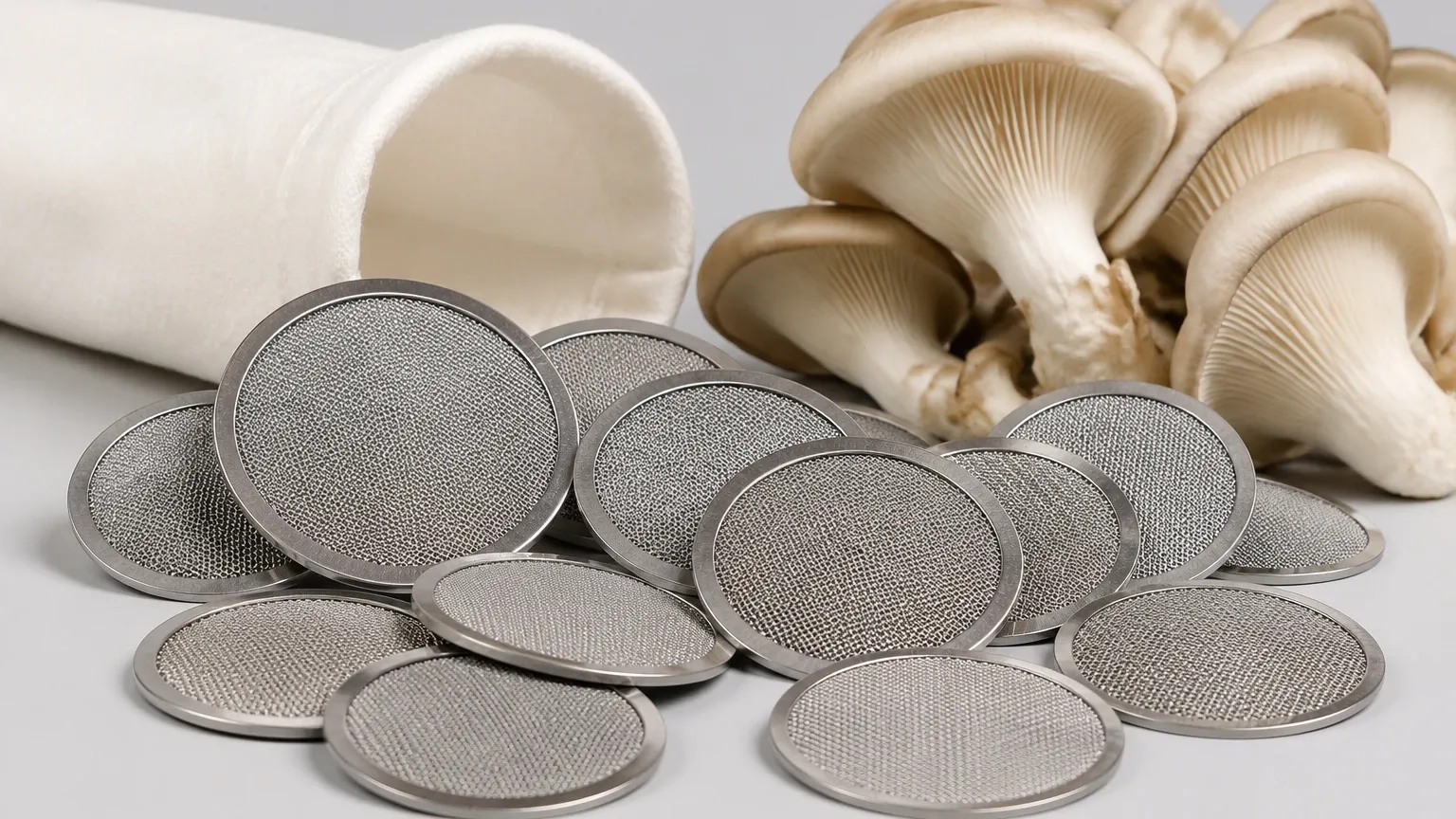
* Framed Edges: The mesh is encased in a metal rim (aluminum or stainless steel), providing a rigid surface for gaskets or mechanical clamps.
* Sintered Edges: The layers of mesh are fused together at the perimeter, preventing fraying and ensuring a clean, solid edge.
* Spot Welding: For multi-layer packs, spot welding keeps the layers aligned during installation and operation.
Durability and Reusability
One of the primary drivers for selecting stainless steel filter discs for mushrooms is the total cost of ownership. Synthetic filters are often treated as consumables, discarded after a single use or a few sterilization cycles. In contrast, a precision-manufactured stainless steel filter disc can be cleaned and reused for years. This reduces long-term material costs and minimizes the waste stream of a large-scale facility.
Comparing Stainless Steel Mesh to Synthetic Media
To make an informed purchasing decision, it is helpful to compare the performance characteristics of different filter media types used in the industry.
| Feature | Stainless Steel Wire Mesh | Synthetic (PTFE/PE) |
| :— | :— | :— |
| Temperature Limit | Up to 800°C (Material dependent) | Typically <150°C |
| Durability | Extremely High (Rigid) | Low (Prone to tearing) |
| Cleanability | Ultrasonic/Backwashable | Limited/Disposable |
| Pore Consistency | High (Precision Weave) | Variable (Fiber-based) |
| Initial Cost | Higher | Lower |
| Lifecycle Cost | Lower (Due to reusability) | Higher (Continuous replacement) |
For commercial laboratories and industrial spawn producers, the reliability of stainless steel ensures that the filtration parameters remain constant across thousands of batches, reducing the risk of unexpected contamination spikes due to filter degradation.
Customization Options for Industrial Applications
No two industrial filtration requirements are identical. Depending on the vessel design and the specific fungal species being cultivated (which may have different oxygen requirements), custom filter configurations are often necessary. Kaifil specializes in tailoring Filter Discs & Packs to meet these specific engineering needs.
Layering and Sintering
For applications requiring both high filtration fineness and high mechanical strength, multiple layers of wire mesh can be sintered together. A typical five-layer sintered mesh might include:
1. Protective Layer: A coarse mesh to protect the finer inner layers.
2. Filter Layer: The precision mesh that defines the micron rating.
3. Dispersion Layer: Ensures even airflow across the filter surface.
4. Support Layers: Two or more layers of heavy-duty mesh to provide structural rigidity against pressure differentials.
Shape and Sizing
While circular discs are the most common, industrial processes may require square, rectangular, or custom-shaped packs. Precision laser cutting and CNC machining allow for the production of filters that fit perfectly into proprietary housing designs or specialized cultivation equipment.
Maintenance and Replacement Cycles
While stainless steel filter discs are highly durable, they are not maintenance-free. Over time, airborne dust, spores, or substrate particles can accumulate on the surface or within the mesh structure, leading to an increased pressure drop and reduced gas exchange.
Cleaning Protocols
To maintain optimal performance, a regular cleaning schedule should be implemented. Effective methods include:
* Ultrasonic Cleaning: The most effective method for removing fine particles trapped within the weave. High-frequency sound waves create cavitation bubbles that dislodge contaminants.
* Backwashing: Directing a high-pressure stream of water or air through the filter in the opposite direction of normal flow.
* Chemical Cleaning: Using mild detergents or specialized solvents to dissolve organic buildup, followed by thorough rinsing.
Determining Replacement
A filter disc should be replaced if it shows signs of permanent mechanical damage, such as warping that prevents a proper seal, or if the pressure drop remains unacceptably high even after professional cleaning. In a controlled industrial environment, establishing a baseline pressure drop for new filters allows operators to monitor performance and schedule maintenance before growth rates are negatively affected.
Conclusion for Technical Purchasing Teams
Selecting the right filter discs for mushrooms is a critical decision that impacts both the biological success of the cultivation and the economic efficiency of the operation. For industrial applications, the transition from disposable synthetic media to precision-engineered stainless steel Filter Discs & Packs offers significant advantages in terms of durability, sterilization compatibility, and long-term cost-effectiveness.
When consulting with a manufacturer like Kaifil, engineers should be prepared to discuss their specific micron requirements, expected airflow volumes, sterilization temperatures, and mechanical mounting constraints. By focusing on high-quality materials and precision manufacturing, facilities can ensure a robust barrier against contamination while providing the optimal environment for mycelial development. This technical approach to filtration is a cornerstone of modern, scalable, and reliable industrial mycology.
