


Metal Filter Disc Espresso
In the precision-driven world of commercial coffee equipment manufacturing and industrial food processing, the efficiency of a filtration system is often the determining factor in product consistency and equipment longevity. For engineers and technical procurement teams, selecting a metal filter disc espresso component requires a deep understanding of metallurgy, fluid dynamics, and mechanical stress. Unlike consumer-grade accessories, industrial-grade filtration components must withstand rigorous duty cycles, high-pressure environments, and aggressive cleaning protocols while maintaining precise micron ratings.
As a specialized manufacturer of stainless steel filtration solutions, Kaifil provides high-performance Filter Discs & Packs designed to meet the exacting standards of the beverage industry. This guide examines the technical specifications, engineering considerations, and material science behind metal filtration in espresso applications.
The Engineering Role of Metal Filter Discs in Espresso Extraction
Espresso extraction is a high-pressure process, typically operating between 9 and 15 bars. In this environment, the filter disc serves two primary functions: flow distribution and particulate retention. A metal filter disc espresso component is positioned to ensure that water is distributed evenly across the coffee puck (in the case of shower screens) or to ensure that the final beverage is free of sediment while allowing essential oils to pass through (in the case of basket filters).
From a technical perspective, the "precision" of these discs is measured by the uniformity of the pore size and the structural integrity of the mesh. Inconsistent pore distribution leads to "channeling," where water finds the path of least resistance, resulting in uneven extraction and a compromised final product. For OEM manufacturers, specifying a filter with high geometric accuracy is essential for maintaining the reputation of their brewing hardware.
Material Selection: Why Stainless Steel Dominates
When designing or sourcing a metal filter disc espresso, material selection is the first critical decision. The environment involves constant exposure to high-temperature water (90°C to 96°C), organic acids, and pressure fluctuations.
Stainless Steel 304 vs. 316L
While Stainless Steel 304 is the standard for many food-grade applications, 316L is often preferred for high-end industrial espresso components. The addition of molybdenum in 316L provides superior resistance to pitting and crevice corrosion, particularly in environments where water chemistry may vary or where harsh descaling chemicals are used.
Food-Grade Compliance
Industrial filtration components must adhere to strict regulatory standards, such as FDA or LFGB compliance. Kaifil ensures that all stainless steel materials used in the production of filter discs are traceable and free from contaminants, ensuring that the filtration process does not introduce off-flavors or hazardous substances into the beverage.
Technical Anatomy of Filter Discs & Packs
Industrial espresso filtration often requires more than a single sheet of mesh. Depending on the equipment design, engineers may specify various configurations of Filter Discs & Packs to achieve specific flow characteristics.
Single-Layer Etched or Woven Discs
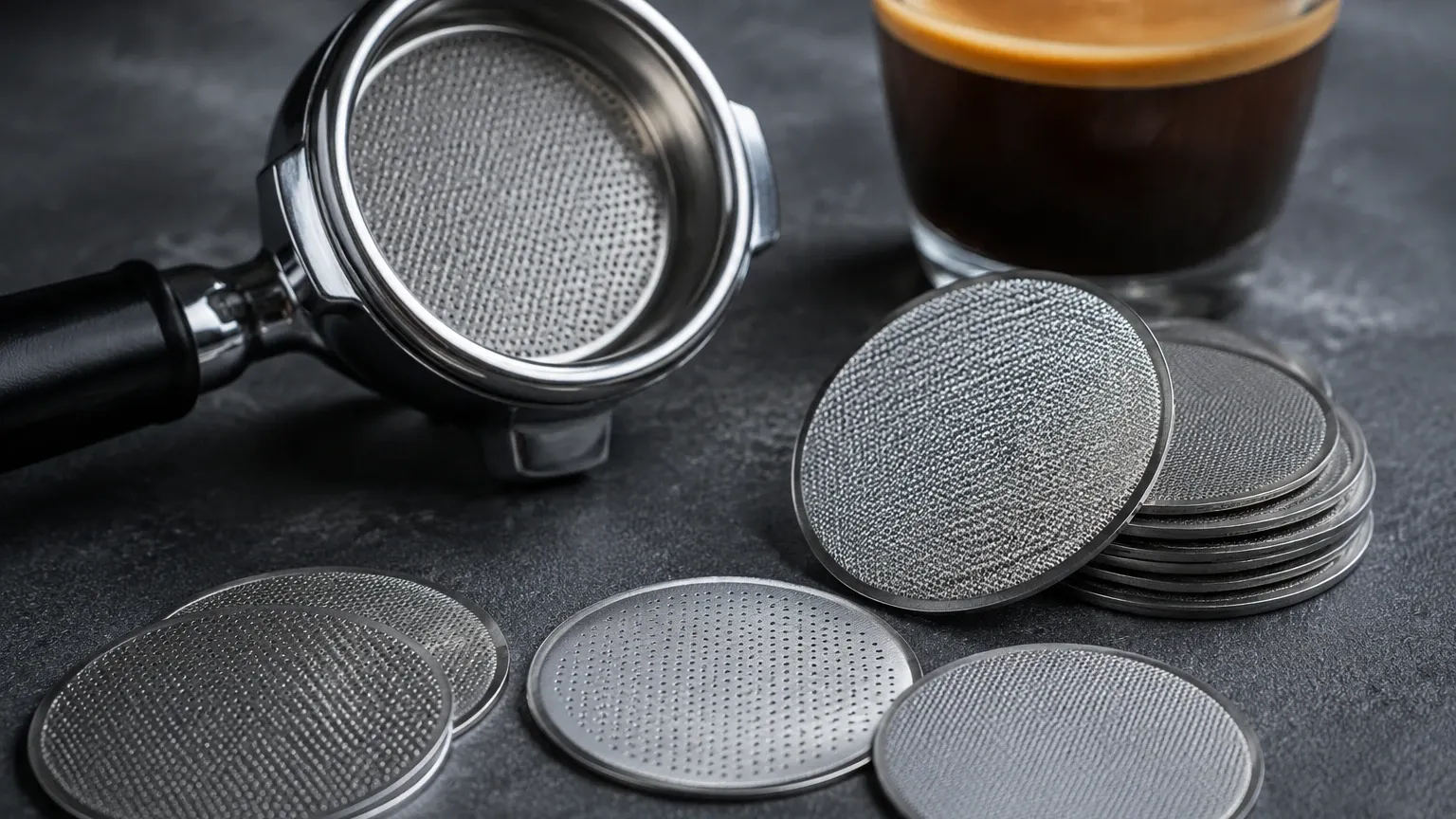
Single-layer discs are often used as shower screens. These can be manufactured using precision photo-etching or high-density weaving. Etched discs allow for incredibly precise hole placement and geometry, which is vital for uniform water dispersion. Woven mesh discs, on the other hand, offer a larger open area and are often used in portafilter baskets where high flow rates are required.
Multi-Layer Sintered Packs
For applications requiring extreme durability and fine filtration, multi-layer sintered filter packs are utilized. Sintering involves bonding multiple layers of wire mesh together using heat and pressure without the use of adhesives. This creates a porous metal structure that is incredibly rigid and can withstand high back-pressure without deforming. A typical sintered pack might include a fine filtration layer protected by coarser support layers on both sides.
Rimming and Edge Treatment
In a B2B context, the "finish" of the disc is a functional requirement, not just an aesthetic one. Rimming—the process of enclosing the mesh edges in a metal U-binder or spot-welding the edges—is crucial for preventing bypass. If the disc does not fit perfectly within its housing, unfiltered liquid can escape around the edges. Precision-engineered rims also provide the structural thickness needed for gaskets to seal effectively.
Performance Metrics: Micron Ratings and Flow Consistency
The performance of a metal filter disc espresso is defined by its micron rating. In espresso applications, this typically ranges from 10 microns to 200 microns, depending on the specific stage of filtration.
* Fine Filtration (10–50 Microns): Often used in secondary filtration stages to remove the smallest "fines" that can cause bitterness or sediment.
* Standard Extraction (50–150 Microns): The common range for portafilter baskets, balancing the retention of solids with the passage of aromatic oils.
* Coarse Dispersion (150+ Microns): Typically found in shower screens where the goal is water distribution rather than particulate capture.
Engineers must also consider the "open area" percentage. A higher open area reduces the pressure drop across the filter, allowing for faster flow rates. However, this must be balanced against the mechanical strength of the mesh, as a higher open area often means thinner wire diameters.
Industrial Advantages Over Disposable Filtration
For commercial coffee service and industrial beverage production, the shift toward metal filter disc espresso components is driven by both economic and performance factors.
1. Consistency: Unlike paper filters, which can vary in thickness and porosity between batches, a precision-manufactured metal disc provides a constant, repeatable variable in the extraction equation.
2. Flavor Profile: Metal filters allow the passage of coffee oils (lipids) that are often trapped by paper. In a B2B environment, this allows roasters and equipment manufacturers to deliver a specific "mouthfeel" that characterizes their brand.
3. Sustainability and TCO: While the initial cost of a stainless steel filter pack is higher than a box of paper filters, the Total Cost of Ownership (TCO) is significantly lower over the equipment's lifespan. A well-maintained metal disc can last for thousands of cycles, reducing waste and recurring procurement costs.
Customization and OEM Capabilities
Every commercial espresso machine or industrial extraction unit has unique geometric and hydraulic requirements. Kaifil specializes in customized filtration solutions, working closely with engineering teams to develop bespoke Filter Discs & Packs that fit specific proprietary designs.
Customization options include:
* Dimensional Accuracy: Precise outer diameters (OD) and inner diameters (ID) with tolerances as tight as +/- 0.05mm.
* Layer Configuration: Custom-stacking mesh counts to achieve a specific pressure drop profile.
* Surface Treatments: Electropolishing to enhance corrosion resistance and create a non-stick surface that resists coffee oil buildup.
* Mounting Features: Integration of center holes, specialized rim shapes, or spot-welded support structures.
Maintenance and Longevity in Commercial Environments
In a high-volume commercial setting, the longevity of a metal filter disc espresso is dependent on the maintenance protocol. Coffee oils and micro-particulates can eventually clog even the most precisely engineered mesh.
Cleaning Protocols
* Backflushing: The most common daily maintenance task, using pressure to force water and cleaning agents backward through the disc.
* Ultrasonic Cleaning: For industrial-scale operations, ultrasonic baths are the gold standard. High-frequency sound waves create cavitation bubbles that dislodge particulates from deep within the mesh pores, a process that is particularly effective for multi-layer sintered packs.
* Chemical Soaking: The use of specialized proteolytic cleaners to break down oils. Stainless steel 316L is highly resistant to these chemicals, ensuring that frequent cleaning does not degrade the filter's structural integrity.
Replacement Cycles
Even with rigorous cleaning, metal filters are subject to mechanical fatigue. In a B2B context, it is recommended to establish a preventative maintenance schedule. Signs that a filter disc requires replacement include visible deformation of the mesh, persistent clogging that affects flow rate, or wear on the rim that compromises the seal.
Selecting the Right Partner for Industrial Filtration
Choosing a supplier for espresso filtration components involves evaluating more than just the price per unit. For engineers, the priority is a partner who understands the technical nuances of wire mesh manufacturing and can provide documented material certifications and consistent quality control.
Kaifil’s expertise in stainless steel filtration allows us to support global customers in the chemical, pharmaceutical, and food and beverage sectors. By focusing on durability, precision, and customized design, we help our clients achieve optimized filtration performance in even the most demanding industrial environments.
For technical specifications or to discuss a custom design for your equipment, explore our range of Filter Discs & Packs and consult with our engineering team to find the ideal solution for your application.
