


Filter Discs
In industrial filtration, the filter disc represents one of the most versatile and critical components for ensuring fluid purity and protecting downstream equipment. These precision-engineered components are utilized across a vast spectrum of industries, from polymer extrusion and chemical processing to pharmaceutical manufacturing and food production. Selecting the appropriate filter discs requires a deep understanding of material science, fluid dynamics, and the specific mechanical requirements of the application environment.
As a specialized manufacturer, Kaifil provides high-performance Filter Discs & Packs designed to meet rigorous industrial standards. This guide explores the technical considerations, material properties, and engineering factors that professionals must evaluate when integrating filter discs into their filtration systems.
Understanding Filter Disc Construction and Mesh Types
The performance of a filter disc is primarily dictated by the characteristics of the wire mesh from which it is constructed. Industrial filter discs are typically fabricated from woven wire cloth, which offers a stable pore structure and predictable filtration accuracy. The choice of weave pattern significantly impacts both the flow rate and the particle retention capabilities of the disc.
Plain Weave and Twill Weave
Plain weave is the most common configuration, where each warp wire crosses over and under each shute wire. This provides a high percentage of open area, making it ideal for applications requiring high flow rates with relatively low pressure drops. Twill weave, where wires cross over two and under two, allows for the use of heavier wires in a given mesh count, enhancing the mechanical strength of the disc for high-pressure environments.
Dutch Weave Variations
For fine filtration requirements, Dutch weaves (Plain Dutch or Twill Dutch) are often employed. These weaves utilize a higher count of smaller diameter shute wires, creating a dense, wedge-shaped pore structure. This design allows for extremely fine micron ratings while maintaining high structural integrity, making them suitable for high-pressure liquid and gas filtration.
Multi-Layer Filter Packs
In many demanding applications, a single layer of mesh is insufficient. Multi-layer filter discs, often referred to as filter packs, combine several layers of different mesh counts. A typical configuration includes a fine filtration layer protected by coarser support layers on both sides. This arrangement prevents the fine mesh from deforming under pressure and improves the overall dirt-holding capacity of the unit.
Material Selection for Corrosive and High-Temperature Environments
The longevity and reliability of filter discs depend heavily on the metallurgy of the wire mesh. Stainless steel is the industry standard due to its excellent mechanical properties and resistance to oxidation and corrosion.
* Stainless Steel 304: The most widely used grade, providing good corrosion resistance and durability for general industrial applications, such as water treatment and food processing.
* Stainless Steel 316L: Containing molybdenum, this grade offers superior resistance to chlorides and pitting. It is the preferred choice for pharmaceutical, chemical, and marine applications where the filter is exposed to aggressive solvents or saline environments.
* High-Temperature Alloys: For specialized applications like hot gas filtration or polymer melt processing, alloys such as Inconel or Monel may be used to maintain structural integrity at temperatures exceeding 500°C.
When selecting a material, engineers must consider the chemical compatibility of the fluid, the operating temperature, and the potential for galvanic corrosion if the disc is in contact with dissimilar metals within the filter housing.
Key Performance Metrics: Micron Rating and Pressure Drop
When specifying filter discs, engineers must balance the need for high filtration accuracy with the operational constraints of the system. Two primary metrics define this balance: the micron rating and the pressure drop ($ΔP$).
Absolute vs. Nominal Micron Rating
It is essential to distinguish between nominal and absolute micron ratings. A nominal rating refers to the ability of the filter to retain a certain percentage (usually 60% to 90%) of particles of a specific size. An absolute rating, however, indicates the pore size of the mesh where no particle larger than the stated micron size can pass through. In critical applications like pharmaceutical sterile filtration, absolute ratings are mandatory to ensure process integrity.
Managing Pressure Drop
Every filter disc introduces a resistance to flow, resulting in a pressure drop. This $ΔP$ increases as the filter accumulates contaminants. If the initial pressure drop is too high, it reduces the effective service life of the filter and increases energy consumption. Engineers must calculate the required surface area and mesh porosity to ensure that the initial $ΔP$ remains within acceptable limits for the pump or system capacity.
Edge Finishing and Structural Integrity
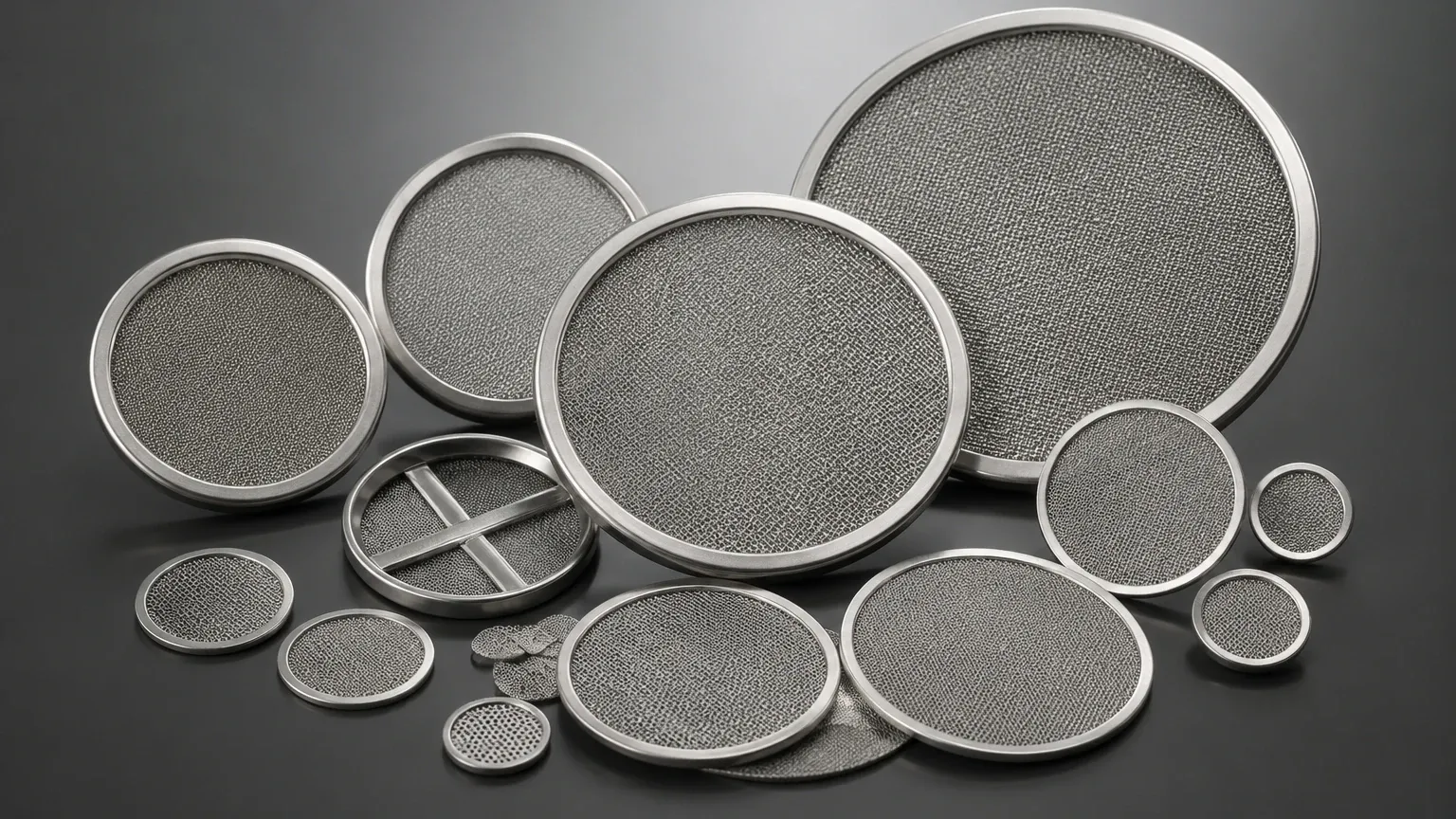
The method used to finish the edges of filter discs is a critical engineering detail that prevents bypass and ensures safe handling. Without proper edge treatment, individual wires can fray, leading to downstream contamination or mechanical failure.
1. Spot Welded Edges: Multiple layers are joined at specific points around the circumference. This is a cost-effective method for discs used in internal housings where the edge is compressed by a gasket.
2. Framed or Rimmed Edges: The disc is encased in a metal rim, typically made of aluminum, stainless steel, or copper. This provides a rigid structure and acts as a built-in gasket, ensuring a leak-proof seal in high-pressure applications like polymer extrusion screen changers.
3. Sintered Edges: For the most demanding applications, the layers are diffusion-bonded (sintered) together. This creates a monolithic structure where the wires cannot migrate, making it ideal for high-vibration environments or ultra-clean processes.
Industrial Applications of Filter Discs
Filter discs are integrated into various equipment types, each with specific performance requirements. Understanding these applications helps in selecting the right disc configuration.
Polymer and Plastic Extrusion
In the plastics industry, filter discs are used in screen changers to remove unmelted resins and contaminants from the polymer melt. These discs must withstand extreme pressures (up to 500 bar) and high temperatures. Multi-layer packs with reinforced edges are standard here to prevent "blowouts."
Chemical and Petrochemical Processing
Filter discs serve as catalyst recovery units and guard filters for sensitive instrumentation. The chemical resistance of 316L stainless steel is vital here to prevent premature failure due to acid or alkali exposure.
Food and Beverage Filtration
In this sector, filter discs are used for clarifying liquids, such as oils, juices, and syrups. The materials must be food-grade and easy to clean (CIP – Clean-In-Place) to maintain hygiene standards. Stainless steel mesh is preferred over synthetic media because it does not shed fibers and can be sterilized repeatedly.
Hydraulic and Lubrication Systems
Precision metal filter discs protect hydraulic valves and bearings from particulate wear. These discs are often used as "last chance" filters located immediately upstream of critical components to catch any debris generated within the system itself.
Engineering Considerations for Customization
Off-the-shelf solutions may not always meet the specific needs of a complex industrial process. Customization is often necessary to optimize filtration performance and total cost of ownership. When requesting custom filter discs, engineers should confirm the following parameters:
* Dimensional Tolerances: Precise outer and inner diameters are required to ensure a proper fit within the filter housing and prevent bypass.
* Layer Sequence: In multi-layer discs, the sequence of mesh counts (e.g., 20/100/20) must be optimized for the specific particle size distribution of the process fluid.
* Mechanical Load: The expected differential pressure across the disc will determine if additional support mesh or a thicker rim is required.
* Cleaning Compatibility: If the discs are intended to be reused, the mesh structure must be robust enough to withstand ultrasonic cleaning or backwashing without losing its pore integrity.
Maintenance and Replacement Cycles
While stainless steel filter discs are highly durable, they are not infinite. Establishing a clear maintenance and replacement protocol is essential for preventing system downtime.
Monitoring the pressure drop across the filter is the most reliable method for determining when a disc needs cleaning or replacement. A sudden drop in pressure may indicate a media rupture (bypass), while a rapid increase suggests heavy contaminant loading or a change in fluid viscosity.
In many B2B environments, the total cost of ownership is reduced by selecting high-quality stainless steel discs that can be cleaned and reused multiple times. However, for applications involving hazardous chemicals or sterile pharmaceutical products, single-use discs may be preferred to eliminate the risk of cross-contamination and the costs associated with cleaning validation.
Conclusion
Filter discs are foundational to industrial process efficiency, providing the necessary barrier against contamination in diverse environments. By carefully evaluating mesh types, material grades, and structural reinforcements, engineering and purchasing teams can select filtration solutions that enhance product quality and protect expensive machinery.
Kaifil's expertise in manufacturing custom stainless steel filtration components ensures that every filter disc is engineered for precision and durability. Whether for high-pressure polymer extrusion or sensitive chemical processing, selecting the right filter disc is a strategic decision that impacts the overall reliability of the industrial operation.
