


Filter Media Pack
In high-pressure industrial filtration and polymer processing, the efficiency of a system often hinges on the configuration of the filtration elements. A filter media pack is a sophisticated assembly of multiple layers of wire mesh or non-woven metal fibers designed to remove contaminants from liquid or gaseous streams. Unlike a simple single-layer screen, these packs are engineered to provide a balance of structural integrity, precise filtration accuracy, and high dirt-holding capacity. For engineers and procurement teams, understanding the technical nuances of these components is essential for optimizing production uptime and ensuring the longevity of downstream equipment.
At Kaifil, we specialize in the manufacturing of custom stainless steel filtration solutions, providing precision-engineered Filter Discs & Packs that meet the rigorous demands of chemical processing, pharmaceutical manufacturing, and hydraulic systems. This guide examines the engineering principles, material considerations, and selection criteria necessary for implementing an effective filter media pack.
The Role of a Filter Media Pack in Industrial Processes
The primary function of a filter media pack is to provide depth filtration or multi-stage surface filtration within a compact footprint. In many industrial applications, such as plastic extrusion or fiber spinning, the media is subjected to extreme pressures and temperatures. A single layer of fine mesh would likely fail under these conditions or clog too rapidly to be economically viable.
By layering different mesh counts and weave types, a filter media pack achieves several objectives simultaneously:
1. Graduated Filtration: The outermost layers typically consist of coarse mesh to catch large particles, while the inner layers provide the target micron rating. This prevents the fine filtration layer from blinding prematurely.
2. Structural Support: Fine filtration mesh is inherently delicate. Coarser support layers provide the mechanical strength required to withstand high differential pressures without deforming or rupturing.
3. Flow Distribution: Properly designed packs ensure that the fluid or melt is distributed evenly across the entire surface area, preventing localized high-velocity zones that could lead to "breakthrough" or uneven wear.
Key Components and Material Specifications
Material selection is the foundation of any industrial filtration solution. Because these packs often operate in corrosive environments or at high temperatures, stainless steel is the industry standard.
Stainless Steel Alloys
* Grade 304: The most common stainless steel used for general-purpose filtration. It offers good corrosion resistance and is cost-effective for applications involving water, food products, and mild chemicals.
* Grade 316L: Containing molybdenum, 316L provides superior resistance to chlorides and acids. The "L" denotes low carbon content, which improves weldability and prevents intergranular corrosion in the heat-affected zones of spot-welded or sintered packs.
* Specialty Alloys: For extreme environments, materials like Monel, Inconel, or Hastelloy may be utilized to resist specific chemical attacks or maintain integrity at temperatures exceeding 500°C.
Weave Types in the Media Pack
The performance of the filter media pack is largely determined by the weave of the individual layers. Common options include:
* Plain Weave: A simple over-under pattern providing high flow rates and easy cleaning.
* Dutch Weave: This weave uses larger diameter warp wires and smaller diameter shute wires, resulting in a dense, strong mesh with very fine pore sizes. It is ideal for high-pressure applications.
* Twill Weave: Allows for a heavier wire diameter in a given mesh count, increasing the mechanical strength of the layer.
Engineering Design: Multi-Layer vs. Single-Layer Configurations
When designing a filter media pack, engineers must decide between loose-layered packs and bonded (sintered or welded) packs. The choice depends on the housing design and the required pressure rating.
Loose-Layered Packs
In these configurations, the various mesh layers are cut to size and placed together, often held in place by a metal rim or spot welding at the edges. These are common in polymer extrusion where the pack is compressed within a breaker plate assembly. They are cost-effective and allow for flexibility in layer replacement.
Sintered Multi-Layer Packs
Sintering involves heating the layered mesh in a vacuum furnace until the contact points of the wires fuse together without melting the entire structure. This creates a monolithic plate that is incredibly strong, maintains a fixed pore size under pressure, and can be cleaned and reused multiple times. Sintered packs are preferred in high-precision chemical and pharmaceutical applications where fiber migration (the shedding of mesh fragments) must be zero.
Technical Performance Metrics for Filter Discs & Packs
To evaluate the suitability of a Filter Discs & Packs solution, engineers focus on three critical performance metrics: micron rating, pressure drop, and dirt-holding capacity.
Micron Rating (Absolute vs. Nominal)
* Nominal Rating: Indicates the ability of the filter to retain a majority of particles of a specific size (e.g., 95% of 20-micron particles). This is often used for less critical applications.
* Absolute Rating: Refers to the diameter of the largest hard spherical particle that will pass through the filter under specified test conditions. In critical hydraulic or pharmaceutical processes, absolute ratings are mandatory to ensure system protection.
Pressure Drop (ΔP)
The resistance to flow across the filter media is known as the pressure drop. A high initial pressure drop indicates that the filter may be too restrictive for the pump capacity or that the mesh count is unnecessarily fine. An optimized filter media pack balances the required filtration fineness with a low initial ΔP to maximize energy efficiency.
Dirt-Holding Capacity (DHC)
DHC defines the total mass of contaminants a filter can retain before reaching its maximum allowable differential pressure. A multi-layer pack significantly increases DHC compared to a single layer by utilizing the depth of the media to trap particles throughout the thickness of the pack rather than just on the surface.
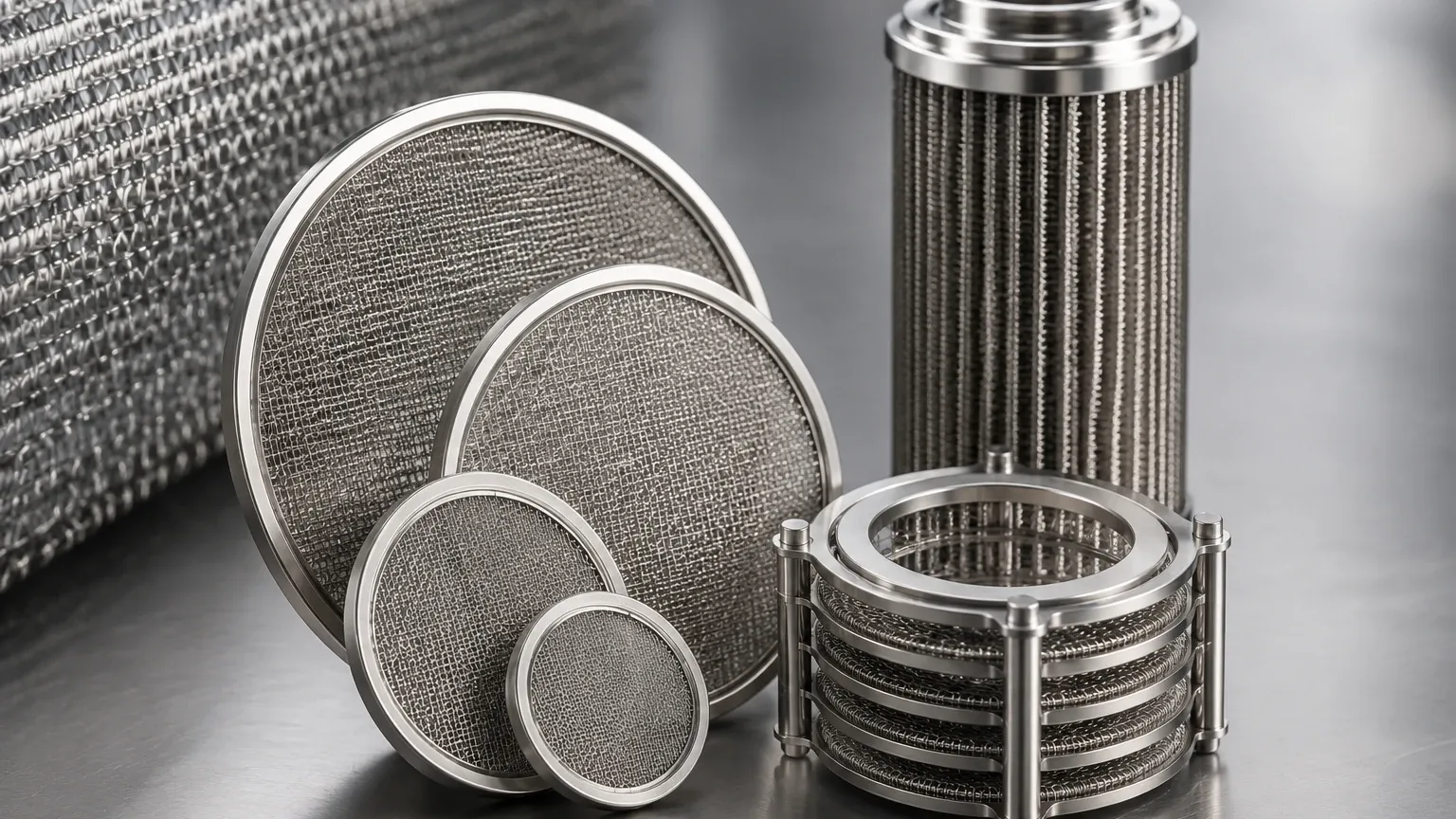
Customization Options and Structural Enhancements
Industrial filtration is rarely a one-size-fits-all field. Customization is necessary to ensure the filter fits perfectly within existing machinery and performs under specific operational stresses.
Edging and Rims
To prevent fraying and ensure a bypass-free seal, filter packs can be finished with various edging techniques:
* Aluminum or Stainless Steel Rims: A metal U-channel is crimped around the circumference of the disc. This provides a rigid sealing surface and makes the pack easier to handle.
* Spot Welding: The layers are fused at several points along the perimeter. This is a low-profile option that keeps layers aligned during installation.
* Plasma or Laser Cutting: For unrimmed packs, precision cutting ensures clean edges and exact dimensional tolerances, which is vital for automated assembly lines.
1.
Shapes and Dimensions
While circular discs are the most common, filter packs can be manufactured in various geometries, including oval, rectangular, or annular (donut-shaped) configurations. The thickness of the pack can also be adjusted by adding or removing support layers to meet the specific depth requirements of the filter housing.
Selecting the Right Filter Media Pack for Your Application
Choosing the correct configuration requires a thorough analysis of the process fluid and the operational environment. Engineers should consider the following factors during the selection process:
1. Fluid Viscosity: High-viscosity fluids, such as molten polymers, require packs with high mechanical strength and larger open areas to maintain flow.
2. Contaminant Type: Are the particles hard and abrasive, or soft and deformable? Hard particles are easily trapped by surface mesh, while soft gels often require depth-style multi-layer packs.
3. Operating Temperature: Constant high temperatures can lead to metal fatigue or oxidation. Selecting the correct alloy (e.g., 316L or Inconel) is critical for long-term stability.
4. Cleaning Requirements: If the filters are intended to be cleaned (via ultrasonic baths or pyrolysis) and reused, a sintered or robustly rimmed pack is necessary to withstand the cleaning process.
Operational Maintenance and Replacement Strategies
The total cost of ownership for filtration components is not just the purchase price, but also the cost of downtime and replacement labor. Implementing a data-driven replacement strategy can significantly reduce these costs.
Monitoring Differential Pressure
The most reliable way to determine when a filter media pack needs replacement is by monitoring the differential pressure across the filter housing. Most systems are designed with a "terminal ΔP"—the point at which the risk of media collapse or contaminant bypass becomes too high. Replacing the pack just before this point ensures maximum utilization of the media without risking equipment damage.
Visual Inspection and Failure Analysis
When a pack is removed, it should be inspected for signs of uneven loading, media migration, or structural deformation. Uneven loading may suggest issues with flow distribution in the housing, while deformation indicates that the pack's structural layers are insufficient for the operating pressures.
Why Technical Expertise Matters in Procurement
Sourcing industrial filters requires more than just matching a part number. As a manufacturer, Kaifil provides the engineering support necessary to refine filtration specifications based on real-world performance data. Whether you are dealing with high-pressure hydraulic systems or sensitive chemical catalysts, the design of the Filter Discs & Packs directly impacts the purity of your end product and the efficiency of your plant.
By focusing on precision manufacturing and material integrity, we help technical teams move beyond "off-the-shelf" limitations to develop customized solutions that address specific challenges like rapid blinding, chemical corrosion, or mechanical failure. When specifying your next filter media pack, ensure that the manufacturer can provide detailed material certifications, micron rating validations, and customized structural designs to meet your exact application requirements.
