


Filter Pack Biocone
In the demanding landscape of industrial polymer extrusion, chemical processing, and high-viscosity fluid management, the efficiency of the filtration system directly impacts product quality and operational uptime. Among the specialized components used to ensure purity, the filter pack biocone stands out as a critical element for managing flow dynamics and particle retention. These conical or bi-conical filter assemblies are engineered to withstand extreme pressures and temperatures while providing a high surface area within a compact footprint.
For engineers and procurement professionals, selecting the correct Filter Discs & Packs involves understanding the intersection of metallurgy, fluid mechanics, and mechanical design. This guide explores the technical nuances of the biocone configuration, the materials that define its performance, and the criteria necessary for optimizing industrial filtration processes.
The Role of Biocone Geometry in Polymer Filtration
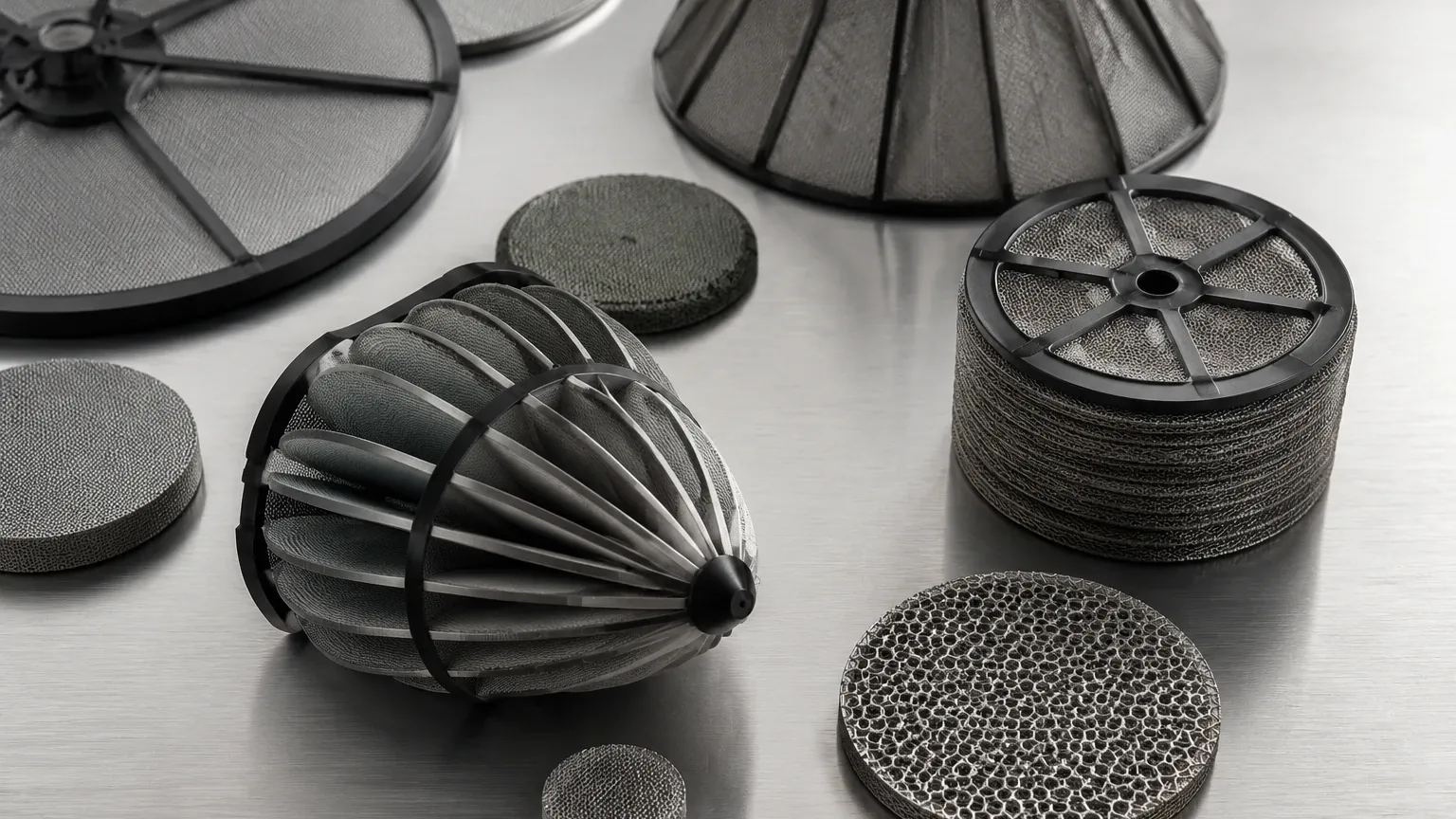
The term "biocone" refers to the specific conical geometry of a filter pack, often utilized in the spinneret assemblies of synthetic fiber production or polymer melt extrusion. Unlike standard flat filter discs, the biocone shape is designed to fit into specialized housings where flow distribution is paramount.
The primary advantage of the biocone design is the increase in effective filtration area (EFA) relative to the diameter of the filter housing. In high-pressure extrusion, the melt must pass through the filtration media without excessive pressure drops that could lead to polymer degradation or mechanical failure. By employing a conical structure, the filter pack allows for a more gradual transition of the fluid, reducing dead zones where material might stagnate and thermally decompose.
Furthermore, the biocone shape provides inherent structural rigidity. Under the intense hydraulic loads of a melt pump, flat mesh discs may deflect or bow if not properly supported. The conical geometry naturally distributes these forces across the surface of the mesh, maintaining the integrity of the filtration layers and ensuring consistent micron retention across the entire production cycle.
Material Engineering: Why Stainless Steel is the Standard
Industrial filtration environments, particularly those requiring a filter pack biocone, are characterized by corrosive chemicals, high temperatures (often exceeding 300°C), and significant mechanical stress. Consequently, stainless steel is the material of choice for these components.
304 vs. 316L Stainless Steel
Most standard applications utilize Grade 304 stainless steel due to its excellent mechanical properties and cost-effectiveness. However, for pharmaceutical, food-grade, or highly corrosive chemical applications, Grade 316L is preferred. The addition of molybdenum in 316L provides superior resistance to pitting and crevice corrosion, which is vital when the filter is exposed to cleaning solvents or acidic process fluids.
Wire Mesh Weave Types
The performance of the biocone is largely determined by the weave of the stainless steel wire mesh used in its construction:
* Plain Weave: Suitable for high-flow applications with lower pressure requirements.
* Dutch Weave: Offers a tighter pore structure and higher mechanical strength, making it ideal for fine filtration in high-pressure systems.
* Twilled Dutch Weave: Provides the highest level of filtration accuracy, often used when removing microscopic impurities from polymer melts.
In many biocone designs, multiple layers of different weaves are combined. A fine filtration layer is typically sandwiched between coarser support and drainage layers to prevent the fine mesh from collapsing or migrating under pressure.
Manufacturing Precision in Filter Discs & Packs
The manufacturing of a filter pack biocone requires precision to ensure that the final component fits perfectly within the extruder's breaker plate or filter housing. Any deviation in dimensions can lead to "bypass," where unfiltered fluid escapes around the edges of the pack, compromising the entire batch of product.
Sintering and Spot Welding
To maintain the conical shape and ensure that the multiple layers of mesh act as a single unit, manufacturers employ sintering or precision spot welding. Sintering involves bonding the contact points of the wire mesh through a diffusion process in a high-temperature vacuum furnace. This creates a rigid, porous structure that will not fray or shift during operation. For less demanding applications, spot welding along the perimeter and the apex of the cone provides sufficient stability while remaining cost-effective.
Edging and Sealing
The perimeter of the biocone is often finished with an aluminum or stainless steel rim (edging). This rim serves two purposes: it provides a mechanical seal against the housing walls and protects the edges of the wire mesh from fraying. A high-quality seal is the most critical factor in preventing bypass, which is a common cause of fiber breakage in synthetic yarn production.
Performance Metrics: Pressure Drop and Filtration Efficiency
When evaluating a filter pack biocone, engineers must balance two competing metrics: filtration efficiency (micron rating) and pressure drop (ΔP).
Understanding Pressure Drop
As a filter captures contaminants, the resistance to flow increases, leading to a rise in upstream pressure. If the initial pressure drop of a clean biocone is too high, the operational window before the filter reaches its terminal pressure is shortened. The biocone’s increased surface area is specifically designed to mitigate this, allowing for higher dirt-holding capacity and longer run times compared to flat discs of the same diameter.
Micron Rating: Absolute vs. Nominal
It is essential to distinguish between nominal and absolute filtration ratings. A nominal rating refers to the ability of the mesh to retain a certain percentage of particles of a given size. An absolute rating, however, indicates the size of the largest spherical particle that can pass through the mesh. In precision industries like pharmaceutical manufacturing or high-end film extrusion, absolute-rated biocones are necessary to ensure zero defects.
Selection Guide: Confirming Specifications for OEM Applications
Before ordering a customized filter pack biocone, technical teams should confirm several key specifications to ensure compatibility and performance.
1. Operating Environment: What is the maximum operating temperature and pressure? This dictates the choice of alloy and the necessity of sintered layers.
2. Fluid Characteristics: What is the viscosity of the fluid? High-viscosity polymers require more robust support layers to prevent mesh distortion.
3. Contaminant Profile: What is the nature of the impurities? Hard, abrasive particles may require hardened mesh, while soft, gel-like contaminants may require a specific depth-filtration layer sequence.
4. Dimensional Tolerances: Precise measurements of the cone height, base diameter, and the angle of the biocone are required to ensure a leak-proof fit in the housing.
By providing these details, engineers can work with manufacturers to develop Filter Discs & Packs that are tailored to their specific machinery, rather than relying on generic off-the-shelf solutions that may underperform.
Common Risks and Failure Modes in Industrial Filtration
Even the best-engineered filter pack biocone can fail if not properly managed. Understanding common failure modes helps in developing better maintenance and selection strategies.
* Mesh Migration: In low-quality filters, individual wires can break off and enter the process stream. This is usually the result of poor welding or using non-sintered mesh in a high-vibration environment.
* Bypass: As mentioned previously, bypass occurs when the seal between the biocone and the housing fails. This can be caused by incorrect sizing or the use of an inappropriate edging material that cannot withstand the process temperature.
* Collapse: If the pressure drop across the filter exceeds the mechanical strength of the support layers, the biocone may collapse inward. This not only stops filtration but can also damage downstream components like gear pumps or spinnerets.
* Chemical Incompatibility: Using 304 stainless steel in an environment containing chlorides or high-temperature steam can lead to stress corrosion cracking, resulting in premature filter failure.
Operational Longevity and Cleaning Protocols
The total cost of ownership for filtration components is influenced by how many times a filter pack biocone can be cleaned and reused. Stainless steel filters are inherently cleanable, but the method used must be compatible with the contaminant.
Cleaning Methods
* Ultrasonic Cleaning: High-frequency sound waves create cavitation bubbles that dislodge particles from deep within the mesh layers. This is highly effective for fine Dutch weave meshes.
* Chemical Cleaning: Acids or alkalis are used to dissolve organic buildups or polymer residues. It is vital to ensure the chemical does not attack the stainless steel or the brazing/welding materials.
* Burn-off / Pyrolysis: In polymer applications, filters are often placed in a vacuum oven to burn off residual plastic. While effective, repeated thermal cycling can eventually weaken the temper of the stainless steel wire, leading to brittleness.
Engineers should establish a maximum number of cleaning cycles for each biocone. Over time, the structural integrity of the mesh will diminish, and the risk of mesh migration increases. Monitoring the pressure drop of a "cleaned" filter is a good way to determine if it has reached the end of its functional life; if the clean pressure drop is significantly higher than that of a new filter, the internal pores are likely permanently blinded.
Conclusion
The filter pack biocone is a sophisticated component that plays a vital role in maintaining the purity and consistency of industrial fluids. By leveraging the geometric advantages of the conical shape and the material benefits of high-grade stainless steel, these filters provide a robust solution for the most demanding extrusion and chemical processes.
When sourcing these components, focusing on manufacturing precision, material certification, and application-specific design is essential. Whether for OEM equipment or process optimization, a well-engineered biocone ensures that filtration remains a reliable part of the production chain rather than a bottleneck. For those seeking specialized solutions, exploring the variety of available Filter Discs & Packs is the first step toward achieving superior filtration performance and long-term operational efficiency.
