


Filter Pack Raw
In the landscape of industrial filtration, the term "filter pack raw" refers to the fundamental components and raw materials—primarily high-grade metal wire mesh and specialized alloys—that are engineered into finished filtration units. For engineers and procurement specialists in sectors like polymer extrusion, chemical processing, and pharmaceutical manufacturing, understanding the nuances of these raw materials is critical. The performance of Filter Discs & Packs is directly dictated by the quality, metallurgical composition, and structural integrity of the raw mesh used in their construction.
Selecting the appropriate filter pack raw materials requires a deep dive into the mechanical and chemical demands of the application. Whether the goal is to remove contaminants from a high-viscosity polymer melt or to provide fine particulate separation in a corrosive chemical environment, the journey from raw wire to a precision-engineered filter pack involves complex engineering decisions.
The Role of Raw Materials in Industrial Filtration
The efficiency of any filtration system is only as reliable as its weakest component. In the context of filter pack raw materials, reliability begins with the wire drawing process and the subsequent weaving of the mesh. Industrial filter packs are often subjected to extreme pressures, sometimes exceeding several thousand PSI, and temperatures that can degrade inferior metals.
Using high-quality raw materials ensures that the filter maintains its pore geometry under stress. If the raw wire mesh lacks the necessary tensile strength or if the alloy composition is inconsistent, the filter may suffer from "media migration" or pore enlargement. This leads to bypass, where contaminants pass through the filter, potentially damaging downstream equipment like spinnerets in fiber production or precision valves in hydraulic systems. Therefore, sourcing filter pack raw components from manufacturers who prioritize metallurgical traceability is a prerequisite for high-performance industrial operations.
Core Material Options for Filter Discs & Packs
Stainless steel is the industry standard for filter pack raw materials due to its balance of cost, durability, and corrosion resistance. However, the specific grade of stainless steel chosen can significantly impact the lifecycle of the filter.
Stainless Steel 304 and 304L
Grade 304 is the most common raw material for general-purpose industrial filtration. It offers excellent strength and basic corrosion resistance. The "L" variant (low carbon) is often preferred when the filter pack requires extensive welding, as it minimizes carbide precipitation that can lead to intergranular corrosion at the weld sites.
Stainless Steel 316 and 316L
For more demanding environments, particularly those involving chlorides or acidic solutions, 316L is the preferred filter pack raw material. The addition of molybdenum enhances its resistance to pitting and crevice corrosion. In pharmaceutical and food-grade applications, 316L is often mandatory to meet hygiene and safety standards.
Exotic Alloys and Specialized Metals
In extreme cases where standard stainless steel fails, engineers look toward exotic filter pack raw options. These include:
* Hastelloy: Used in highly aggressive chemical environments where even 316L might succumb to corrosion.
* Inconel: Ideal for high-temperature applications, such as gas filtration or heat treatment processes.
* Monel: Frequently used in marine environments or applications involving hydrofluoric acid.
Weave Structures and Their Impact on Performance
The way the filter pack raw wire is woven determines the filtration accuracy (micron rating) and the flow characteristics of the finished pack. Different weave patterns offer different advantages in terms of mechanical strength and "dirt-holding capacity."
Plain Weave
This is the simplest weave where each warp wire crosses over and under each weft wire. It provides a consistent pore size and is easy to clean, making it a staple raw component for single-layer filter discs.
Twill Weave
In a twill weave, the wires are woven in a pattern where each wire passes over two and then under two wires. This allows for the use of heavier wires for a given mesh count, resulting in a more robust filter pack raw material that can withstand higher mechanical loads.
Dutch Weave (Plain and Twill)
Dutch weaves use a combination of different wire diameters for the warp and weft. This creates a much denser mesh with smaller, triangular-shaped openings. Dutch weave filter pack raw materials are essential for fine filtration (down to 5-10 microns) and are known for their exceptional strength and resistance to high-pressure differentials.
Engineering Specifications for Filter Pack Raw Components
When specifying filter pack raw materials, engineers must look beyond the basic mesh count. Several technical parameters define the suitability of the raw material for a specific industrial task.
Micron Rating: Absolute vs. Nominal
Understanding the difference between absolute and nominal ratings is vital. An absolute rating refers to the largest spherical particle that can pass through the mesh under laboratory conditions. A nominal rating is more of an average, indicating that a certain percentage of particles of a specific size will be retained. For critical applications, the filter pack raw mesh must be tested to ensure it meets the absolute micron rating required by the process.
Open Area and Flow Rate
The "open area" percentage of the raw mesh determines the flow resistance. A higher open area allows for higher flow rates and lower initial pressure drops but may compromise the structural integrity of the mesh if the wire diameter is too thin. Balancing these factors is a key part of the design phase for Filter Discs & Packs.
Wire Diameter and Mesh Thickness
The thickness of the raw material affects the overall thickness of the multi-layer pack. In many extrusion processes, the filter cavity has a fixed depth, meaning the total thickness of the assembled filter pack raw layers must be precisely controlled to ensure a proper seal and prevent leakage.
Manufacturing and Customization of Multi-Layer Packs
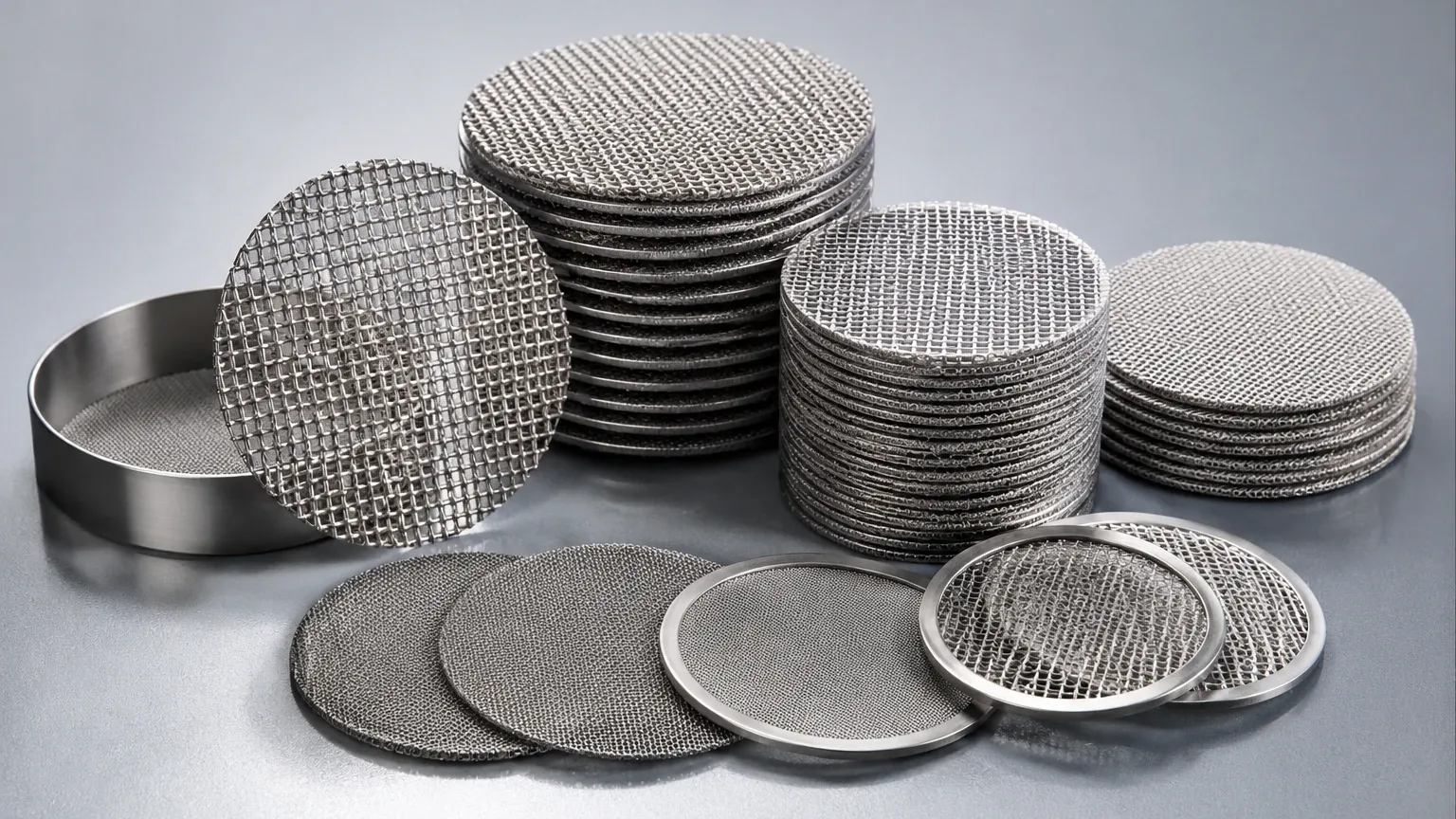
Most industrial applications do not use a single sheet of mesh. Instead, they utilize multi-layer packs that combine different grades of filter pack raw materials to achieve a specific performance profile. A typical configuration might include:
1. A Surface Layer: A coarse mesh used to capture large debris and protect the finer layers.
2. The Filtration Layer: The primary layer (often a Dutch weave) that defines the micron rating of the pack.
3. Support Layers: Heavier, coarse meshes that provide the mechanical rigidity needed to prevent the fine filtration layer from deforming under pressure.
4. Drainage Layers: These help distribute the fluid flow evenly across the surface of the filtration layer.
These layers are often held together by spot welding or by an aluminum, stainless steel, or copper rim. The choice of edging material is another critical "raw" component decision, as it must be compatible with both the process fluid and the housing into which the pack is installed.
Quality Control and Performance Evaluation
To ensure that the filter pack raw materials meet the required standards, several quality control measures are typically employed during manufacturing:
* Bubble Point Testing: This test measures the pressure required to force air through a liquid-saturated mesh. It is a standard method for verifying the pore size and integrity of the filtration layer.
* Material Certification: Providing Mill Test Reports (MTRs) ensures that the chemical composition of the stainless steel or alloy matches the specification.
* Dimensional Inspection: Ensuring that the diameter and thickness of the discs or packs fall within tight tolerances, which is especially important for automated filter changers in plastic extrusion.
Inconsistent quality in the filter pack raw mesh can lead to premature clogging, known as "blinding," or catastrophic failure where the mesh tears under pressure. Rigorous testing of the raw components is the only way to mitigate these risks.
Strategic Procurement: From Raw Material to Finished Filter
For B2B buyers, the challenge lies in balancing performance with the total cost of ownership. While high-quality filter pack raw materials may have a higher upfront cost, they often provide a longer service life and better protection for expensive machinery.
When working with a manufacturer like Kaifil, it is important to provide detailed application data, including:
* The type of fluid or gas being filtered.
* The operating temperature and pressure.
* The desired micron rating and allowable pressure drop.
* The chemical environment (pH levels, presence of corrosive agents).
By understanding these variables, a manufacturer can recommend the optimal combination of filter pack raw materials and construction methods. Customization is often the most cost-effective route, as it allows for the creation of a filter pack that is perfectly tailored to the specific debris load and flow requirements of a particular production line.
Maintenance and Replacement Cycles
The lifecycle of a filter pack is heavily influenced by the nature of the raw materials used. In some industries, such as polymer recycling, filter packs are considered consumables and are replaced frequently. In others, such as hydraulic systems, they may be cleaned and reused.
Stainless steel filter pack raw materials are generally amenable to cleaning via ultrasonic baths, chemical cleaning, or burnout ovens. However, each cleaning cycle can slightly degrade the mechanical properties of the mesh. Monitoring the pressure differential across the filter is the most effective way to determine when the filter pack raw material has reached the end of its functional life and requires replacement.
Conclusion
The integrity of industrial filtration processes depends on the meticulous selection and engineering of filter pack raw materials. From the initial choice of alloy to the complex layering of different weave patterns, every decision impacts the efficiency, safety, and cost-effectiveness of the operation. By focusing on high-quality stainless steel and precision manufacturing, companies can ensure that their Filter Discs & Packs deliver consistent performance in even the most demanding environments. Understanding the technical foundations of these components allows engineers to optimize their systems, reduce downtime, and maintain the highest standards of product purity.
