


Filter Water Pack
In industrial water treatment and fluid processing, the efficiency of a filtration system is often determined by the precision and durability of its internal components. A filter water pack—typically a multi-layered assembly of stainless steel wire mesh—serves as a critical barrier against contaminants in high-pressure and high-temperature environments. Unlike standard disposable filters, these metal assemblies are engineered for longevity, reusability, and specific flow characteristics. For engineers and procurement specialists, selecting the correct Filter Discs & Packs requires a deep understanding of material science, mesh geometry, and the mechanical stresses of the application.
Engineering Fundamentals of Filter Water Packs
Industrial filter packs are rarely single-layer components. To achieve a balance between fine filtration and structural integrity, manufacturers like Kaifil utilize a multi-layer construction. This design ensures that the fine filtration mesh is supported by coarser layers, preventing the mesh from deforming under differential pressure.
Material Selection: SS304 vs. SS316L
The choice of alloy is the first technical decision in the design of a filter water pack. While Stainless Steel 304 is suitable for general-purpose water filtration, Stainless Steel 316L is the industry standard for more demanding environments. The "L" denotes low carbon, which improves weldability and resistance to intergranular corrosion. In water treatment applications involving brackish water, chemicals, or high temperatures, 316L provides the necessary molybdenum content to resist pitting and crevice corrosion.
Mesh Weave Types
The performance of the pack depends heavily on the weave of the wire mesh. Common weaves include:
- Plain Weave: The most common and economical, where wires cross over and under each other. It offers high transparency and low pressure drop.
- Dutch Weave: This weave uses heavier warp wires and finer shute wires, creating a dense, strong mesh with very fine filtration openings. It is ideal for high-pressure water filtration where particle retention is critical.
- Twilled Weave: Allows for thicker wires and is used when the pack requires higher mechanical strength without sacrificing filtration accuracy.
Structural Design and Customization Options
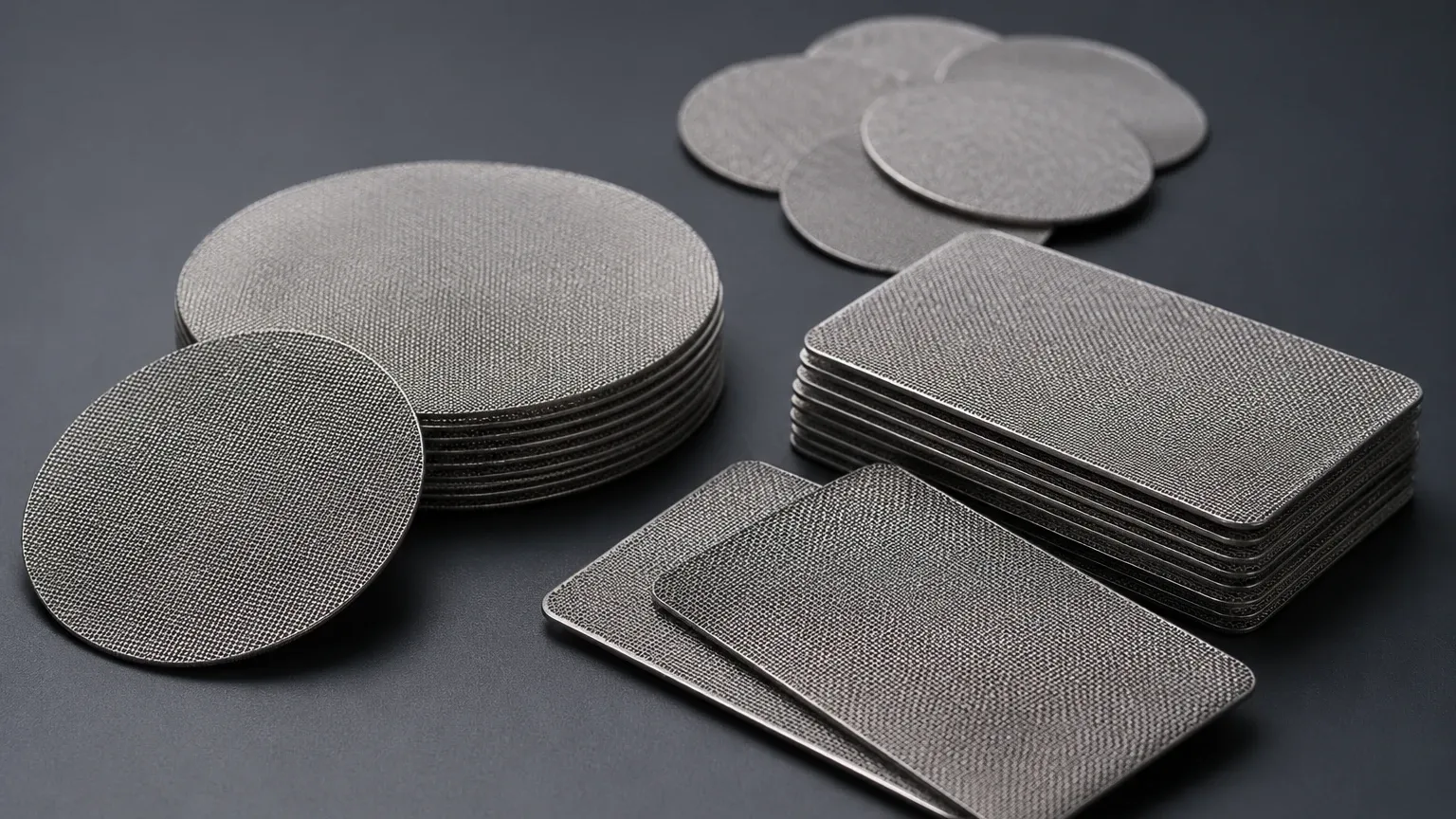
To integrate a filter water pack into an industrial housing, the physical structure must be customized to the specific equipment. Standard shapes include circular discs, but rectangular, oval, and donut-shaped packs are frequently required for specialized machinery.
Layer Configuration and Bonding
A typical pack might consist of three to five layers. A common configuration includes a fine filtration layer sandwiched between two coarser support layers. These layers can be bonded in several ways:
1. Spot Welding: The layers are welded at specific points along the perimeter or across the surface to maintain alignment.
2. Rimmed or Framed: The mesh layers are encased in a metal rim (typically aluminum, stainless steel, or copper). This provides a superior seal within the filter housing and prevents bypass, which is a common failure point in high-pressure water systems.
3. Sintering: For the most extreme environments, the layers are diffusion-bonded (sintered) together. This creates a monolithic structure that cannot delaminate, offering the highest level of mechanical stability.
Edge Treatments
Unprotected mesh edges can fray, leading to metallic contamination of the filtrate or injury during maintenance. Rimmed edges or compressed spot-welded borders ensure that the filter water pack remains intact throughout its service life and during the cleaning process.
Key Evaluation Criteria for Industrial Water Filtration
When specifying a filter water pack for a project, engineers must evaluate several performance metrics to ensure the component meets the operational requirements of the system.
Micron Rating and Filtration Accuracy
The micron rating defines the size of the particles the mesh will retain. It is essential to distinguish between nominal and absolute ratings. A nominal rating refers to the ability of the filter to retain a majority of particles of a certain size, while an absolute rating indicates that no particles larger than the specified micron size will pass through. For precision water treatment, absolute ratings are often preferred to ensure consistent water quality.
Flow Rate and Pressure Drop (ΔP)
Every filter introduces resistance to the flow. A well-designed filter water pack must provide the required filtration fineness while minimizing the pressure drop. If the initial ΔP is too high, it reduces the overall efficiency of the pump system and shortens the time between cleaning cycles. Engineers must calculate the effective filtration area (EFA) to ensure the pack can handle the required volume of water without excessive resistance.
Mechanical Strength and Burst Pressure
In hydraulic and high-pressure water systems, the filter pack is subjected to significant mechanical stress. If the mesh is not properly supported, the pressure can cause the fine wires to stretch or snap. The use of multiple layers and robust rimming techniques is essential to prevent structural failure under peak load conditions.
Maintenance, Cleaning, and Reusability
One of the primary advantages of stainless steel filter packs over polymer-based alternatives is their reusability. In many industrial processes, the total cost of ownership is significantly reduced because the filters can be cleaned and returned to service.
Cleaning Methods
- Backwashing: Reversing the flow of water through the pack to dislodge accumulated debris. This is effective for surface-loading contaminants.
- Ultrasonic Cleaning: Using high-frequency sound waves in a cleaning solvent to remove deeply embedded particles within the mesh pores. This is the most effective method for restoring the original flow characteristics of a multi-layer pack.
- Chemical Cleaning: Using mild acids or bases to dissolve organic or mineral scaling. This requires the mesh material to be chemically compatible with the cleaning agents (e.g., using SS316L for acid resistance).
Replacement Indicators
While metal packs are durable, they are not infinite. Indicators that a pack needs replacement include:
- Permanent deformation of the mesh (blinding or stretching).
- A baseline pressure drop that remains high even after thorough cleaning.
- Physical damage to the rim or spot welds.
Common Risks and Selection Pitfalls
Failing to account for specific environmental factors can lead to premature filter failure or system downtime. Purchasing teams should be aware of the following risks:
1. Galvanic Corrosion: If a stainless steel filter pack is used in a housing made of a different metal (like carbon steel) in an electrolytic environment (like saltwater), galvanic corrosion can occur. Using matching materials or non-conductive gaskets is necessary.
2. Inadequate Support: Using a fine mesh disc without a support layer in a high-flow application will almost certainly lead to mesh rupture.
3. Incorrect Micron Selection: Choosing a micron rating that is too fine for the application will lead to rapid clogging and excessive maintenance, while a rating that is too coarse will fail to protect downstream equipment like nozzles or membranes.
Applications Across Industrial Sectors
The versatility of the filter water pack makes it a staple in various industries beyond simple water treatment:
- Chemical Processing: Filtering catalysts and removing impurities from corrosive liquid streams.
- Food and Beverage: Ensuring the purity of process water used in ingredient mixing and equipment sanitation, where food-grade stainless steel is a regulatory requirement.
- Pharmaceuticals: High-precision filtration for sterile water systems and active pharmaceutical ingredient (API) processing.
- Hydraulics: Protecting sensitive valves and pumps from particulate matter in water-glycol hydraulic fluids.
- Oil and Gas: Sand control and produced water filtration in upstream operations.
Information Confirmation for Technical Procurement
Before finalizing a custom order for filter packs, technical teams should confirm the following data points with the manufacturer:
- Exact Dimensions: Outside diameter (OD), inside diameter (ID) for donut shapes, and total thickness of the pack.
- Mesh Specifications: Mesh count per inch or micron rating for each layer.
- Material Certification: Requesting mill test reports (MTRs) to verify the grade of stainless steel.
- Operating Parameters: Maximum operating temperature and maximum allowable differential pressure.
- Quantity and Lead Times: Understanding how batch sizes affect the manufacturing process, especially for custom-tooled rimmed packs.
By focusing on these technical details, engineers can ensure that the Filter Discs & Packs they integrate into their systems will provide reliable, long-term performance in even the most demanding industrial water applications.
