


Filters 1000
In high-precision industrial filtration, the term "filters 1000" often refers to the specific requirements of ultra-fine mesh counts or specialized micron ratings necessary for critical separation processes. For engineers and procurement specialists, selecting the correct Filter Discs & Packs is not merely a matter of finding a compatible size, but understanding the fluid dynamics, material integrity, and mechanical stresses involved in fine-mesh applications.
Industrial filtration systems operating at the 1000-mesh level or requiring precise particle retention in the sub-micron to low-micron range demand a sophisticated approach to component design. This guide explores the technical parameters of high-density filter discs, the engineering considerations for multi-layer packs, and the operational factors that influence the total cost of ownership in demanding environments such as polymer extrusion, chemical processing, and pharmaceutical manufacturing.
Technical Specifications of High-Mesh Filtration
When discussing "filters 1000," technical professionals are typically focused on the mesh count—the number of openings per linear inch. A 1000-mesh stainless steel wire cloth represents the upper echelon of woven wire technology. At this density, the wire diameters are exceptionally thin, and the aperture sizes are small enough to capture microscopic contaminants that would pass through standard industrial screens.
Mesh Count vs. Micron Rating
The relationship between mesh count and micron rating is critical for performance evaluation. While a standard 100-mesh screen might offer an aperture of approximately 140 microns, a 1000-mesh specification moves into the territory of 15 to 25 microns, depending on the weave type (such as plain Dutch weave or twilled Dutch weave).
For applications requiring "filters 1000" performance, engineers must verify:
* Aperture Size: The nominal and absolute filtration ratings.
* Open Area Percentage: High mesh counts naturally have lower open areas, which significantly impacts flow resistance and pressure drop.
* Wire Diameter: Thinner wires allow for more openings but reduce the mechanical strength of the individual layer.
Weave Types for Fine Filtration
Not all 1000-grade filters are created equal. The weave pattern dictates the flow characteristics and particle retention capabilities:
1. Plain Dutch Weave: Provides a compact, firm wire cloth with high tensile strength, ideal for high-pressure applications.
2. Twilled Dutch Weave: Allows for the highest mesh counts (including those exceeding 1000) by over-lapping wires, creating a tortuous path for particles and enabling finer filtration than plain weaves.
3. Reverse Dutch Weave: Designed for applications where high pressure and high-frequency backwashing are required, often used in continuous polymer filtration.
Engineering Considerations for Filter Discs & Packs
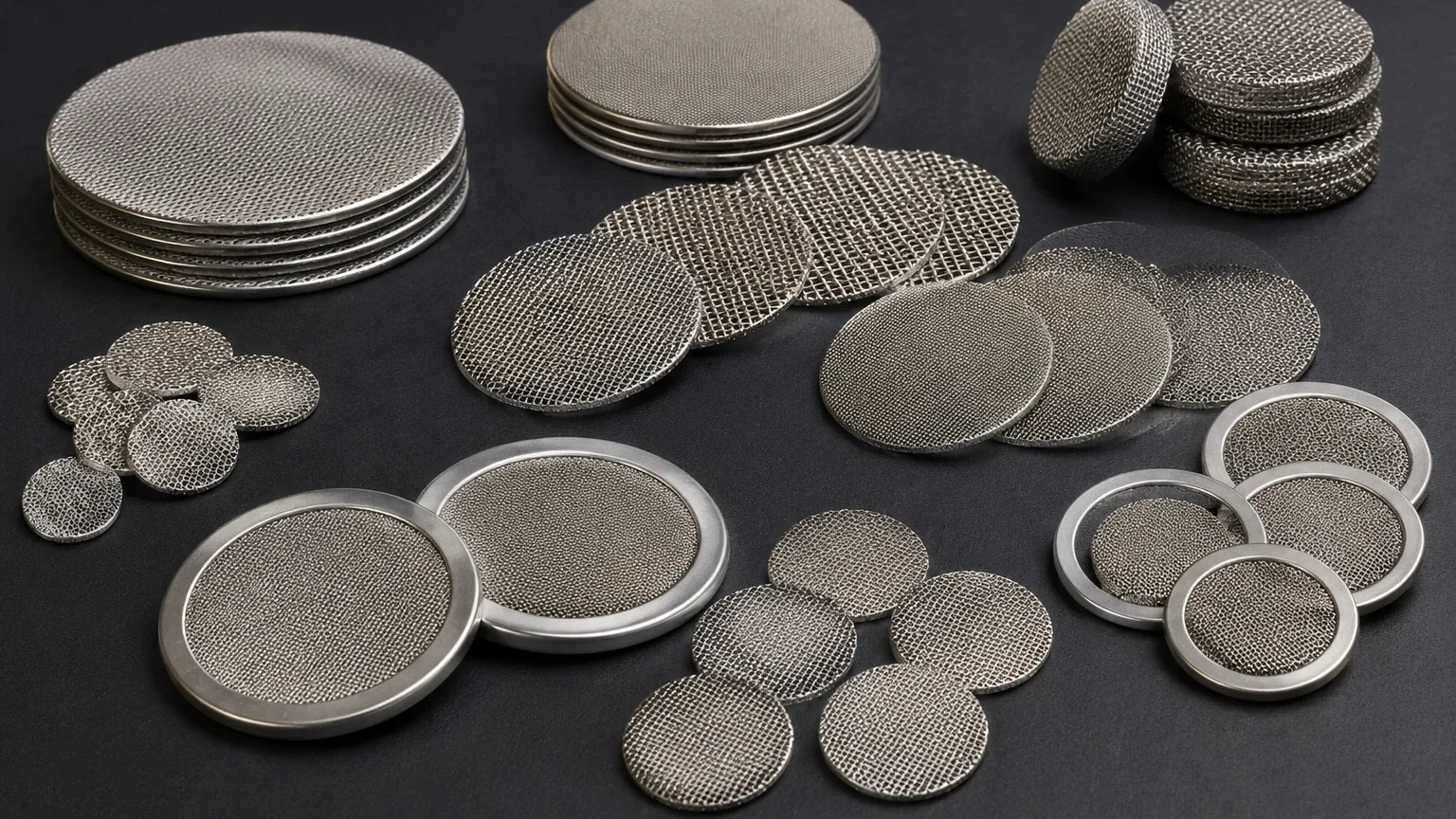
Single-layer filter discs are rarely sufficient for high-density filtration. At the 1000-mesh level, the wire cloth is delicate and can easily deform or rupture under industrial pressures. To resolve this, manufacturers utilize multi-layer Filter Discs & Packs to provide a balance of precision and structural integrity.
The Multi-Layer Construction
A typical high-performance filter pack is engineered as a "sandwich" of different mesh specifications:
* Filtration Layer: The primary layer (e.g., the 1000-mesh cloth) responsible for particle retention.
* Support Layers: Coarser mesh layers (such as 20 or 40 mesh) placed on either side of the filtration layer to prevent it from flexing or collapsing under differential pressure.
* Drainage Layers: Intermediate layers that help distribute fluid flow evenly across the filtration surface, reducing localized blinding and extending service life.
Edge Treatment and Framing
For "filters 1000" applications, the integrity of the disc edge is paramount. If the edges are not properly secured, bypass can occur, allowing unfiltered media to contaminate the downstream flow. Common edge treatments include:
* Spot Welding: Multiple layers are welded at specific points to maintain alignment during installation.
* Aluminum or Stainless Steel Rim: The layers are compressed within a metal frame (rim), which provides a leak-proof seal and simplifies handling.
* Plasma or Laser Cutting: Ensures clean, burr-free edges that fit precisely into recessed housings or extruder breaker plates.
Material Selection for Demanding Environments
The effectiveness of filters 1000 components depends heavily on the alloy selected. Since these filters are often used in corrosive or high-temperature environments, material compatibility is a primary engineering concern.
Stainless Steel 304 and 316L
Stainless steel is the industry standard due to its durability and resistance to oxidation.
* SS304: Suitable for general industrial use where moderate corrosion resistance is required.
* SS316L: The preferred choice for chemical and pharmaceutical applications. The addition of molybdenum and lower carbon content provides superior resistance to pitting and crevice corrosion, especially in chloride-rich environments.
High-Nickel Alloys
In extreme cases where stainless steel may fail—such as in highly acidic or high-temperature chemical processing—specialized alloys like Hastelloy, Inconel, or Monel are used. These materials maintain their structural properties at temperatures exceeding 500°C and resist aggressive chemical attack, ensuring that the precision of the 1000-mesh filtration is not compromised by material degradation.
Performance Expectations and Pressure Dynamics
One of the most common challenges with fine filters 1000 is the management of differential pressure (ΔP). As the mesh count increases, the resistance to flow increases exponentially. Engineers must calculate the clean pressure drop to ensure the system pump or extruder can handle the load without exceeding safety limits.
Factors Influencing Pressure Drop
* Viscosity of the Media: High-viscosity polymers require more force to pass through fine mesh than water-based chemicals.
* Contaminant Loading: The nature of the solids being removed (hard particles vs. gelatinous "soft" contaminants) determines how quickly the filter will blind.
* Flow Velocity: Higher velocities increase the risk of particle breakthrough and increase the rate of pressure buildup.
To optimize performance, it is often recommended to use a graduated filtration approach within the pack. By placing a slightly coarser "pre-filter" layer before the 1000-mesh layer, larger contaminants are captured early, preventing the fine mesh from clogging prematurely.
Application-Specific Requirements
Polymer and Plastic Extrusion
In the production of high-quality films, fibers, and resins, Filter Discs & Packs are used to remove "gels" and un-melted particles. The use of 1000-mesh packs ensures the clarity and tensile strength of the final product. In these applications, the filters must withstand pressures often exceeding 3,000 PSI.
Chemical and Petrochemical Processing
Precision filtration is required to protect downstream catalysts and sensitive instrumentation. Filters 1000 components are used in the filtration of additives, solvents, and fuels where even microscopic particulate matter can cause system failure or product off-specification.
Food and Pharmaceutical Production
In these sectors, cleanability and material certification are as important as filtration accuracy. Stainless steel filter discs must be manufactured to high hygienic standards, often requiring ultrasonic cleaning to ensure they are free of manufacturing oils and residues before use.
Maintenance, Replacement, and Total Cost of Ownership
While the initial purchase price of high-mesh Filter Discs & Packs is a factor, the total cost of ownership (TCO) is driven by service life and replacement frequency.
Determining Replacement Cycles
Replacement cycles are typically dictated by the maximum allowable differential pressure. Once the ΔP reaches a predetermined threshold, the filter must be cleaned or replaced. In continuous processes, this often involves a duplex filter system or a continuous screen changer to avoid downtime.
Cleaning vs. Disposal
Stainless steel filters 1000 are often cleanable, depending on the nature of the contaminant. Methods such as:
* Burn-off (Pyrolysis): Removing polymer residues in a controlled furnace.
* Ultrasonic Cleaning: Using high-frequency sound waves in a chemical bath to dislodge fine particles from the mesh interstices.
* Backflushing: Reversing the flow to push contaminants off the surface.
However, for ultra-fine 1000-mesh layers, aggressive cleaning can sometimes damage the delicate wires. Engineering teams must weigh the cost of cleaning and validation against the cost of a new filter pack.
Selecting a Manufacturing Partner for Custom Solutions
When sourcing filters 1000, off-the-shelf solutions may not always meet the specific nuances of a complex industrial process. Customization is often necessary to ensure the filter fits perfectly within the existing hardware and performs under specific thermal and chemical loads.
Key Information to Confirm Before Ordering
Before finalizing a specification for Filter Discs & Packs, engineers should confirm the following with their manufacturer:
1. Exact Dimensions: Diameter tolerances are critical for preventing bypass in recessed housings.
2. Layer Sequence: The specific order of mesh counts within a multi-layer pack.
3. Material Certification: Ensuring the alloy meets ASTM or ISO standards for the intended application.
4. Quantity and Lead Times: High-mesh wire cloth is a specialized material; ensuring consistent supply for high-volume production lines is essential for operational continuity.
By focusing on these technical details, procurement and engineering teams can ensure that their filtration systems operate at peak efficiency, protecting both the final product quality and the longevity of the industrial equipment. For those requiring specialized configurations or high-durability designs, Filter Discs & Packs provide the necessary precision for the most demanding "filters 1000" applications.
