


Milk Filter Discs
In the dairy industry, maintaining the highest standards of purity and hygiene is not merely a regulatory requirement but a fundamental necessity for product quality and equipment longevity. Milk filter discs serve as a critical primary barrier in the milk collection and processing chain. These components are designed to remove physical impurities—such as sediment, organic matter, and airborne particles—that may enter the milk during the milking process or transport. While traditional operations once relied heavily on single-use fabric or paper filters, modern industrial dairy processing has increasingly shifted toward high-precision stainless steel Filter Discs & Packs to ensure consistency, durability, and cost-effectiveness.
For engineers and procurement professionals, selecting the appropriate filtration media involves a deep understanding of material properties, flow dynamics, and hygiene protocols. This guide explores the technical specifications of milk filter discs, the engineering considerations for their implementation, and the advantages of transitioning to reusable stainless steel solutions.
The Role of Precision Filtration in Dairy Processing
Filtration in the dairy sector occurs at multiple stages, from the initial milking point to the final packaging line. Milk filter discs are typically installed in the milk line between the receiver jar and the cooling tank or at the inlet of processing equipment. Their primary function is to protect the downstream components—such as plate heat exchangers (PHEs), separators, and homogenizers—from damage caused by particulate matter.
If sediment is allowed to pass through the system, it can lead to several industrial challenges:
1. Equipment Fouling: Small particles can lodge within the narrow channels of heat exchangers, reducing thermal efficiency and increasing the frequency of required maintenance.
2. Product Contamination: Physical impurities can carry bacterial loads, potentially affecting the somatic cell count (SCC) and the overall shelf life of the dairy product.
3. Mechanical Wear: Abrasive particles can cause premature wear on pump seals and valves, leading to increased downtime and repair costs.
By utilizing precision-engineered milk filter discs, dairy processors can achieve a reliable level of pre-filtration that ensures the integrity of the entire production line.
Material Selection and Engineering Standards
The choice of material for milk filter discs is governed by the need for corrosion resistance, mechanical strength, and food safety compliance. In industrial environments, stainless steel is the gold standard, specifically grades 304 and 316L.
Stainless Steel 304 vs. 316L
While both materials offer excellent durability, the choice often depends on the specific cleaning chemicals and environmental conditions of the facility. Stainless steel 304 is suitable for most standard dairy applications. However, 316L contains molybdenum, which provides enhanced resistance to pitting and crevice corrosion, particularly when exposed to chlorides or the aggressive acidic and alkaline cleaners used in Clean-in-Place (CIP) cycles.
Construction and Mesh Types
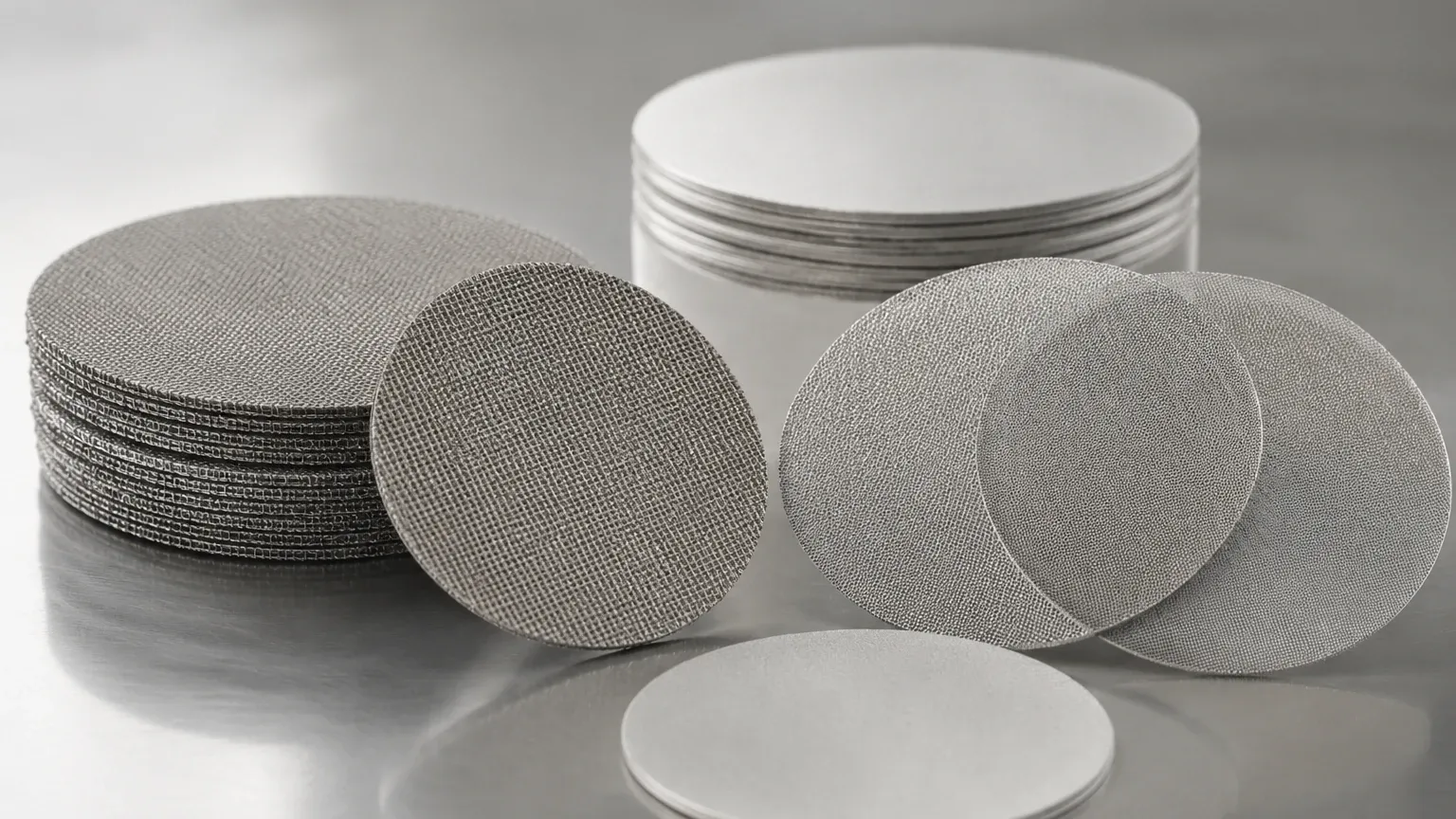
Milk filter discs are typically constructed from woven wire mesh or sintered metal.
- Woven Wire Mesh: Provides a high open area, allowing for high flow rates with minimal pressure drop. It is available in various weave patterns, such as plain weave or twilled weave, depending on the required filtration fineness.
- Sintered Mesh: For more demanding applications, multiple layers of wire mesh are sintered together under heat and pressure. This creates a robust, multi-layered filter disc that offers superior mechanical strength and prevents wire migration, ensuring that no metal fragments enter the product stream.
Comparing Disposable vs. Reusable Filter Discs & Packs
Historically, the dairy industry relied on non-woven polyester or cotton discs. While these are inexpensive in terms of initial unit cost, they present several disadvantages in a high-volume B2B context compared to stainless steel Filter Discs & Packs.
Filtration Consistency
Disposable filters are prone to "channeling" or stretching under high pressure, which can allow larger particles to bypass the filter. In contrast, stainless steel discs maintain a rigid pore structure, ensuring that the micron rating remains constant even under fluctuating pressure conditions.
Environmental and Operational Impact
A large-scale dairy operation can consume thousands of disposable filters annually, contributing significant waste and requiring extensive storage space. Reusable stainless steel discs eliminate this waste stream. Although the initial investment is higher, the total cost of ownership (TCO) is significantly lower over the product's lifespan due to the elimination of recurring procurement and disposal costs.
Pressure Resistance
In automated milking systems and high-pressure transfer lines, disposable filters may rupture, leading to catastrophic system contamination. Stainless steel filter discs are engineered to withstand high differential pressures, providing a safety margin that is essential for continuous industrial operations.
Key Performance Metrics: Micron Rating and Flow Capacity
When specifying milk filter discs, engineers must balance the need for fine filtration with the requirement for high throughput. The two most critical metrics are the micron rating and the flow capacity.
Micron Rating
For milk filtration, the target is usually the removal of macro-impurities. Common micron ratings for milk filter discs range from 50 to 150 microns. A finer mesh (lower micron rating) will capture smaller particles but will also clog more quickly, necessitating more frequent cleaning. Conversely, a coarser mesh allows for longer run times but may permit smaller sediments to pass through.
Flow Rate and Pressure Drop
The flow capacity of a filter disc is determined by its effective filtration area and the percentage of open area in the mesh. In a B2B setting, it is vital to calculate the "clean pressure drop"—the resistance the filter adds to the system when it is first installed. If the pressure drop is too high, it can strain pumps and reduce the overall efficiency of the milk transfer process. Engineering teams must ensure that the disc diameter and mesh configuration are optimized for the specific flow requirements of the processing line.
Maintenance, Cleaning, and Hygiene Compliance
In the food and beverage industry, the ability to effectively clean filtration components is as important as their filtration performance. Stainless steel milk filter discs are designed to be compatible with standard industrial cleaning protocols.
Clean-in-Place (CIP) Compatibility
Most modern dairy facilities utilize CIP systems to sanitize equipment without disassembly. Stainless steel discs can withstand the high temperatures (often exceeding 80°C) and the concentrated chemical solutions used in these processes. Because the mesh is precision-woven or sintered, there are no "dead zones" where organic matter can become trapped and foster bacterial growth, provided the correct flow velocity is maintained during the cleaning cycle.
Ultrasonic Cleaning
For deep cleaning, especially when dealing with stubborn protein deposits or mineral scaling (milk stone), stainless steel discs can be treated in ultrasonic baths. This process uses high-frequency sound waves to create cavitation bubbles that dislodge microscopic debris from within the mesh pores, restoring the filter to its original performance specifications.
Regulatory Compliance
Industrial milk filter discs must meet stringent regulatory standards, such as those set by the FDA (Food and Drug Administration) and 3-A Sanitary Standards. These standards dictate that materials must be non-toxic, non-absorbent, and have a surface finish that prevents the accumulation of pathogens.
Customization Options for Industrial Dairy Equipment
No two dairy processing facilities are identical, and off-the-shelf filtration components may not always meet specific engineering requirements. Customization is a key service for OEM (Original Equipment Manufacturer) partners and plant managers looking to optimize their systems.
Edge Binding and Reinforcement
To ensure a leak-proof seal within the filter housing, milk filter discs can be equipped with various edge treatments. These include:
- Stainless Steel Rimming: A solid metal border that provides structural rigidity and a precise mating surface for gaskets.
- Rubber or Silicone Edging: Integrated gaskets that simplify installation and ensure a tight seal in specialized housings.
Multi-Layer Configurations
In some applications, a single layer of mesh may not be sufficient. Custom Filter Discs & Packs can be engineered with multiple layers of varying mesh counts. For example, a coarse outer layer can act as a pre-filter to capture large debris, while a fine inner layer provides the final filtration. This graded density approach extends the service life of the disc and improves overall filtration efficiency.
Bespoke Dimensions
Whether the application requires a small 2-inch disc for a specialized sampling line or a large-diameter pack for a high-capacity bulk receiving station, custom manufacturing allows for exact fitment, reducing the risk of bypass and simplifying the integration into existing hardware.
Technical Evaluation Before Procurement
Before finalizing a purchase order for milk filter discs, technical teams should confirm several key parameters with their supplier to ensure the solution is fit for purpose:
1. Chemical Compatibility: Confirm that the stainless steel grade and any sealing materials (like EPDM or Viton) are compatible with the specific sanitizers used in the facility.
2. Maximum Differential Pressure: Determine the point at which the disc may deform or fail, ensuring it exceeds the maximum surge pressure of the system.
3. Certification Documentation: Request material mill reports and certificates of compliance (COC) to satisfy quality audit requirements.
4. Replacement Cycles: While stainless steel is reusable, it is not infinite. Establish a baseline for when a disc should be retired due to mechanical fatigue or irreversible blinding.
By focusing on these technical details, dairy processors can move beyond simple commodity purchasing and implement a filtration strategy that enhances operational reliability and product safety. Stainless steel milk filter discs represent a sustainable, high-performance solution for the modern dairy industry, providing the precision required to meet today's rigorous global standards.
