


Adhesive Filter Discs
In the landscape of industrial filtration and component protection, adhesive filter discs represent a specialized intersection of precision engineering and assembly efficiency. Unlike traditional mechanical fastening methods, adhesive-backed filtration components provide a streamlined solution for sealing, venting, and protecting sensitive equipment from particulate contamination while allowing for controlled gas or fluid flow. For engineers and procurement teams, selecting the correct adhesive filter discs requires a deep understanding of material compatibility, environmental stressors, and filtration performance metrics.
As a manufacturer specializing in custom stainless steel filtration solutions, Kaifil provides technical expertise in the development of Filter Discs & Packs designed for demanding industrial environments. This guide explores the technical nuances of adhesive filter discs, their material compositions, and the critical factors that determine their success in industrial applications.
The Technical Role of Adhesive Filter Discs
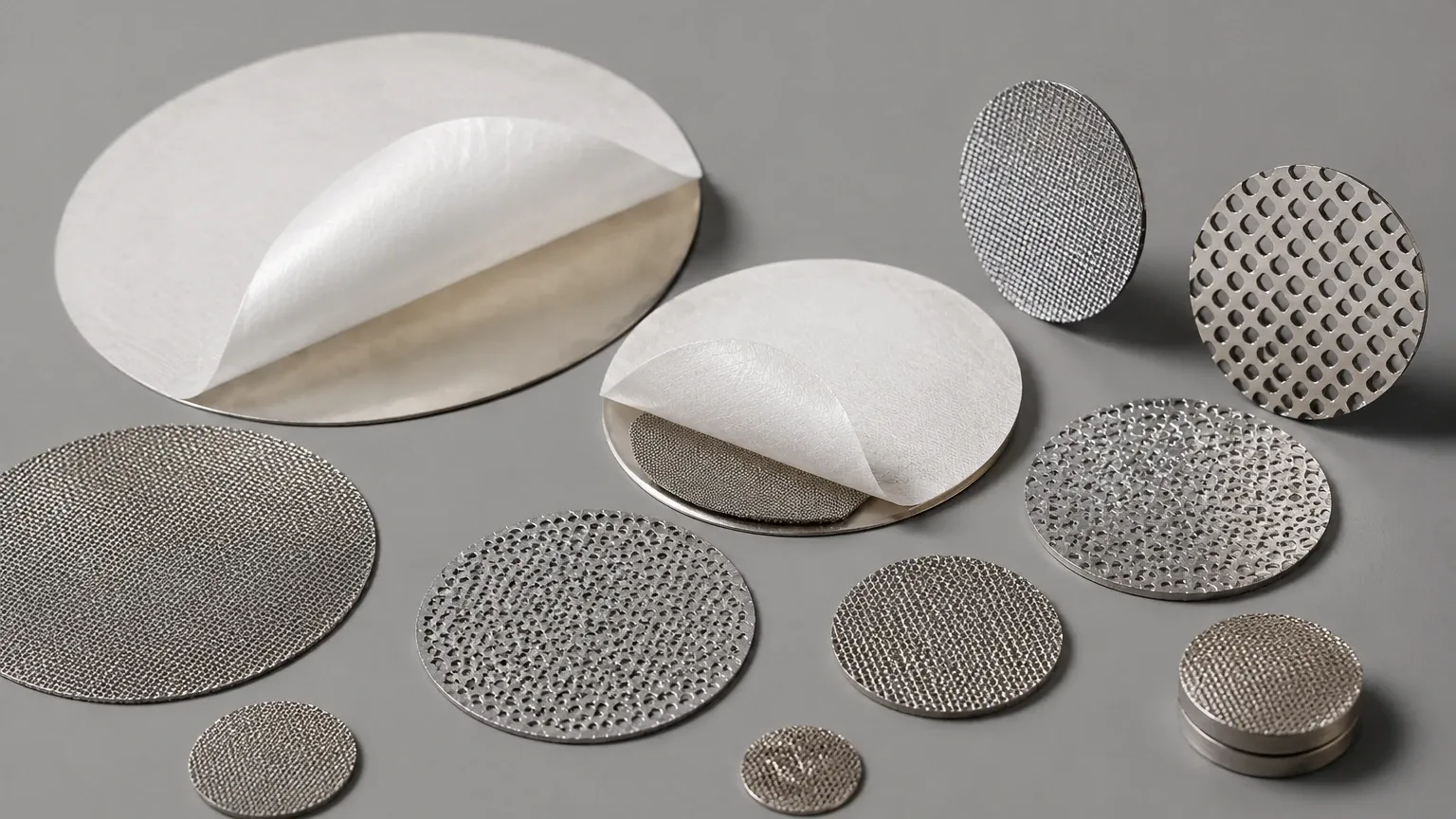
Adhesive filter discs are primarily used for pressure equalization, moisture management, and particulate exclusion. They consist of a filtration medium—typically stainless steel wire mesh or a synthetic membrane—integrated with a pressure-sensitive adhesive (PSA) ring or backing. This design allows the filter to be applied directly to a housing or substrate, creating a secure seal that prevents bypass while maintaining the desired filtration accuracy.
In B2B applications, these components are often found in automotive sensors, electronic enclosures, medical devices, and hydraulic systems. The "adhesive" element is not merely a convenience; it serves as a critical sealing gasket that ensures all air or fluid passes through the filter medium rather than around the edges. This is particularly vital in environments where vibration, thermal expansion, or space constraints make mechanical clamps or threaded housings impractical.
Material Selection: The Filtration Medium
The performance of adhesive filter discs begins with the choice of the filtration medium. Stainless steel wire mesh is the industry standard for durability and chemical resistance. Depending on the application, several weave types may be employed:
1. Plain Weave Mesh: Offers a simple, consistent aperture size suitable for basic particulate exclusion and high flow rates.
2. Dutch Weave Mesh: Utilizes a higher density of wires in the shute direction, providing superior strength and finer filtration ratings, often required for high-pressure applications.
3. Sintered Mesh: For extreme environments, multiple layers of mesh are sintered together to create a rigid, non-deformable structure that maintains filtration integrity even under significant mechanical stress.
Stainless steel 304 and 316L are the preferred alloys due to their corrosion resistance. In pharmaceutical or food-grade applications, 316L is often mandated due to its superior resistance to chlorides and acidic cleaning agents. When these meshes are converted into adhesive filter discs, they must be precision-cut to ensure no loose wires or burrs interfere with the adhesive bond or the downstream process.
Understanding Adhesive Systems for Industrial Filters
The adhesive component of the disc is as technically significant as the mesh itself. The selection of an adhesive must account for the substrate material (e.g., aluminum, ABS plastic, powder-coated steel) and the operational environment.
Acrylic Adhesives
Acrylic-based adhesives are the most common choice for industrial filter discs. They offer excellent resistance to UV light, oxidation, and many chemicals. Crucially, acrylics provide high initial tack and build strength over time, making them suitable for long-term outdoor exposure in venting applications.
Silicone Adhesives
For applications involving extreme temperatures—ranging from -70°C to over 250°C—silicone adhesives are preferred. While they generally offer lower initial adhesion than acrylics, their stability under thermal cycling is unmatched. They are frequently used in automotive engine compartments and high-heat industrial processing equipment.
Performance Considerations for Adhesives
When evaluating adhesive filter discs, engineers must confirm the following adhesive properties:
* Shear Strength: The ability of the adhesive to resist sliding forces, especially important in pressurized systems.
* Peel Adhesion: The force required to remove the disc from the substrate.
* Outgassing: In sensitive electronic or optical applications, low-outgassing adhesives are required to prevent volatile organic compounds (VOCs) from fogging lenses or corroding circuits.
Key Engineering Specifications and Evaluation Criteria
To ensure the reliability of Filter Discs & Packs in a specific application, several performance metrics must be quantified during the design and selection phase.
Filtration Accuracy (Micron Rating)
The micron rating defines the size of the particles the disc will effectively trap. In adhesive filter discs, this can range from coarse 100-micron protection for large debris to sub-micron levels for sterile venting. It is essential to balance filtration precision with the required flow rate; a filter that is too fine may cause an unacceptable pressure drop or premature clogging.
Air Permeability and Pressure Drop
In venting applications, the disc must allow air to pass through at a specific rate to prevent pressure buildup within an enclosure. This is measured as air permeability (e.g., L/m²/s at a specific pressure). Engineers must calculate the maximum expected pressure differential to ensure the disc does not burst or delaminate from its adhesive backing.
Chemical Compatibility
Industrial environments often expose filters to oils, fuels, cleaning solvents, and hydraulic fluids. Both the stainless steel mesh and the adhesive must be chemically inert relative to these substances. For instance, certain adhesives may soften or lose bond strength when exposed to petroleum-based lubricants, leading to filter failure.
Common Industrial Applications
Adhesive filter discs serve diverse roles across multiple sectors, each with unique technical requirements:
* Automotive Sensors: Protecting oxygen sensors and ECU housings from dust and water ingress while allowing for pressure equalization during temperature fluctuations.
* Medical Devices: Serving as hydrophobic vents in IV sets or fluid collection bags, where they prevent liquid leakage while allowing air to escape.
* Telecommunications: Protecting outdoor antenna housings and base stations from environmental contaminants while managing internal humidity.
* Hydraulic Systems: Used as breather filters in small reservoirs where space is limited, and a traditional screw-in breather is too large.
Overcoming Operational Challenges and Risks
Despite their utility, adhesive filter discs are subject to specific failure modes that must be addressed through proper design and installation.
Delamination and Bypass
The most common risk is the failure of the adhesive bond, leading to a "bypass" where contaminants enter through the gap between the filter and the housing. This is often caused by improper surface preparation (e.g., residual oils on the substrate) or selecting an adhesive that is incompatible with the substrate's surface energy.
Clogging and Service Life
Because adhesive filter discs are often small, they have a limited surface area for holding dirt. In high-particulate environments, these discs can clog quickly. Engineers should evaluate the total cost of ownership by considering the replacement cycle. If a disc requires frequent replacement in a hard-to-reach location, a larger surface area or a multi-layer sintered disc may be a more cost-effective long-term solution.
Installation Errors
Adhesive discs require precise placement. In automated assembly lines, vacuum-pick-and-place systems are used to ensure the disc is centered over the vent hole. Any misalignment can reduce the effective filtration area or compromise the seal.
Customization and OEM Considerations
Off-the-shelf solutions rarely meet the exacting standards of specialized industrial equipment. Customization is often necessary to align the disc's dimensions, mesh weave, and adhesive type with the specific demands of the project.
Kaifil’s manufacturing process allows for the production of custom Filter Discs & Packs tailored to specific micron ratings and geometric requirements. When working with an OEM partner, engineers should provide detailed information regarding:
* The substrate material and surface finish.
* The maximum and minimum operating temperatures.
* The expected exposure to chemicals or moisture.
* The required airflow at a given pressure differential.
By addressing these factors during the prototyping phase, manufacturers can develop an adhesive filter disc that ensures long-term reliability and minimizes the risk of field failures.
Conclusion
Adhesive filter discs are critical components that provide essential protection and pressure management in a compact, easy-to-install format. By combining the durability of stainless steel wire mesh with the sealing capabilities of advanced industrial adhesives, these discs solve complex engineering challenges across the automotive, medical, and electronics sectors.
When selecting a filtration partner, it is vital to choose a manufacturer that understands the technical interplay between material science and mechanical design. Precise manufacturing ensures that every disc meets the required filtration accuracy and bond strength, providing peace of mind for engineers and purchasing teams alike. For those seeking high-performance, customized filtration components, exploring the full range of Filter Discs & Packs is the first step toward optimizing system performance and durability.
