


100 Micron Filter Cartridge
In industrial filtration, the selection of a specific micron rating is a critical engineering decision that directly impacts process efficiency, equipment longevity, and product purity. A 100 micron filter cartridge occupies a strategic position in the filtration hierarchy, typically serving as a robust pre-filter or a primary filter for coarse particulate removal. At 100 microns (0.1 millimeters), the filtration threshold is designed to capture visible debris, sediment, and larger suspended solids that could otherwise damage sensitive downstream components like high-pressure pumps, spray nozzles, or membrane systems.
For engineers and procurement professionals, understanding the technical nuances of a 100 micron filter cartridge—ranging from material composition to flow dynamics—is essential for optimizing system performance. Kaifil, a specialist in custom stainless steel filtration solutions, provides high-performance components designed to meet these rigorous industrial requirements. To explore the full range of available filtration technologies, professionals can visit the Main Page for comprehensive product specifications and application support.
Technical Specifications and Micron Rating Accuracy
The term "100 micron" refers to the pore size of the filter media, but the effectiveness of this rating depends heavily on whether it is classified as nominal or absolute.
Nominal vs. Absolute Filtration
* Nominal Rating: A nominal 100 micron filter cartridge is designed to retain a major percentage (typically 60% to 85%) of particles at the 100-micron threshold. These are often used in less critical applications where some bypass of larger particles is acceptable in exchange for higher flow rates and lower costs.
* Absolute Rating: An absolute 100 micron filter cartridge is engineered to provide a consistent retention efficiency of 99% or higher. In critical industrial processes, such as pharmaceutical pre-filtration or fine chemical production, absolute ratings are preferred to ensure predictable results and protect downstream equipment from specific particle sizes.
Understanding 100 Microns in Context
To visualize the scale, a human hair is approximately 70 to 100 microns in diameter. Therefore, a 100 micron filter cartridge is effective at removing sand, scale, large rust particles, and various organic fibers. In many industrial water treatment systems, this level of filtration is the "first line of defense," preventing the rapid clogging of finer 5-micron or 1-micron polishing filters.
Material Selection for Industrial Environments
While 100 micron filter cartridges can be manufactured from various materials, including polypropylene (melt-blown or string-wound) and polyester, stainless steel remains the material of choice for demanding B2B industrial applications. Stainless steel wire mesh filters offer several distinct advantages over synthetic alternatives.
Stainless Steel 304 and 316L
Stainless steel 304 is suitable for general-purpose filtration in non-corrosive environments. However, for chemical processing, marine applications, or food and beverage production, 316L stainless steel is the industry standard due to its superior resistance to pitting and chloride-induced corrosion. These metal cartridges can withstand extreme temperatures (up to 500°F or higher depending on seals) and high differential pressures that would cause synthetic cartridges to collapse or bypass.
Wire Mesh Structures
A 100 micron filter cartridge utilizing stainless steel wire mesh can be constructed using different weave patterns:
1. Plain Weave: The most common structure, providing a high open area and low pressure drop.
2. Dutch Weave: Offers higher mechanical strength and a more tortuous path for particles, enhancing filtration depth even at a 100-micron rating.
3. Sintered Mesh: For high-pressure hydraulic systems, multiple layers of mesh are sintered together to create a rigid, non-deformable filter element that maintains its 100-micron rating under extreme mechanical stress.
Engineering Considerations: Flow Rate and Pressure Drop
When integrating a 100 micron filter cartridge into a system, engineers must calculate the clean pressure drop ($ΔP$) and the projected terminal pressure drop.
Surface Area and Pleating
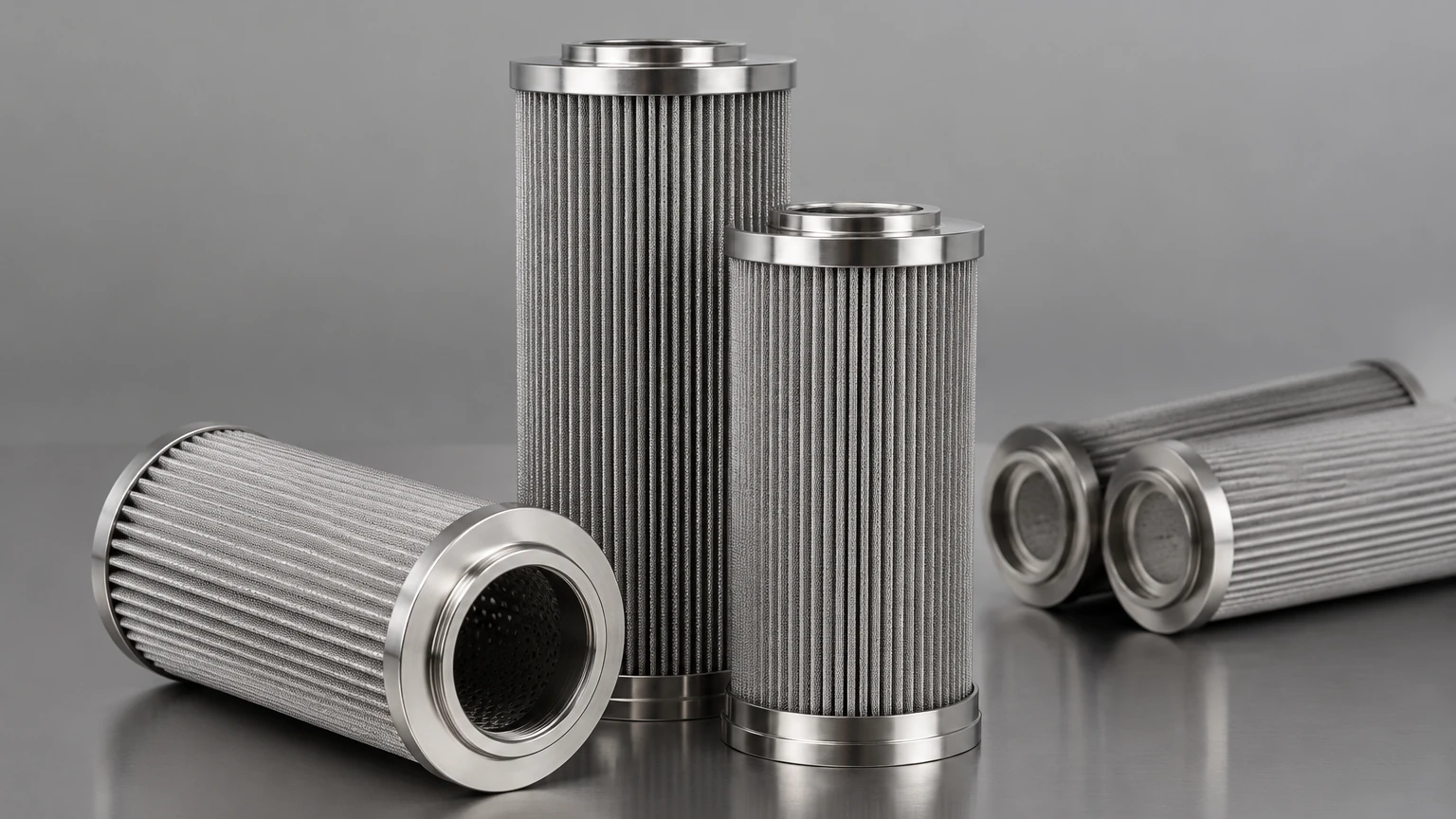
The flow capacity of a filter is directly proportional to its surface area. A standard cylindrical 100 micron filter cartridge has a finite surface area based on its diameter and length. To increase flow rates without increasing the footprint of the filter housing, manufacturers like Kaifil often use pleated designs. Pleating the stainless steel mesh can increase the effective filtration area by 300% to 500%, significantly reducing the initial pressure drop and extending the time between cleaning cycles.
Viscosity and Flux
The viscosity of the fluid significantly impacts the performance of a 100 micron filter cartridge. While water flows easily through a 100-micron mesh, high-viscosity oils or resins require a much larger surface area or a lower flux (flow per unit area) to prevent an excessive pressure drop. Engineers must ensure that the chosen cartridge can handle the maximum flow rate at the highest expected fluid viscosity without exceeding the bypass valve setting of the housing.
Common Industrial Applications
The 100 micron filter cartridge is a versatile component used across a broad spectrum of industries. Its primary role is to provide reliable coarse filtration where durability is paramount.
Cooling Water Systems
In power plants and manufacturing facilities, cooling water is often drawn from open sources like rivers or cooling towers. A 100 micron filter cartridge effectively removes algae clumps, pipe scale, and large grit, protecting heat exchangers from fouling and reducing maintenance downtime.
Hydraulic and Lubrication Oils
Hydraulic systems are sensitive to particulate contamination. A 100-micron stainless steel cartridge is frequently used as a suction strainer or a return-line filter to capture large metallic wear particles. Because these filters are cleanable, they offer a lower total cost of ownership in high-debris environments compared to disposable glass-fiber elements.
Food and Beverage Processing
In the production of juices, syrups, and oils, 100-micron filtration is used to remove pulp, seeds, or large impurities before the product undergoes pasteurization or fine filtration. Stainless steel cartridges are preferred here because they can be sterilized using steam-in-place (SIP) or clean-in-place (CIP) protocols.
Maintenance, Cleaning, and Reusability
One of the primary reasons B2B buyers select stainless steel 100 micron filter cartridges is their reusability. Unlike disposable polypropylene filters that must be discarded once clogged, metal filters can be cleaned and returned to service multiple times.
Cleaning Methods
* Backwashing: Reversing the flow of the fluid to dislodge particles from the surface of the mesh. This is effective for surface-loading 100-micron filters.
* Ultrasonic Cleaning: Using high-frequency sound waves in a cleaning solvent to remove deeply embedded particles. This is the most thorough method for restoring the original pressure drop characteristics of the cartridge.
* Chemical Cleaning: Using acids or alkalis to dissolve organic or mineral deposits, provided the chemical is compatible with the 304 or 316L stainless steel and the gasket materials.
Replacement Indicators
Despite being cleanable, a 100 micron filter cartridge will eventually reach the end of its functional life. Signs that a cartridge needs replacement include permanent deformation of the mesh (media migration), irreparable damage to the end caps or seals, or a "permanent" pressure drop that cannot be resolved through standard cleaning procedures.
Selection Criteria: What to Confirm Before Purchase
To ensure the 100 micron filter cartridge performs as expected, technical teams should confirm several key parameters with their supplier:
1. Housing Compatibility: Confirm the end cap configuration. Common types include Double Open End (DOE), Code 7 (226 O-rings with locking fins), and Code 3 (222 O-rings). Incorrect end caps lead to fluid bypass.
2. Seal Material: Ensure the O-rings or gaskets (Buna-N, EPDM, Viton, or PTFE) are chemically compatible with the process fluid and the operating temperature.
3. Differential Pressure Rating: Determine the maximum $ΔP$ the cartridge can withstand before structural failure occurs. For high-pressure applications, internal support cores are often required.
4. Customization Requirements: If standard sizes (10", 20", 30", or 40") do not fit the existing infrastructure, custom lengths and diameters must be specified.
Kaifil specializes in these custom configurations, ensuring that even non-standard filtration systems can be equipped with high-quality stainless steel components. For detailed engineering support or to view specific product options, visiting the Main Page provides access to technical resources and direct consultation with filtration experts.
Conclusion: Total Cost of Ownership
While the initial cost of a stainless steel 100 micron filter cartridge is higher than that of a disposable synthetic filter, the total cost of ownership (TCO) is often significantly lower. The durability, high temperature resistance, and ability to be cleaned multiple times make it a more sustainable and cost-effective choice for industrial operations. By selecting the right material, weave, and structural design, engineers can ensure their filtration systems operate with maximum uptime and minimal environmental impact.
