


3-a Ssi
In the realm of industrial processing—specifically within the food, beverage, dairy, and pharmaceutical sectors—maintaining the highest levels of hygiene is not merely a regulatory requirement but a fundamental operational necessity. Central to these hygiene protocols is the 3-A Sanitary Standards, Inc., commonly referred to as 3-a ssi. This non-profit corporation is dedicated to advancing hygienic equipment design through the development of comprehensive sanitary standards and accepted practices. For engineers and procurement specialists tasked with selecting filtration components, understanding the nuances of these standards is critical to ensuring product safety, process efficiency, and regulatory compliance.
Industrial filtration systems, particularly those utilizing stainless steel wire mesh and custom cartridges, must be designed to prevent microbial growth and facilitate thorough cleaning. The guidelines established by 3-A SSI provide a framework for manufacturers and end-users to evaluate whether a piece of equipment is capable of being cleaned to a microbiological level. This article explores the technical requirements of 3-A SSI, the engineering considerations for sanitary filtration, and the role of high-quality stainless steel components in meeting these rigorous benchmarks.
The Role and Importance of 3-A SSI in Industrial Filtration
3-A SSI was formed by the collaboration of three distinct groups: the dairy industry, the equipment manufacturers, and the regulatory sanitarians. Today, its influence extends far beyond dairy, serving as a global benchmark for sanitary design. The primary objective of these standards is to protect the public from potential contamination by ensuring that equipment surfaces are smooth, non-porous, and easily cleanable.
In the context of filtration, 3-A SSI standards dictate how filter housings, support cores, and the filter media itself must be constructed. Unlike standard industrial filters where the primary concern is particle retention and pressure drop, sanitary filters must also account for "cleanability." If a filter component has crevices, sharp internal corners, or rough surfaces, it can harbor bacteria and biofilms that survive standard cleaning cycles. 3-A SSI provides the engineering criteria to eliminate these risks.
Key Evaluation Criteria for Sanitary Equipment
When evaluating filtration components under the 3-A SSI framework, several technical criteria are prioritized:
1. Material Composition: Only specific materials are permitted for use in product contact zones. Stainless steel is the preferred choice due to its corrosion resistance and durability.
2. Surface Finish: The roughness of the surface, measured as Ra (Roughness Average), must meet specific limits to ensure that microorganisms cannot adhere to the metal.
3. Accessibility for Cleaning: The design must allow for either Clean-in-Place (CIP) or easy disassembly for Clean-out-of-Place (COP) procedures.
4. Joinery and Welding: All welds must be ground smooth and flush with the base metal to eliminate pits or cracks where contaminants could accumulate.
Engineering Considerations for 3-A Compliant Filtration
Designing a filter that meets 3-A SSI requirements involves a delicate balance between filtration efficiency and sanitary integrity. For a manufacturer like Kaifil, this requires precision engineering and a deep understanding of metallurgy.
Material Selection: The Dominance of Stainless Steel
3-A SSI standards generally require the use of AISI 300 series stainless steel for product contact surfaces. Grade 316L is the industry standard for most sanitary applications because its low carbon content and molybdenum addition provide superior resistance to pitting and corrosion, especially when exposed to the aggressive chemicals used in CIP cycles.
Materials must be non-absorbent, non-toxic, and resistant to the temperatures and pressures of the specific process. In filtration, this applies not only to the outer housing but also to the internal wire mesh and support structures. Any elastomers or gaskets used in the assembly must also comply with 3-A Standard 18-03, ensuring they do not degrade or leach chemicals into the product stream.
Surface Finish and Ra Values
A critical requirement for 3-A SSI compliance is the surface finish. For most stainless steel components in contact with the product, a maximum Ra of 0.8 μm (32 micro-inches) is required. Achieving this often involves mechanical polishing followed by electropolishing.
Electropolishing is a chemical-electrical process that removes a microscopic layer of metal, smoothing out the peaks and valleys of the surface. This not only meets the Ra requirements but also enhances the chromium-to-iron ratio on the surface, creating a more robust passive layer that prevents rust. In complex filtration components like pleated wire mesh cartridges, ensuring every surface meets these finish requirements is a significant engineering challenge that requires specialized manufacturing capabilities.
Eliminating Dead Legs and Crevices
In sanitary engineering, a "dead leg" is an area in a piping or filtration system where the process fluid can stagnate and is not reached by the cleaning solution during a CIP cycle. 3-A SSI standards provide strict ratios for the length of a branch compared to its diameter to minimize these zones.
For filter manufacturers, this means designing housings with smooth transitions and avoiding threaded connections in the product zone. Instead, Tri-Clamp or other sanitary fittings are used. Internal components must be designed with radiused corners (typically a minimum of 3.2 mm or 1/8 inch) to ensure that cleaning fluids can effectively scrub all surfaces.
Stainless Steel Wire Mesh in Sanitary Applications
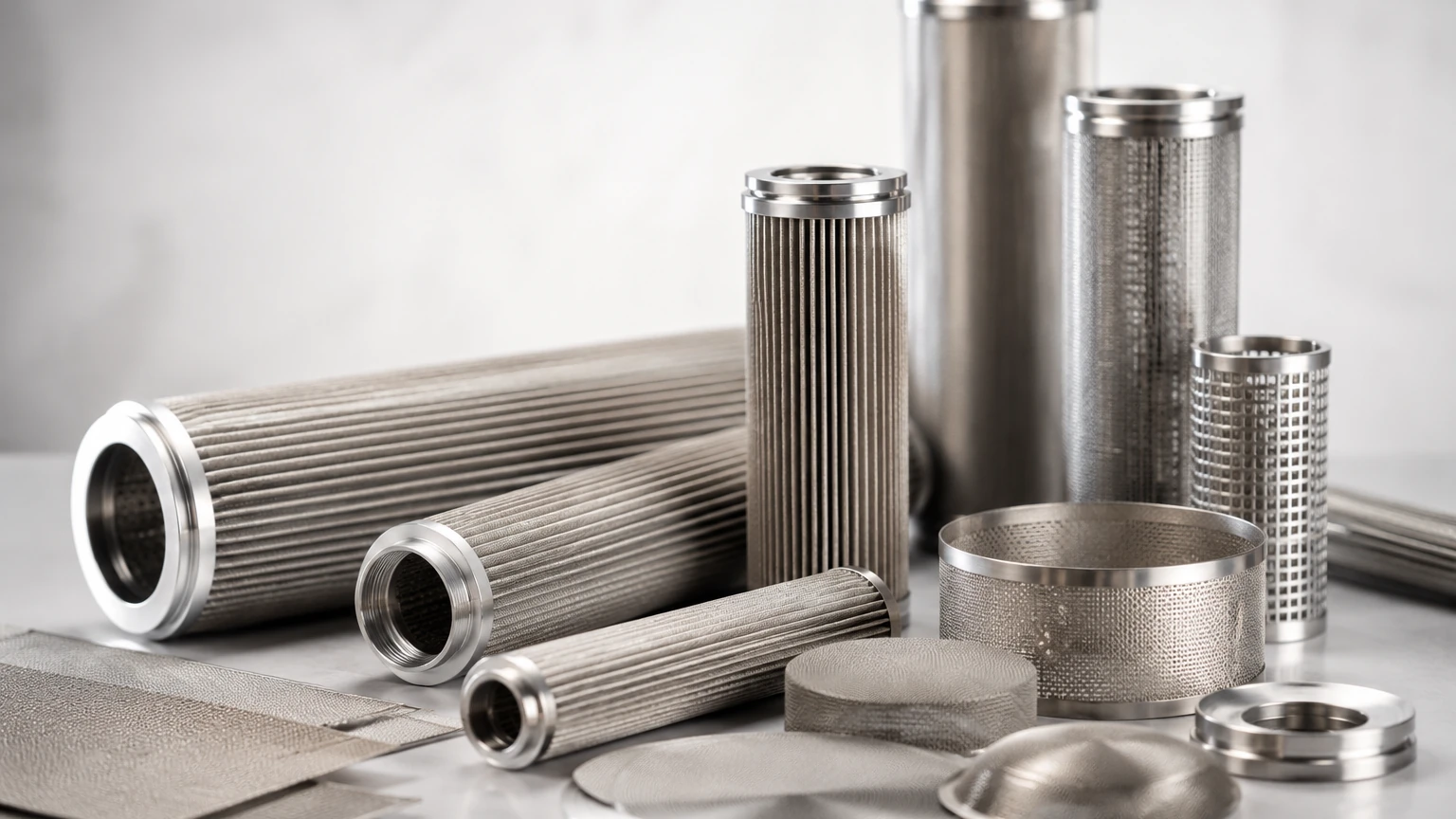
Stainless steel wire mesh is a core component of many sanitary filtration systems. It is used in strainers, filter inserts, and support cages. To align with 3-A SSI principles, the wire mesh must be manufactured with high precision.
Weave Types and Cleanability
Not all wire mesh weaves are suitable for sanitary applications. Simple weaves like Plain Weave or Twilled Weave are often preferred because they are easier to clean than complex, multi-layered Dutch weaves. However, when fine filtration is required, manufacturers must ensure that the mesh is securely bonded—often through sintering—to prevent individual wires from migrating into the product stream and to eliminate microscopic gaps between wires where bacteria could grow.
Sintered Metal Filters
Sintered stainless steel is frequently used in applications requiring 3-A SSI compliance. By diffusion-bonding multiple layers of wire mesh or metallic powder, engineers create a porous structure that is incredibly strong and dimensionally stable. Because the wires are fused together, there are no "loose" contact points, which significantly improves the cleanability of the media compared to traditional non-sintered mesh.
The Third-Party Verification (TPV) Process
One of the defining characteristics of 3-A SSI is the requirement for Third-Party Verification (TPV). Unlike some standards that allow for self-certification, 3-A SSI requires that equipment undergo an independent audit by a Certified Conformance Evaluator (CCE).
This audit involves a physical inspection of the equipment and a review of the manufacturing processes, material certifications, and engineering drawings. Only after successfully passing this audit can a manufacturer display the 3-A Symbol. For purchasing teams, the presence of the 3-A Symbol is a powerful assurance that the filtration component has been vetted against the most rigorous sanitary design criteria available.
Common Risks of Non-Compliant Filtration Systems
Using filtration components that do not adhere to 3-A SSI or similar sanitary standards introduces several risks to a production facility:
1. Microbial Contamination: Pits, cracks, and dead zones provide a haven for bacteria like Listeria or Salmonella. If these are not eliminated by cleaning, they can contaminate subsequent batches of product.
2. Batch Loss and Recalls: Contamination discovered after packaging can lead to expensive product recalls and damage to brand reputation.
3. Reduced Equipment Lifespan: Non-sanitary designs may suffer from localized corrosion in areas where cleaning chemicals or product residue are trapped.
4. Regulatory Non-Compliance: Inspectors from the FDA or other health authorities often look for 3-A SSI compliance as evidence of Good Manufacturing Practices (GMP).
Maintenance and Replacement Cycles
Even the best-designed 3-A compliant filter requires proper maintenance to remain effective. Engineers should establish clear protocols for:
* Inspection: Regularly checking the integrity of the wire mesh and the condition of the surface finish. Any scratches or mechanical damage can compromise the sanitary nature of the component.
* Cleaning Verification: Using ATP (Adenosine Triphosphate) testing or swabbing to verify that CIP cycles are effectively removing all organic matter.
* Gasket Replacement: Elastomeric seals are the most common point of failure in a sanitary system. They should be replaced on a scheduled basis, even if they appear intact, to prevent leaks or contamination.
Custom Filtration Solutions and 3-A SSI
Many industrial processes require unique filtration configurations that cannot be met by off-the-shelf products. In these cases, working with an experienced manufacturer like Kaifil is essential. Customization allows for the optimization of flow rates and pressure drops while strictly adhering to 3-A SSI design principles.
When ordering custom stainless steel filter cartridges or wire mesh components, engineers should confirm the following with their supplier:
* Material Traceability: Ensure that MTRs (Material Test Reports) are available for all stainless steel used.
* Weld Procedures: Confirm that all welds in the product zone are performed using TIG (Tungsten Inert Gas) welding and are ground to the required Ra finish.
* Design Review: Provide detailed drawings to ensure that all radii and transitions meet the 3-A SSI requirements for the specific equipment category (e.g., Standard 10-04 for Filters).
Conclusion
Navigating the requirements of 3-a ssi is a critical task for any professional involved in the design or operation of sanitary processing systems. By focusing on material integrity, surface finish, and geometric design, 3-A standards provide a roadmap for achieving the highest levels of product safety.
For those in the chemical processing, food and beverage, and pharmaceutical industries, selecting filtration components that respect these principles is the best way to ensure long-term operational success. Whether you are implementing a standard wire mesh filter or a complex custom cartridge, the commitment to sanitary design—as championed by 3-A SSI—remains the gold standard for protecting both the consumer and the manufacturer's reputation. For more information on high-performance, precision-engineered filtration components, engineers are encouraged to Review product options and application support to find solutions tailored to their specific sanitary requirements.
