


3a Sanitary Standards
In the highly regulated sectors of food, beverage, and pharmaceutical processing, the integrity of equipment is paramount to ensuring consumer safety and product quality. Central to this integrity are the 3a sanitary standards, a set of criteria designed to ensure that equipment can be effectively cleaned and sanitized, thereby preventing microbial contamination. For engineers and procurement professionals sourcing filtration components, understanding these standards is not merely a matter of compliance but a fundamental requirement for operational reliability.
Industrial filtration systems, particularly those utilizing stainless steel media, play a critical role in these processes. Whether removing particulates from a dairy stream or ensuring the purity of a pharmaceutical intermediate, the filter must meet rigorous design and fabrication benchmarks. This guide explores the technical nuances of 3a sanitary standards as they apply to stainless steel filtration, providing the necessary context for informed decision-making.
Understanding 3a Sanitary Standards in Industrial Filtration
3-A Sanitary Standards, Inc. (3-A SSI) is an independent, not-for-profit corporation dedicated to enhancing product safety in the food, beverage, and pharmaceutical industries. The standards they develop focus on the "cleanability" of equipment. In the context of filtration, this means that every surface in contact with the product must be accessible for cleaning, either through manual disassembly (Clean-Out-of-Place or COP) or through automated systems (Clean-In-Place or CIP).
Unlike standard industrial filters, which may prioritize flow rate or pressure drop above all else, a filter designed to 3a sanitary standards must balance performance with hygiene. This involves specific requirements for material composition, surface finish, and geometric design. The primary objective is to eliminate "dead legs" or crevices where bacteria could harbor and multiply, even after a cleaning cycle has been completed.
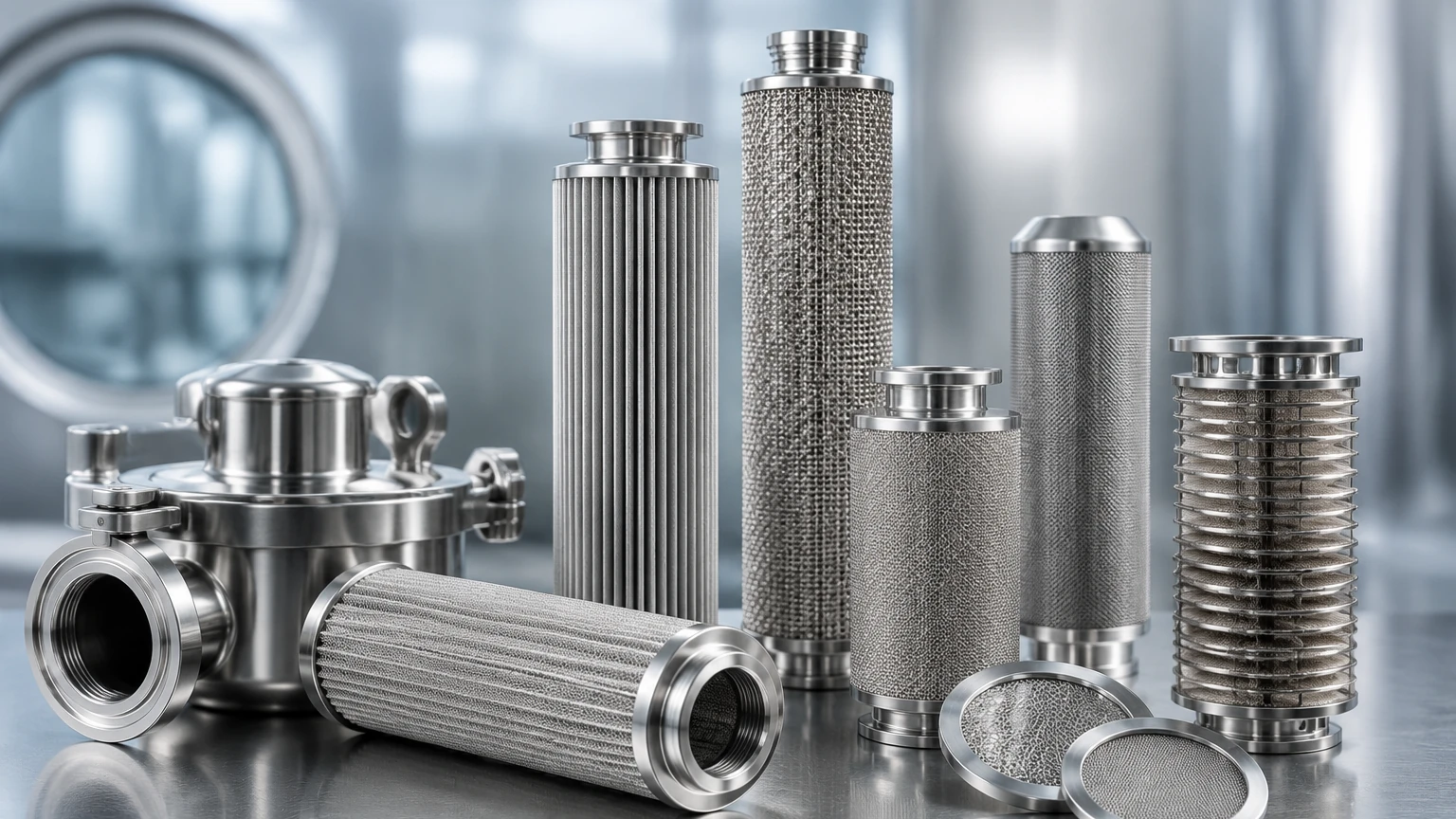
For manufacturers like Kaifil, adhering to these standards involves precision engineering at every stage of production. From the initial weaving of the stainless steel wire mesh to the final welding of the cartridge end caps, every step must be documented and verified to meet the stringent requirements of the industry.
Material Selection and Traceability for Sanitary Compliance
Material integrity is the foundation of 3a sanitary standards. In the realm of metal filtration, this almost exclusively refers to high-grade stainless steel. The most common materials used are AISI 304 and 316L.
Stainless Steel Grades
While 304 stainless steel is suitable for many applications, 316L is often preferred for sanitary filtration due to its superior corrosion resistance, particularly against the chlorides found in many cleaning agents and certain food products. The "L" in 316L stands for low carbon, which is crucial for components that require welding. Low carbon content prevents carbide precipitation during the welding process, a phenomenon that can lead to intergranular corrosion and compromise the sanitary integrity of the filter.
Elastomers and Gaskets
It is a common misconception that 3-A standards only apply to metal. Any non-metal components, such as gaskets, O-rings, and seals used in filter housings or cartridges, must also comply with specific 3-A Sanitary Standards (such as Standard 18-). these materials must be non-toxic, non-absorbent, and capable of withstanding the high temperatures and harsh chemicals used during sterilization cycles without degrading or leaching substances into the product stream.
Traceability
For engineers, material traceability is a non-negotiable requirement. A reputable manufacturer must provide Mill Test Reports (MTRs) for all stainless steel components. This documentation proves the chemical composition and mechanical properties of the steel, ensuring that the final product aligns with the specifications required by the Main Page of the project’s safety protocol.
Engineering and Design Requirements for Sanitary Filters
The design of a sanitary filter is governed by the principle that all surfaces must be smooth and free of pits, folds, or crevices. This is quantified through specific engineering metrics.
Surface Roughness (Ra)
One of the most critical aspects of 3a sanitary standards is the surface finish, typically measured as Roughness Average (Ra). For most sanitary applications, a surface finish of 32 micro-inches (0.8 micrometers) Ra or smoother is required. Achieving this finish often requires a combination of mechanical polishing and electropolishing. Electropolishing is particularly effective for complex filter geometries, as it uses an electrochemical process to remove microscopic peaks from the metal surface, resulting in a mirror-like finish that is highly resistant to bacterial adhesion.
Weld Quality and Radius
Welding in sanitary filtration is a specialized skill. All welds must be continuous, smooth, and ground flush with the base metal. Tack welds or skip welds are strictly prohibited as they create inaccessible gaps. Furthermore, the standards dictate minimum radii for internal corners—typically 1/8 inch (3.2 mm) or larger. This ensures that cleaning fluids can reach every part of the assembly and that no product can become trapped in sharp angles.
Self-Draining Design
To prevent the growth of microorganisms between batches, sanitary filter housings and components must be designed to be self-draining. This means that when the system is shut down, gravity should naturally pull all remaining liquid toward the discharge point. Any pooling of liquid is a significant risk factor for contamination.
Clean-In-Place (CIP) and Sterilization Performance
In modern industrial processing, efficiency is driven by the ability to clean equipment without disassembly. 3a sanitary standards are specifically designed to facilitate Clean-In-Place (CIP) procedures. For a filtration component, this introduces several performance expectations.
Chemical Resistance
CIP cycles often involve the use of caustic soda (sodium hydroxide) and nitric acid at elevated temperatures. The filter media, whether it is a pleated wire mesh or a sintered metal fiber, must maintain its structural integrity and filtration accuracy throughout these aggressive cycles. Stainless steel is the material of choice here because it does not swell, soften, or shed fibers when exposed to these chemicals, unlike many polymer-based filters.
Thermal Stability
Sterilization-In-Place (SIP) often follows the CIP cycle, utilizing saturated steam at temperatures exceeding 121°C (250°F). Sanitary filters must be engineered to handle the thermal expansion and contraction associated with these cycles. Precision-welded stainless steel cartridges are ideal for this, as they offer the mechanical strength to withstand pressure differentials even at high temperatures.
Flow Dynamics during Cleaning
Engineering a filter for 3-A compliance also involves considering the flow dynamics of the cleaning fluid. The internal structure of the filter must allow for sufficient turbulence and velocity of the CIP solution to mechanically scrub the surfaces. If the filter mesh is too dense or the support structure is poorly designed, "shadow zones" may occur where the cleaning solution cannot penetrate, leaving behind residues.
Common Risks and Compliance Challenges
Even with a clear understanding of 3a sanitary standards, several risks can compromise the performance of a filtration system. Identifying these early in the procurement phase is essential for long-term operational success.
1. Improper Surface Treatment: A common failure point is the use of mechanical polishing without subsequent passivation or electropolishing. Mechanical polishing can sometimes embed abrasive particles into the stainless steel surface, which can lead to localized corrosion (pitting).
2. Dead Legs in Custom Manifolds: When designing custom filtration systems, engineers must ensure that any branch or tee in the piping is no longer than two times its diameter (the 2D rule). Excessively long dead legs prevent the cleaning solution from circulating effectively.
3. Incompatible Gasket Materials: Using a standard industrial EPDM gasket in a process involving fatty acids or oils can cause the gasket to swell and fail. Ensuring that all soft parts are specifically rated for the process fluid and meet 3-A requirements is critical.
4. Inadequate Documentation: In the event of an audit or a contamination incident, the inability to produce material certifications or weld maps can lead to costly shutdowns and legal liabilities. Professionals should always verify that their supplier provides a complete documentation package.
Selecting a Manufacturer for Custom Sanitary Filtration
When sourcing filters that must adhere to 3a sanitary standards, the choice of manufacturer is as important as the specification itself. A manufacturer like Kaifil provides the technical expertise required to bridge the gap between theoretical standards and practical application.
OEM and Customization Capabilities
Many sanitary applications require non-standard dimensions or unique filtration ratings. A manufacturer with robust OEM capabilities can customize the wire mesh weave, the cartridge length, and the end-cap configuration (such as Code 7 or Tri-Clamp fittings) while maintaining full compliance with sanitary design principles. This ensures that the filter fits seamlessly into existing infrastructure without requiring extensive modifications.
Verification and Testing
Beyond visual inspection, sanitary filters should undergo rigorous testing. This includes pressure testing to ensure weld integrity and bubble point testing to verify the filtration rating. For high-precision applications, manufacturers may also perform surface roughness measurements using profilometers to provide documented proof of Ra values.
Total Cost of Ownership
While filters meeting 3a sanitary standards may have a higher initial purchase price than standard industrial filters, the total cost of ownership is often lower. The durability of stainless steel, combined with the ability to perform repeated CIP/SIP cycles, significantly extends the replacement interval. Furthermore, the reduction in risk regarding product recalls and batch contamination provides a value that far outweighs the upfront investment.
Conclusion: Achieving Excellence in Sanitary Filtration
Adhering to 3a sanitary standards is a critical component of modern industrial processing. By focusing on material purity, precision engineering, and cleanable designs, these standards provide a framework for maintaining the highest levels of hygiene. For engineers and purchasing teams, the key to success lies in understanding these technical requirements and partnering with a manufacturer that can deliver reliable, high-performance filtration solutions.
Whether you are designing a new processing line or optimizing an existing one, prioritizing sanitary compliance ensures that your filtration system will perform dependably in the most demanding environments. For more information on custom stainless steel filtration components and technical support, you can explore the Main Page of our resource center to find solutions tailored to your specific industrial needs.
