


Ahu Filters
In industrial ventilation and climate control, Air Handling Units (AHUs) serve as the primary mechanism for regulating and circulating air as part of a heating, ventilating, and air-conditioning (HVAC) system. Within these units, ahu filters are critical components designed to remove airborne particulates, protect sensitive downstream equipment, and ensure that the air quality meets specific industrial standards. For engineers and facility managers, selecting the correct filtration media is not merely a matter of maintenance but a strategic decision that impacts energy efficiency, equipment longevity, and process integrity.
Industrial environments—ranging from chemical processing plants to pharmaceutical cleanrooms—demand filtration solutions that can withstand high face velocities, varying humidity levels, and potential chemical exposure. While standard commercial buildings may rely on disposable synthetic media, industrial AHUs often require robust configurations, including metal pre-filters and high-efficiency cartridges, to manage heavy dust loads and corrosive atmospheres. Understanding the technical specifications and engineering principles behind these filters is essential for optimizing system performance.
Technical Classifications and Filtration Standards
The performance of ahu filters is governed by international standards that categorize efficiency based on the size of particles they can capture. Historically, the North American market has relied on the MERV (Minimum Efficiency Reporting Value) scale, defined by ASHRAE 52.2. MERV ratings range from 1 to 16, with higher numbers indicating a greater ability to trap smaller particles.
* MERV 1-4: Typically used as pre-filters to capture large particulates like lint and carpet fibers. These protect the AHU’s internal components from heavy buildup.
* MERV 8-12: Common in industrial workspaces, these filters capture finer dust, mold spores, and lead dust.
* MERV 13-16: Required for hospitals and high-precision manufacturing, capable of filtering bacteria and smoke particles.
In recent years, the global industry has transitioned toward ISO 16890, which replaces the MERV system with a more nuanced classification based on particulate matter (PM) size: ePM1, ePM2.5, and ePM10. This standard allows engineers to select filters based on the specific pollutants present in their local environment. For instance, an AHU located near a heavy industrial zone may require a higher ePM1 rating to combat combustion particles, whereas a facility in a rural area might focus on ePM10 for pollen and coarse dust.
Engineering Considerations for Industrial AHU Systems
When specifying ahu filters for an industrial Air Handling Unit, engineers must balance three primary variables: filtration efficiency, pressure drop, and dust holding capacity (DHC).
Pressure Drop and Energy Consumption
Pressure drop, or resistance to airflow, is measured in Pascals (Pa) or inches of water gauge (in. w.g.). Every filter introduces an initial resistance when clean. As the filter accumulates debris, this resistance increases, requiring the AHU’s fan to work harder to maintain the required airflow (CFM). This leads to a direct increase in energy consumption. In large-scale industrial operations, the energy cost of overcoming filter resistance often exceeds the initial purchase price of the filter itself. Therefore, selecting a filter with a low initial pressure drop and a slow rate of resistance increase is vital for minimizing the Total Cost of Ownership (TCO).
Face Velocity and Airflow Uniformity
The velocity at which air strikes the filter face—known as face velocity—is typically designed at 2.5 m/s (500 fpm) for most industrial AHUs. If the velocity is too high, it can lead to "particle bypass" or structural failure of the filter media. Conversely, if the velocity is too low, the AHU may not provide sufficient air changes per hour for the process environment. Engineers must ensure that the filter frame and housing are sealed perfectly to prevent air leakage, which bypasses the filtration media entirely and contaminates the downstream system.
The Role of Stainless Steel and Metal Mesh in AHU Filtration
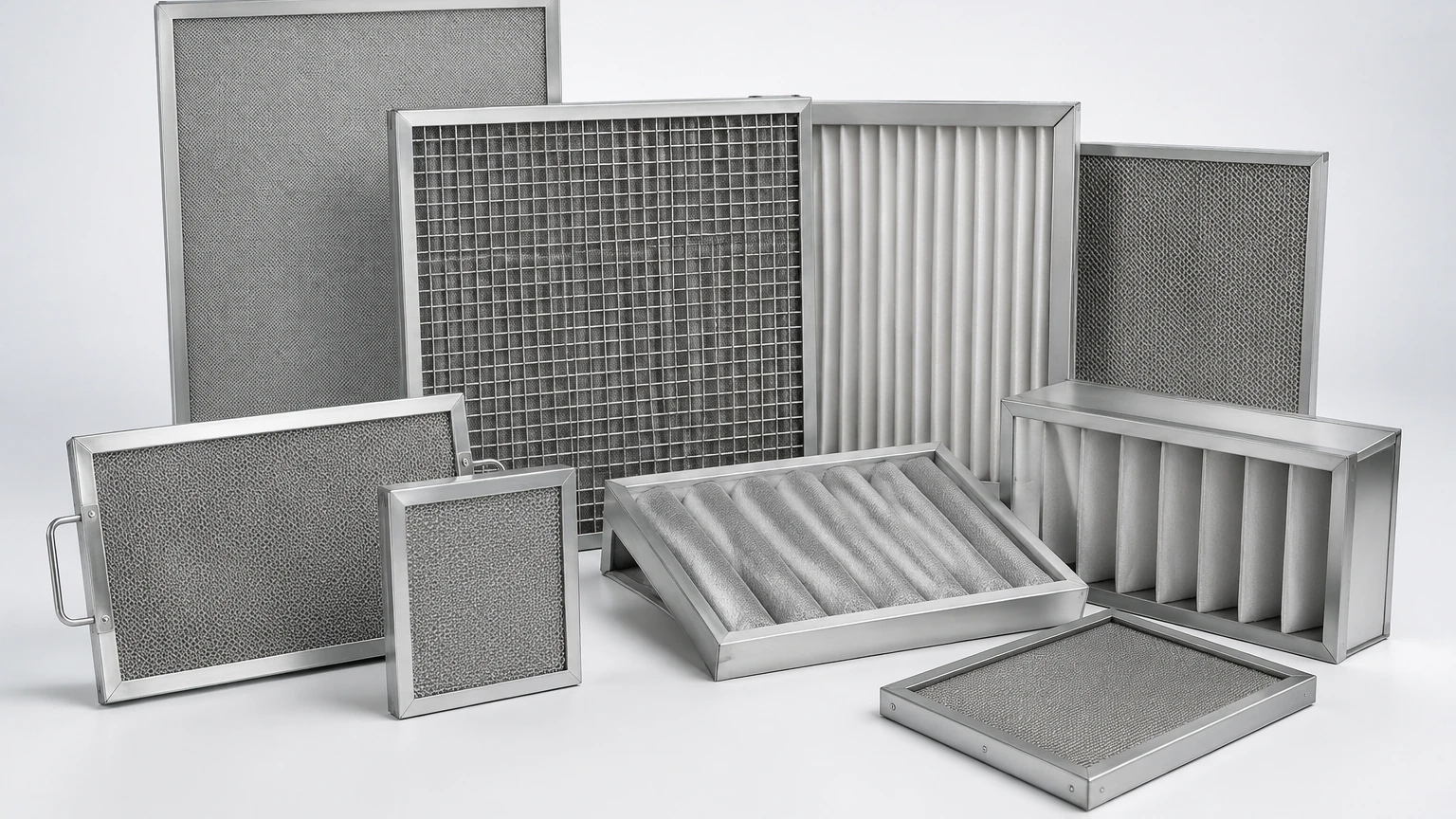
While fiberglass and synthetic pleats are common, many industrial AHUs utilize stainless steel wire mesh filters, especially in the pre-filtration stage. Manufacturers like Kaifil specialize in these durable metal solutions, which offer distinct advantages in demanding applications.
Durability in Harsh Environments
In industries such as chemical processing or food and beverage production, AHUs are often exposed to high humidity, grease, or corrosive vapors. Synthetic filters can degrade or become saturated, leading to mold growth or structural collapse. Stainless steel filters, constructed from 304 or 316L grade wire mesh, are inherently resistant to corrosion and high temperatures. They provide a rigid structure that does not deform under high pressure, ensuring consistent filtration performance over long periods.
Washability and Sustainability
One of the primary benefits of metal ahu filters is that they are cleanable and reusable. In facilities with high concentrations of large particulates or oil mist, disposable filters would require replacement at a frequency that is both costly and environmentally taxing. Stainless steel mesh filters can be washed with steam or chemical solvents and returned to service, significantly reducing waste and long-term procurement costs. For engineers looking for reliable components, reviewing the technical specifications on the Main Page of a professional manufacturer can provide insights into the micron ratings and material grades available for custom metal filtration.
Performance Evaluation: Efficiency vs. Lifecycle Costs
A common mistake in filter procurement is focusing solely on the unit price. A low-cost filter may have a lower dust holding capacity, leading to more frequent change-outs and higher labor costs. Furthermore, if the filter has high initial resistance, the energy penalty can be substantial.
To accurately evaluate filter performance, engineers use the following metrics:
1. Arrestance: The measure of a filter's ability to remove synthetic dust from the air. This is primarily used for coarse filters.
2. Dust Spot Efficiency: A measure of the filter's ability to remove atmospheric dust, which is much finer than synthetic test dust.
3. Fractional Efficiency: The most precise metric, showing the percentage of particles captured at specific sizes (e.g., 0.3 microns, 1.0 microns).
By analyzing these metrics against the projected lifespan of the filter, purchasing teams can determine the most cost-effective solution. In many cases, a high-capacity pleated filter or a permanent stainless steel pre-filter provides better value than standard flat-panel disposables.
Customization and OEM Solutions for Specialized Units
Standard AHU filter sizes (such as 24×24 inches) do not always fit the specialized equipment found in custom industrial processes. OEM (Original Equipment Manufacturer) requirements often dictate unique dimensions, non-standard frame depths, or specialized gaskets to ensure a gas-tight seal.
Customization options often include:
* Material Selection: Choosing between galvanized steel, aluminum, or stainless steel frames based on weight and corrosion requirements.
* Media Layers: Incorporating multiple layers of graduated density mesh to maximize dust holding capacity.
* Reinforcement: Adding cross-bracing or pleated wire backing to handle high-pressure surges in hydraulic or heavy-duty ventilation systems.
Working with a manufacturer that understands these engineering nuances allows for the development of filtration components that are perfectly matched to the AHU’s fan curve and the facility’s air quality requirements.
Maintenance and Replacement Cycles
Maintaining the integrity of an AHU system requires a disciplined approach to filter monitoring. The most effective method is the installation of differential pressure gauges (such as Magnehelic gauges) across the filter bank.
When to Replace or Clean
Filters should be replaced or cleaned when they reach their "Final Resistance," a value typically specified by the filter manufacturer or the AHU designer. Operating beyond this point risks:
* Media Breach: The pressure differential becomes so high that the filter media tears, allowing unfiltered air into the system.
* Gasket Failure: High pressure can force air around the edges of the filter frame.
* Fan Stall: The increased resistance may cause the AHU fan to operate outside its efficient range, leading to mechanical vibration and potential motor burnout.
In pharmaceutical or food-grade environments, replacement cycles may also be dictated by time (e.g., every six months) regardless of pressure drop, to prevent any risk of microbial growth within the filter media.
Conclusion: Selecting the Right Filtration Partner
Selecting ahu filters is a technical process that requires a deep understanding of airflow dynamics, material science, and the specific contaminants of an industrial environment. Whether the application calls for high-efficiency sub-micron filtration or robust stainless steel pre-filters for a chemical exhaust system, the goal remains the same: to protect the process, the equipment, and the personnel.
For technical professionals and purchasing teams, it is essential to partner with manufacturers who provide transparent data regarding filtration accuracy and material durability. By choosing the right components, facilities can achieve a balance between high air quality and operational efficiency. For more information on custom metal filtration solutions and engineering support, you may visit the Main Page to review product options and application support tailored to demanding industrial environments.
