


Air Filter Foam Material
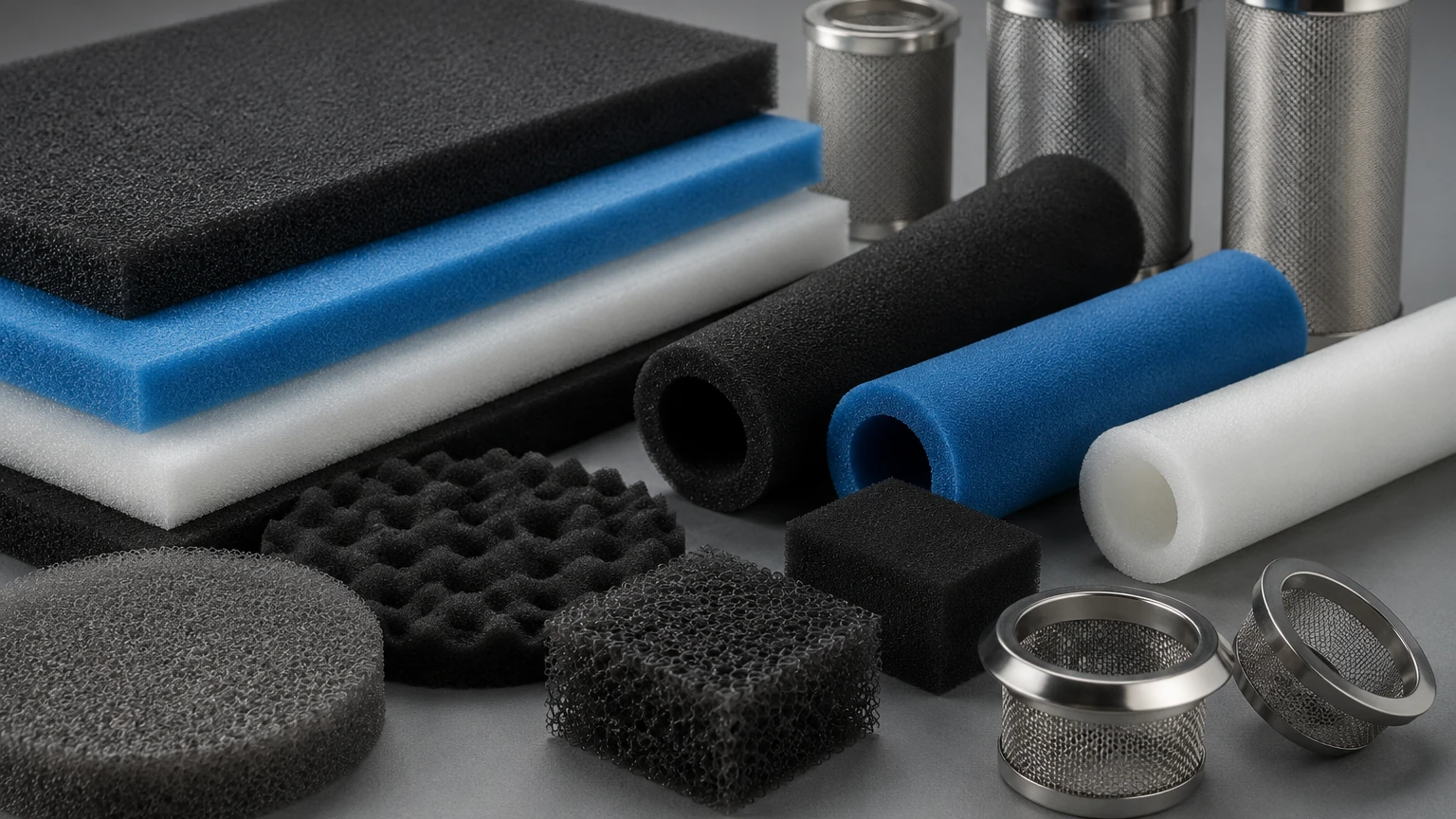
In industrial filtration, the selection of media is a critical engineering decision that dictates the efficiency, longevity, and operational cost of a system. Air filter foam material, specifically reticulated polyurethane foam, serves as a primary choice for a wide range of applications requiring low pressure drop and high dust-holding capacity. Unlike standard sponge materials, filtration-grade foam undergoes a specialized manufacturing process to create a three-dimensional skeletal structure that maximizes surface area while minimizing airflow resistance.
Understanding the technical nuances of air filter foam material—from its chemical composition to its pore structure—is essential for engineers and procurement teams tasked with optimizing air intake and exhaust systems. This guide examines the performance characteristics, material variations, and engineering trade-offs associated with foam filtration media.
Understanding the Structure of Air Filter Foam Material
The effectiveness of air filter foam material is rooted in its "reticulated" structure. Standard polyurethane foam consists of thousands of tiny cells, many of which are closed or partially blocked by thin membranes (cell windows). For filtration purposes, these membranes must be removed through a process called reticulation. This is typically achieved via a thermal shock (combustion) or chemical quenching process that "zaps" the membranes, leaving behind only the dodecahedral skeletal strands.
This open-cell architecture creates a complex, tortuous path for air to travel. As contaminated air passes through the foam, particles are forced to change direction multiple times. This increases the probability of particles colliding with and adhering to the polymer strands through impingement and interception. Because the "windows" are gone, the air encounters very little resistance, which is why reticulated foam is prized for its high permeability.
Technical Specifications: PPI and Porosity
The most critical metric when specifying air filter foam material is PPI, or Pores Per Inch. This measurement defines the coarseness or fineness of the foam and directly correlates to filtration efficiency and pressure drop.
* 10 to 20 PPI (Coarse): These foams have large, visible pores. They are primarily used as pre-filters to capture large debris, such as insects, leaves, and large dust particles. They offer the lowest pressure drop and are often found in heavy-duty machinery and outdoor air intakes.
* 30 to 45 PPI (Medium): This range is the industrial standard for general-purpose filtration. It balances efficiency with airflow, making it suitable for small engines, compressors, and electronic cabinet cooling.
* 60 to 100 PPI (Fine): Fine-pore foams are used in applications requiring higher filtration efficiency, such as medical devices or specialized laboratory equipment. While they capture smaller particles, they also clog faster and create a higher initial pressure drop.
Engineers must also consider the "void volume" or porosity, which in reticulated foam typically exceeds 95%. This high void volume allows the material to store a significant volume of contaminants within its depth before the airflow is significantly restricted.
Material Chemistry: Polyester vs. Polyether
Not all air filter foam material is chemically identical. The two primary types used in industrial settings are polyester-based and polyether-based polyurethanes. Choosing between them depends entirely on the operating environment.
Polyester Foam
Polyester-based foams generally exhibit higher mechanical strength, better tear resistance, and superior resistance to hydrocarbons. They are the preferred choice for applications involving exposure to oils, fuels, and many common industrial solvents. However, polyester foam is susceptible to hydrolysis—a process where the polymer chains break down when exposed to high humidity and elevated temperatures over long periods.
Polyether Foam
Polyether-based foams are highly resistant to moisture and microbial growth. They do not break down in humid environments, making them ideal for water-cooled systems, outdoor equipment in tropical climates, or any application where the filter may remain damp. While they lack the physical toughness and oil resistance of polyester, their environmental stability makes them indispensable for specific industrial sectors.
Performance Metrics: Pressure Drop and Dust Holding Capacity
When evaluating air filter foam material, engineers focus on the relationship between the face velocity of the air and the resulting pressure drop (measured in Pascals or inches of water gauge). A lower pressure drop reduces the load on fans and blowers, leading to significant energy savings over the life of the equipment.
Dust Holding Capacity (DHC) is another vital metric. Because foam is a depth-loading medium, it can capture particles throughout its entire thickness, rather than just on the surface. This allows for a longer service life compared to thin paper or fabric filters. However, as the internal skeletal structure becomes coated with dust, the effective pore size decreases, leading to an exponential rise in pressure drop. Monitoring this curve is essential for establishing maintenance and replacement intervals.
Industrial Applications and Environmental Constraints
Air filter foam material is utilized across diverse sectors due to its versatility and ease of customization. Common applications include:
* HVAC Systems: Used as washable pre-filters to protect more expensive HEPA or pocket filters from large particulate matter.
* Power Tools and Small Engines: Foam filters are standard in chainsaws, lawnmowers, and portable generators because they can be saturated with oil to enhance dust capture in extremely dirty environments.
* Electronics and Server Cooling: Fine PPI foams prevent dust accumulation on sensitive circuit boards while maintaining the high airflow required for thermal management.
* Compressors and Blowers: Foam silencer filters provide both filtration and noise reduction for industrial air intake systems.
Despite its versatility, foam has clear environmental limits. Most polyurethane foams have a maximum continuous operating temperature of approximately 90°C to 120°C (194°F to 248°F). Exposure to temperatures beyond this range causes the material to soften, lose its structure, or even melt. Furthermore, while some foams are treated with flame retardants to meet UL 94 standards, they remain organic polymers that can support combustion under extreme conditions.
Foam vs. Stainless Steel Mesh: A Comparative Analysis
While air filter foam material is cost-effective for many standard applications, it is often insufficient for demanding industrial environments involving high temperatures, high pressures, or aggressive chemical vapors. In these scenarios, engineers often look to the precision and durability of metal filtration components found on the Main Page.
| Feature | Reticulated Foam | Stainless Steel Wire Mesh |
| :— | :— | :— |
| Temperature Limit | ~100°C | Up to 800°C+ |
| Chemical Resistance | Limited (Polymer dependent) | Excellent (Corrosion-resistant) |
| Durability | Moderate (Degrades over time) | High (Permanent/Semi-permanent) |
| Cleanability | Washable (Limited cycles) | Ultrasonic/Backwash (Infinite cycles) |
| Filtration Type | Depth Filtration | Surface/Depth Hybrid |
For systems where the risk of media migration (small pieces of foam breaking off) is unacceptable, or where the filter must be sterilized (such as in food processing or pharmaceuticals), stainless steel components are the superior engineering choice. However, for low-cost, high-volume air intake applications, foam remains a dominant material due to its low initial investment.
Maintenance and Lifecycle Considerations
One of the primary B2B advantages of air filter foam material is its ability to be cleaned and reused. Most industrial foam filters can be washed with water and mild detergents or vacuumed to remove loose debris. This reduces the total cost of ownership compared to disposable paper filters.
However, maintenance teams must be aware of the degradation signs:
1. Loss of Elasticity: If the foam becomes brittle or fails to spring back after compression, the polymer structure is failing.
2. Pore Clogging: If pressure drop remains high after cleaning, fine particulates have become permanently lodged deep within the matrix.
3. Chemical Breakdown: Signs of "gumming" or crumbling indicate that the foam is incompatible with environmental chemicals or has undergone UV degradation.
In high-stakes industrial environments, it is often more cost-effective to implement a scheduled replacement program rather than relying on multiple cleaning cycles, as the filtration efficiency of foam can shift slightly after each wash.
Customization and OEM Integration
Manufacturers like Kaifil provide customized filtration solutions that often integrate various media types to meet specific performance targets. When specifying air filter foam material for a new product design, engineers should confirm the following with their supplier:
* Custom Die-Cutting: Foam can be cut into complex geometries to fit specific housing designs without the need for expensive tooling.
* Lamination: Foam can be bonded to other materials, such as wire mesh or non-woven fabrics, to create multi-stage filtration in a single component.
* Impregnation: Some foams can be impregnated with activated carbon for odor control or antimicrobial agents for medical applications.
By carefully selecting the PPI, base chemistry, and physical dimensions, B2B buyers can ensure their filtration systems operate at peak efficiency. For applications that exceed the physical capabilities of polymers, exploring the robust stainless steel options available on the Main Page ensures that even the most demanding industrial requirements are met with precision-engineered solutions.
