


Extruder Filter
In the realm of industrial polymer processing, food production, and chemical manufacturing, the extruder filter serves as a critical component for ensuring product purity and process stability. As a specialized manufacturer of stainless steel filtration solutions, Kaifil understands that the selection of an extruder filter is not merely a commodity purchase but a technical decision that impacts the efficiency of the entire production line. This guide examines the engineering principles, material considerations, and performance metrics essential for selecting the right filtration media for extrusion applications.
Understanding the Role of the Extruder Filter in Industrial Processing
An extruder filter, often referred to as a screen pack, is positioned between the extruder screw and the die. Its primary function is twofold: removing physical contaminants from the melt and creating backpressure to improve the homogenization of the material.
In polymer extrusion, raw resins or recycled plastics often contain impurities such as un-melted gels, metal fragments, or foreign particles. Without an effective extruder filter, these contaminants can damage expensive dies, clog downstream equipment, or result in structural weaknesses in the final product. Furthermore, the resistance provided by the filter media helps to "shear" the polymer, ensuring a more uniform temperature and viscosity profile as the material enters the die.
For engineers, the challenge lies in balancing filtration fineness with the resulting pressure drop. A filter that is too fine may lead to excessive pressure buildup, potentially triggering safety shutdowns or reducing throughput. Conversely, a filter that is too coarse will fail to protect product quality. Achieving the optimal balance requires a deep understanding of the material's rheology and the specific requirements of the application.
Key Types and Configurations of Extruder Screen Packs
Extruder filters are rarely used as single, standalone meshes. Instead, they are typically configured into screen packs to provide both filtration accuracy and structural integrity. Common configurations include:
Single Layer Screens
These are individual discs of wire mesh, usually made from stainless steel. While cost-effective, they are prone to deformation under high pressure if not supported correctly by a breaker plate. They are typically used in low-pressure applications or where frequent filter changes are expected.
Multilayer Spot-Welded Packs
To enhance durability and filtration efficiency, multiple layers of mesh are spot-welded together at the edges. A typical pack consists of a fine filtration layer sandwiched between coarser support meshes. The coarse layers protect the fine mesh from the mechanical force of the melt flow and prevent it from being pushed through the holes of the breaker plate.
Rimmed or Bound Filters
For high-pressure environments, extruder filters are often finished with a metal rim, typically made from aluminum, copper, or stainless steel. This rim provides a superior seal within the screen changer, preventing "bypass"—a condition where unfiltered material leaks around the edges of the filter pack.
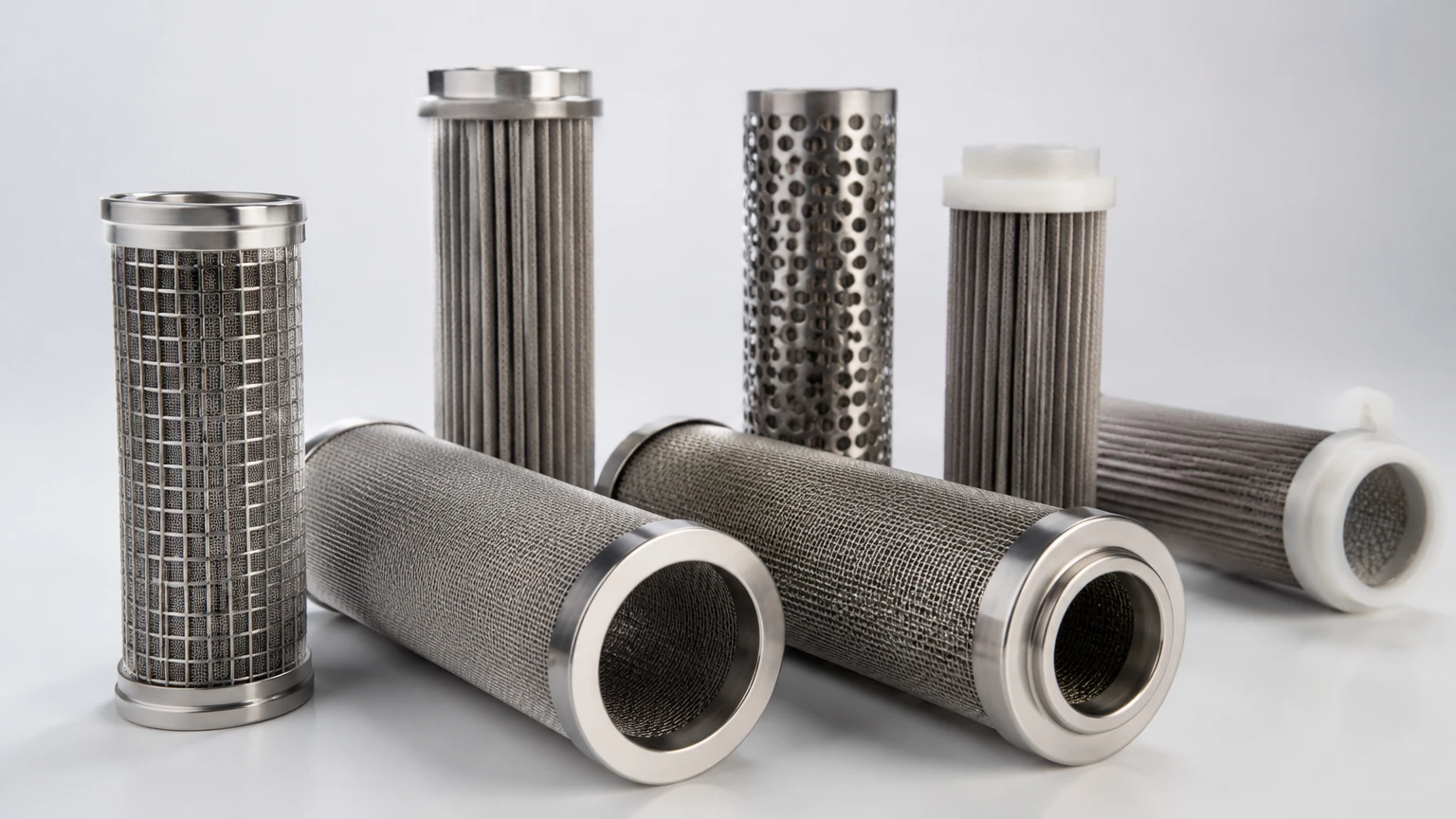
Cylindrical and Pleated Filters
In continuous screen changers or large-scale industrial systems, cylindrical or pleated extruder filters may be used. These designs significantly increase the available surface area, allowing for longer run times between filter changes and reducing the frequency of process interruptions.
Material Selection: Why Stainless Steel is the Standard
The choice of material for an extruder filter is governed by the operating temperature, the chemical nature of the processed material, and the required mechanical strength. Stainless steel is the industry standard due to its exceptional thermal stability and corrosion resistance.
* AISI 304 Stainless Steel: This is the most common material for general-purpose extrusion. It offers good corrosion resistance and can withstand the high temperatures typical of plastic processing.
* AISI 316/316L Stainless Steel: For applications involving corrosive polymers (such as PVC) or food and pharmaceutical processing, 316L is preferred. The addition of molybdenum enhances resistance to pitting and chemical attack, while the low carbon content (316L) improves weldability and prevents intergranular corrosion.
* Specialty Alloys: In extreme cases involving highly abrasive materials or ultra-high temperatures, alloys like Inconel or Monel may be utilized, though these are less common in standard extrusion workflows.
At Kaifil, we prioritize high-grade stainless steel to ensure that our filters maintain their structural integrity even under the intense heat and pressure of a 24/7 production environment. For more information on our material standards and manufacturing capabilities, you can visit our Main Page.
Engineering Considerations: Mesh Weave and Micron Ratings
The filtration performance of an extruder filter is determined by the weave pattern and the wire diameter. Engineers must specify the micron rating—the size of the smallest particle the filter is designed to intercept.
Plain Weave
This is the simplest weave, where each warp wire crosses over and under each weft wire. It provides a high open area and low pressure drop but is limited in its ability to provide very fine filtration (typically above 50 microns).
Dutch Weave (Plain and Twilled)
Dutch weaves use a heavier warp wire and a finer weft wire, resulting in a dense, compact mesh with high strength. Plain Dutch Weave (PDW) offers excellent flow rates, while Twilled Dutch Weave (TDW) allows for even finer filtration, often reaching down to the 5-10 micron range. TDW is particularly effective for high-viscosity melts where structural strength is paramount.
Reverse Dutch Weave (RDW)
In Reverse Dutch Weave, the positions of the warp and weft wires are swapped compared to standard Dutch weave. This results in a mesh that is exceptionally strong in the direction of the melt flow, making it ideal for high-pressure extrusion and automatic ribbon-style screen changers.
Evaluating Performance: Pressure Drop and Melt Consistency
One of the most critical metrics in extruder filter selection is the "clean pressure drop." This refers to the initial resistance the filter offers to the melt flow. As the filter accumulates contaminants, the pressure drop increases.
Engineers must monitor the differential pressure (ΔP) across the filter pack. A rapid increase in ΔP indicates that the filter is reaching its dirt-holding capacity. If the pressure becomes too high, it can lead to:
1. Melt Fracture: High pressure can cause instabilities in the polymer flow, leading to surface defects on the extruded product.
2. Increased Energy Consumption: The extruder motor must work harder to push material through a clogged filter.
3. Temperature Spikes: Excessive friction caused by a clogged filter can lead to localized overheating, potentially degrading heat-sensitive polymers.
By selecting a filter with an optimized open area and high-quality weave, manufacturers can extend the time between filter changes, thereby improving the Total Cost of Ownership (TCO).
Customization Options for Specialized Extrusion Applications
No two extrusion lines are identical. Factors such as screw diameter, breaker plate design, and material viscosity necessitate customized filtration solutions. Kaifil specializes in providing OEM and customized extruder filters tailored to specific technical requirements.
Customization options include:
* Bespoke Diameters: We manufacture screen packs in diameters ranging from a few millimeters to several hundred millimeters to fit any extruder size.
* Layer Sequencing: Engineers can specify the exact sequence of mesh counts in a multilayer pack to achieve specific filtration and support goals (e.g., a 20/60/100/60/20 mesh sequence).
* Shape Variations: While circular discs are standard, we also produce oval, rectangular, and kidney-shaped filters for specialized machinery.
* High-Strength Reinforcement: For ultra-high-pressure applications, we can integrate perforated metal plates or sintered mesh layers into the filter design.
Best Practices for Maintenance and Filter Replacement Cycles
To maintain optimal production quality, a rigorous maintenance and replacement schedule for extruder filters is essential. While automatic screen changers handle much of this process, manual systems require careful monitoring.
When to Replace the Filter
* Pressure Alarms: Most modern extruders are equipped with pressure transducers. Reaching a pre-set pressure limit is the most reliable indicator that a filter change is required.
* Visual Impurities: If the final product shows signs of "specks," gels, or discoloration, the filter may have been breached or reached its bypass limit.
* Flow Fluctuations: Surges in output or inconsistent product dimensions often point to a clogged or damaged screen pack.
Handling and Storage
Stainless steel filters should be stored in a clean, dry environment to prevent contamination before use. During installation, it is vital to ensure that the filter pack is seated flat against the breaker plate. Any wrinkles or gaps can lead to premature failure or leakage.
Conclusion: Optimizing Your Extrusion Process
The extruder filter is a small but vital component in the industrial manufacturing chain. By selecting high-quality stainless steel media and the appropriate weave configuration, engineers can significantly reduce downtime, protect downstream equipment, and ensure the highest levels of product purity.
As a dedicated partner in industrial filtration, Kaifil provides the technical expertise and manufacturing precision required to meet the demanding needs of modern extrusion. Whether you are processing virgin polymers, recycled materials, or complex chemical compounds, our range of custom stainless steel filters is designed to deliver reliable performance under pressure. For detailed technical specifications or to discuss a custom design for your specific application, please explore our full range of solutions on our Main Page.
