


Baghouse Collector
In the landscape of industrial air pollution control, the baghouse collector stands as one of the most efficient and versatile tools for particulate matter (PM) removal. Often referred to as a fabric filter, this system is designed to handle high volumes of dust-laden air, stripping away contaminants to ensure compliance with environmental regulations and to protect downstream equipment. For engineers and facility managers, understanding the nuances of baghouse design—from the cleaning mechanism to the selection of internal support structures—is critical for maintaining operational efficiency and minimizing the total cost of ownership.
As industrial processes become more demanding, particularly in the chemical, pharmaceutical, and food processing sectors, the reliance on standard filtration solutions is often insufficient. This guide explores the technical foundations of the baghouse collector, the critical engineering parameters for selection, and how specialized components, such as those provided by Kaifil, enhance system longevity and performance.
The Fundamental Working Principles of a Baghouse Collector
A baghouse collector operates on the principle of filtration through a porous media. Unlike centrifugal separators (cyclones) that rely on inertia, or electrostatic precipitators that use electrical charges, a baghouse uses physical barriers to intercept particles. The process typically follows a three-stage cycle: collection, cleaning, and discharge.
Particle Collection Mechanisms
During the collection phase, dust-laden gas enters the baghouse housing. As the gas passes through the filter media, particles are trapped through several physical mechanisms:
- Sieving: Particles larger than the pores of the media are physically blocked.
- Interception: Smaller particles following a gas streamline come within one particle radius of a fiber and adhere to it.
- Impaction: Heavy particles with high inertia fail to follow the gas streamlines around fibers and instead strike them directly.
- Diffusion: Extremely fine particles (typically sub-micron) move erratically due to Brownian motion, increasing their likelihood of contacting a fiber.
Over time, a layer of dust, known as a "dust cake," builds up on the surface of the filter. While this cake increases the filtration efficiency by acting as a secondary filter, it also increases the pressure drop across the system, necessitating a cleaning cycle.
Types of Baghouse Collectors by Cleaning Mechanism
The method used to remove the dust cake defines the primary categories of baghouse collectors. Each method has distinct implications for the mechanical stress placed on the filter media and the overall footprint of the system.
1. Pulse-Jet Baghouses
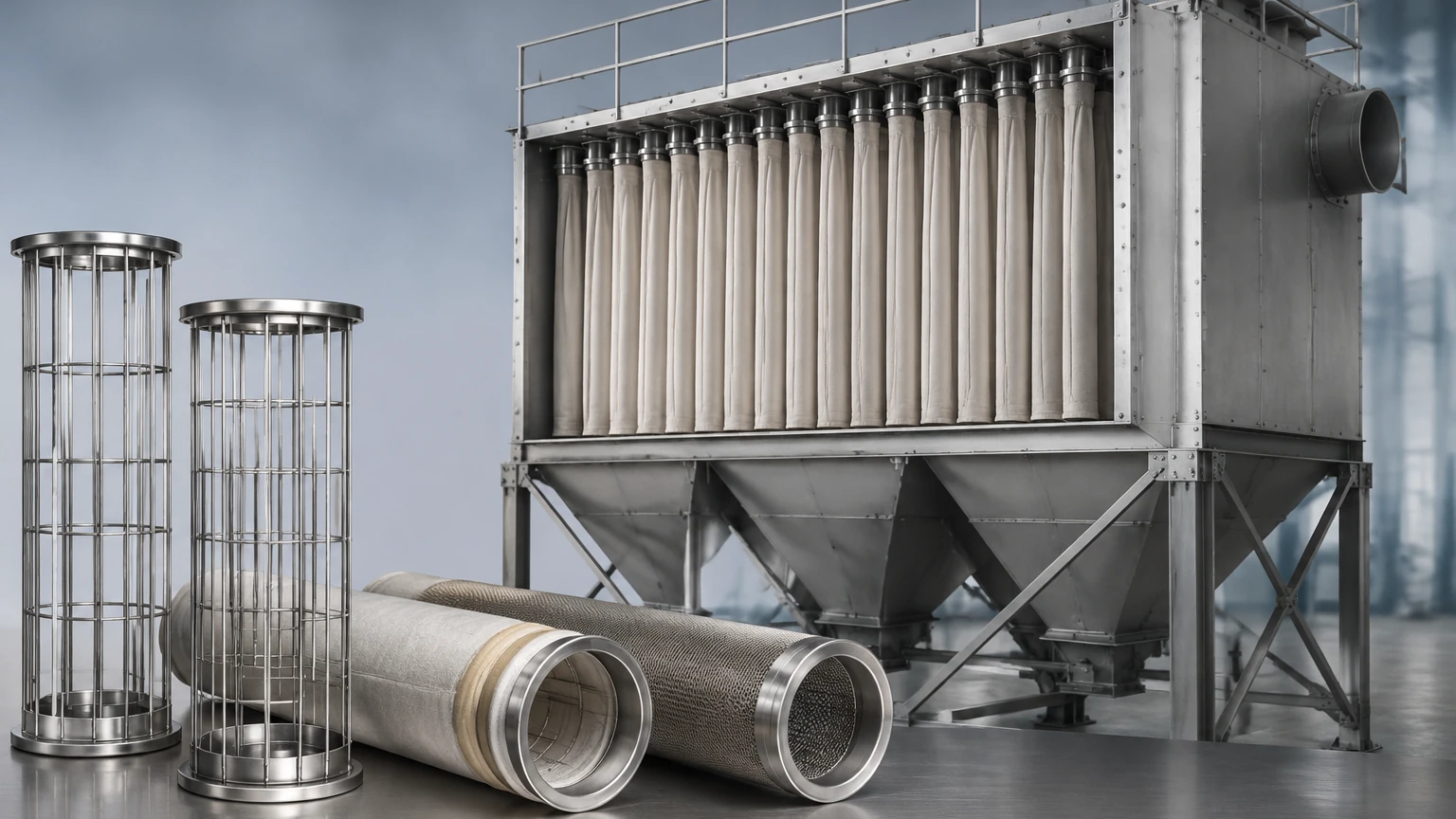
Pulse-jet systems are the most common in modern industrial applications. In this configuration, the filter bags are supported by internal metal cages. Dust is collected on the exterior of the bags. Periodically, a high-pressure pulse of compressed air is shot down into the top of the bag. This creates a shockwave that causes the bag to expand rapidly and then snap back against the cage, dislodging the dust cake.
Pulse-jet collectors are favored for their high air-to-cloth ratios and the ability to clean bags while the system remains online. However, the high-intensity pulses require durable filter media and precision-engineered internal cages to prevent premature wear.
2. Shaker Baghouses
In a shaker baghouse, the bags are suspended from a motorized shaking mechanism at the top and fixed at the bottom. Dust collects on the inside of the bags. To clean them, the compartment is taken offline (airflow is stopped), and the mechanism shakes the bags to vibrate the dust into a hopper. These systems are simpler in design but require more space due to the need for multiple compartments to allow for offline cleaning.
3. Reverse Air Baghouses
Reverse air systems collect dust on the inside of the bags, which are kept taut by a tensioning assembly. To clean, a secondary fan blows clean air in the reverse direction, causing the bags to collapse slightly and the dust cake to crack and fall. This is a gentler cleaning method compared to pulse-jet, making it suitable for fragile media like fiberglass, though it generally requires a lower air-to-cloth ratio.
The Role of Stainless Steel and Metal Components
While the "bag" in a baghouse collector is often a fabric or felt, the performance of the system is heavily dependent on the metal components that support and protect the media. In demanding environments—such as those involving high temperatures, corrosive gases, or strict hygiene requirements—standard carbon steel components fail rapidly.
Filter Cages and Supports
In pulse-jet systems, the filter cage is the backbone of the bag. If the cage is poorly manufactured or suffers from corrosion, it can develop sharp edges or structural weaknesses that tear the filter media. Utilizing stainless steel (304 or 316L) for these cages ensures chemical resistance and prevents rust from contaminating the process stream. This is particularly vital in pharmaceutical and food-grade applications where product purity is paramount.
Sintered Metal and Wire Mesh Integration
In extreme conditions where traditional fabrics would melt or chemically degrade, engineers often turn to all-metal filtration solutions. Stainless steel wire mesh and sintered metal filter cartridges can be integrated into baghouse-style housings. These components offer superior thermal stability (up to 600°C or higher) and can be cleaned and reused for years, significantly reducing the waste and replacement costs associated with disposable bags. For more information on these specialized metal components, engineers can visit the Main Page of the Kaifil website to review technical specifications.
Key Engineering Parameters for Selection
Selecting a baghouse collector requires a deep dive into the specific characteristics of the dust and the carrier gas. A mismatch in these parameters can lead to frequent clogging, high energy costs, or regulatory non-compliance.
Air-to-Cloth (A/C) Ratio
The A/C ratio, also known as the filtration velocity, represents the volume of gas passing through a square foot of filter media per minute (CFM/ft²).
- Low A/C Ratios (1.5:1 to 2.5:1): Typical for shaker and reverse air systems or for very fine, difficult-to-collect dust.
- High A/C Ratios (3:1 to 6:1 or higher): Typical for pulse-jet systems.
A ratio that is too high will drive particles deep into the media (blinding), while a ratio that is too low results in an oversized, unnecessarily expensive system.
Differential Pressure (ΔP)
Differential pressure is the difference in pressure between the dirty and clean sides of the filter. It is the primary indicator of the baghouse's health. A steady ΔP indicates a stable dust cake and effective cleaning. A sudden spike usually suggests moisture in the system (causing the dust to turn into mud) or a failure in the cleaning mechanism.
Particle Size Distribution and Inlet Loading
The concentration of dust (grains per cubic foot) and the size of the particles dictate the type of media required. If the inlet loading is extremely high, a pre-separator like a cyclone may be necessary to remove larger particles before they reach the baghouse collector to prevent abrasive wear on the bags.
Common Operational Risks and Mitigation
Even a well-designed baghouse collector faces risks that can lead to catastrophic failure if not managed through proper engineering and maintenance.
1. Moisture and Dew Point Issues
If the gas temperature drops below the dew point, moisture will condense inside the baghouse. This leads to "blinding," where the dust forms a hard crust that cannot be removed by the cleaning cycle. Insulating the baghouse and maintaining a gas temperature at least 30°F above the dew point is a standard industry practice.
2. Abrasion
High-velocity dust particles can act like sandpaper, wearing down both the filter media and the internal metal supports. Using high-quality stainless steel wire mesh filters or reinforced cages can mitigate this risk in abrasive environments like cement or mining.
3. Chemical Degradation
Acidic or alkaline gases can rapidly destroy certain fabric types. In these scenarios, the selection of the filter media and the metallurgy of the internal components (such as moving to 316L stainless steel) is essential to prevent premature system failure.
Customization and OEM Solutions in Filtration
No two industrial processes are identical, and off-the-shelf baghouse collectors often require modification to meet specific spatial or performance constraints. Customization is where manufacturers like Kaifil provide the most value. By offering OEM capabilities for stainless steel filter cartridges and precision metal components, they allow engineers to design systems that are tailored to the exact chemistry and temperature of their application.
Customization options often include:
- Specialized Alloy Selection: Using Hastelloy or Monel for extreme chemical resistance.
- Custom Dimensions: Designing filter cages or mesh supports to fit existing, non-standard housings.
- Precision Filtration Grades: Adjusting the weave of the wire mesh to achieve specific micron ratings while maintaining high flow rates.
Conclusion: Preparing for Procurement
When evaluating a baghouse collector for a new installation or an upgrade, technical professionals must confirm several key factors before proceeding. These include the exact chemical composition of the gas stream, the peak operating temperatures, and the specific particulate emission limits required by local authorities.
Furthermore, the total cost of ownership should be the guiding metric, rather than just the initial capital expenditure. A system that utilizes high-quality stainless steel components and optimized filter media may have a higher upfront cost but will save significant sums through reduced downtime, lower energy consumption (due to lower ΔP), and extended component life.
For engineers seeking reliable, high-performance filtration components that meet these rigorous standards, exploring the customized solutions available through professional manufacturers is the most effective path forward. By focusing on durability and precision, industrial facilities can ensure their baghouse collector remains a reliable asset for years to come.
