


Basket Strainers Filters
In industrial fluid handling systems, the protection of sensitive downstream equipment—such as pumps, valves, heat exchangers, and spray nozzles—is a critical engineering priority. Basket strainers filters serve as the primary line of defense against particulate contamination, scale, and debris. Unlike simpler Y-strainers, basket-style configurations are designed for high-capacity filtration and ease of maintenance, making them indispensable in chemical processing, water treatment, and food production.
Selecting the appropriate basket strainers filters requires a deep understanding of fluid dynamics, material compatibility, and the specific mechanical requirements of the application. This guide examines the technical specifications, engineering considerations, and selection criteria necessary for optimizing industrial filtration performance.
Engineering Fundamentals of Basket Strainers
A basket strainer is a closed vessel with a removable screen or "basket" that intercepts solids from a flowing liquid. The fundamental advantage of this design is the large surface area provided by the basket geometry. This increased area allows for a higher dirt-holding capacity and a lower pressure drop compared to other strainer types of the same pipe size.
Flow Dynamics and Pressure Drop
One of the most critical factors in the design of basket strainers filters is the differential pressure (ΔP). As fluid passes through the mesh or perforated media, the restriction causes a drop in pressure. This is influenced by:
1. Fluid Viscosity: Thicker fluids require larger mesh openings or larger housing sizes to maintain acceptable flow rates.
2. Velocity: Higher flow velocities increase the risk of turbulence and higher pressure drops.
3. Open Area Ratio (OAR): This is the ratio of the total open area of the basket holes to the internal cross-sectional area of the inlet pipe. A high-quality industrial strainer typically aims for an OAR of at least 6:1 to ensure long service intervals and minimal energy loss.
Engineers must calculate the clean pressure drop and the maximum allowable pressure drop before cleaning is required. Exceeding the recommended ΔP can lead to basket deformation or even structural failure, allowing contaminants to bypass the filter.
Material Selection and Corrosion Resistance
The longevity of basket strainers filters is largely determined by the materials used in the housing and the internal filtration element. In demanding industrial environments, stainless steel is the standard due to its mechanical strength and chemical resistance.
Stainless Steel Grades
* Type 304: Suitable for general-purpose applications, water treatment, and mildly corrosive environments. It offers excellent cost-effectiveness for standard industrial use.
* Type 316/316L: Contains molybdenum, which provides superior resistance to chlorides and pitting. This is essential for marine applications, chemical processing, and pharmaceutical environments where rigorous cleaning agents are used.
* Specialty Alloys: For highly aggressive fluids or high-temperature applications, alloys such as Hastelloy or Monel may be utilized, though stainless steel remains the most versatile choice for the majority of OEM filtration solutions.
Beyond the metal itself, seal and gasket materials (such as EPDM, Viton, or PTFE) must be selected based on their compatibility with the process fluid and the operating temperature range.
Filtration Media: Mesh vs. Perforated Plate
The internal basket of basket strainers filters can be constructed using different types of media depending on the required micron rating and the nature of the contaminants.
Perforated Metal
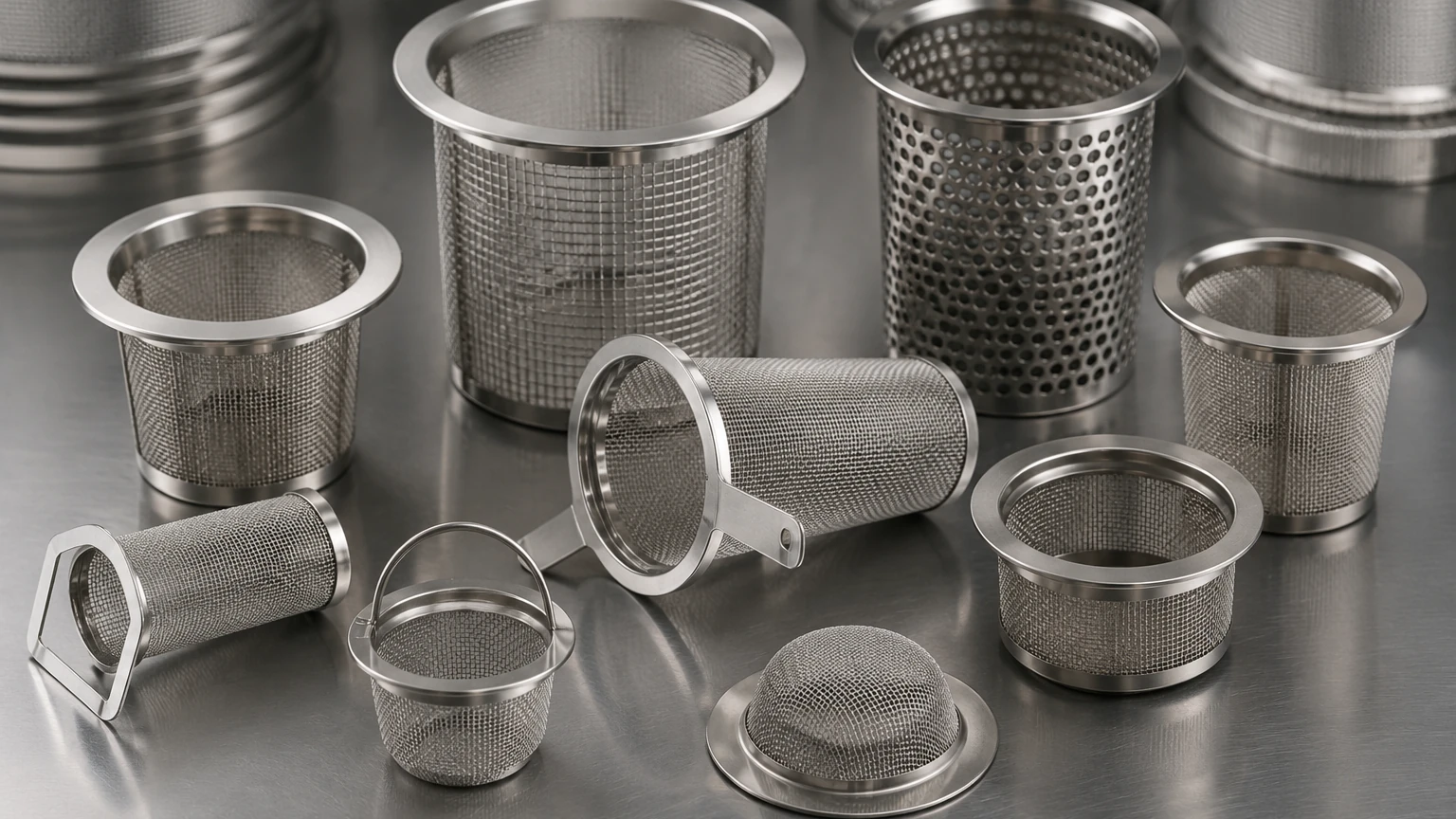
Perforated plates serve as the primary structural component of the basket. They are typically used for coarse filtration, removing large debris like stones, metal chips, or pipe scale. The hole size and pattern (staggered or straight) determine the filtration accuracy and the structural integrity of the basket.
Wire Mesh Liners
For finer filtration requirements, a stainless steel wire mesh liner is added to the perforated basket. Wire mesh allows for precise control over the micron rating, ranging from coarse 20 mesh (approx. 840 microns) to ultra-fine 400 mesh (approx. 37 microns).
* Plain Weave: The most common and economical mesh, providing a straight-through flow path.
* Dutch Weave: Offers higher strength and finer filtration by using a denser packing of wires, ideal for high-pressure applications.
* Sintered Mesh: For extreme environments, multiple layers of mesh are sintered together to create a rigid, high-strength filter element that can withstand high differential pressures without migrating fibers or deforming.
Design Variations: Simplex vs. Duplex Systems
The operational requirements of a facility dictate whether a simplex or duplex configuration is necessary.
Simplex Basket Strainers
Simplex strainers are used in batch processes or systems where the flow can be temporarily halted for basket cleaning. They are compact and cost-effective but require the system to be shut down or bypassed during maintenance. These are common in cooling water loops or chemical transfer lines where intermittent operation is standard.
Duplex Basket Strainers
In continuous-flow applications—such as power generation lubrication systems or 24/7 chemical manufacturing—shutting down for maintenance is not an option. Duplex basket strainers filters feature two separate strainer chambers connected by a diverter valve. When one basket becomes clogged, the flow is switched to the clean chamber, allowing the operator to service the dirty basket without interrupting the process. This ensures constant protection and system uptime.
Customization and OEM Considerations
Off-the-shelf filtration solutions often fail to meet the specific spatial or performance constraints of specialized industrial machinery. Customization is a core component of high-performance filtration engineering. When sourcing basket strainers filters for OEM applications, several factors can be tailored:
* Connection Types: Beyond standard NPT or flanged connections, custom units can feature sanitary tri-clamp fittings for the food and beverage industry or specialized high-pressure couplings.
* Housing Geometry: In tight equipment skids, custom housing heights or offset inlet/outlet ports may be required to fit the available footprint.
* Reinforced Baskets: For high-viscosity fluids or systems prone to pressure spikes, baskets can be reinforced with internal ribs or heavier-gauge perforated metal to prevent collapse.
* Magnetic Inserts: In metalworking or hydraulic applications, magnetic rods can be added to the basket to capture fine ferrous particles that might otherwise pass through the mesh.
For more information on customized stainless steel filtration components, you can visit the Main Page to review product options and application support.
Maintenance and Total Cost of Ownership
While the initial purchase price of basket strainers filters is an important factor, the total cost of ownership (TCO) is heavily influenced by maintenance requirements and the durability of the filter elements.
Cleaning Cycles and Indicators
Manual inspection of baskets is labor-intensive. To optimize maintenance, many industrial strainers are equipped with differential pressure gauges or electronic sensors. These devices alert operators when the ΔP reaches a predetermined set point, indicating that the basket is full. Cleaning typically involves removing the basket, rinsing it with a high-pressure hose or ultrasonic cleaner, and inspecting the mesh for signs of wear or fatigue.
Replacement Cycles
Unlike disposable cartridge filters, stainless steel baskets are designed to be cleaned and reused. However, they are not permanent. Over time, the repeated stress of pressure cycles and cleaning can lead to "work hardening" of the wire mesh, eventually causing brittle fractures. Engineers should establish a replacement schedule based on the severity of the application to prevent catastrophic failure of the filter media.
Reducing Operational Costs
To minimize long-term costs, it is essential to:
1. Size the strainer correctly: An undersized strainer will clog faster, increasing labor costs for cleaning.
2. Select the right micron rating: Filtering finer than necessary increases pressure drop and cleaning frequency. The goal should be to remove only the particles that are harmful to downstream equipment.
3. Invest in quality materials: Using 316L stainless steel in a corrosive environment may have a higher upfront cost but prevents premature housing failure and system contamination.
Industry-Specific Applications
The versatility of basket strainers filters allows them to be adapted for a wide range of specialized industries:
* Chemical Processing: Protecting flow meters and pumps from undissolved solids and chemical precipitates. Corrosion resistance is paramount here.
* Food and Beverage: Used in the filtration of juices, oils, and syrups. These strainers must feature sanitary finishes (polished surfaces) and meet FDA/3A standards to prevent bacterial growth.
* Pharmaceuticals: High-precision filtration for process water and active ingredients, often requiring 316L stainless steel and full traceability of materials.
* Water Treatment: Removing sand, grit, and organic matter from intake water to protect membranes and desalination equipment.
* Hydraulics and Lubrication: Ensuring that lubricating oils remain free of metallic wear particles, which is vital for the longevity of high-speed turbines and engines.
Conclusion
Basket strainers filters are a fundamental component in the reliability of industrial fluid systems. By selecting the right combination of housing design, material grade, and mesh precision, engineers can significantly reduce equipment downtime and maintenance costs. Whether the application requires a simple simplex strainer for a cooling line or a custom-engineered duplex system for a continuous chemical process, understanding the technical nuances of filtration ensures optimal performance. For technical professionals seeking reliable, high-performance filtration components, focusing on material integrity and precision manufacturing is the key to achieving long-term operational success.
