


Black Ink Filter
In the landscape of industrial printing, coding, and marking, the black ink filter serves as a critical safeguard for system integrity and output quality. Black inks, particularly those formulated with carbon black pigments or specialized solvent-based dyes, present unique rheological and physical challenges. For engineers and maintenance professionals, selecting the correct filtration component is not merely a matter of preventing clogs; it is about managing particle size distribution, ensuring chemical compatibility, and optimizing the total cost of ownership in high-speed production environments.
As a manufacturer specializing in custom stainless steel filtration solutions, Kaifil understands that the performance of a black ink filter is dictated by the precision of its media and the robustness of its construction. This guide examines the technical requirements, engineering considerations, and selection criteria for industrial ink filtration systems.
The Role of Filtration in Industrial Ink Systems
Industrial inkjet systems, whether continuous inkjet (CIJ), drop-on-demand (DOD), or high-resolution thermal inkjet (TIJ), rely on microscopic nozzles to deliver precise volumes of fluid. Even minute contaminants or pigment agglomerates can lead to nozzle deflection, irregular drop formation, or complete blockage.
A black ink filter is typically integrated at multiple stages of the fluid path:
1. Bulk Filtration: Removing large contaminants during the ink manufacturing or refilling process.
2. Main System Filtration: Protecting the pump and internal valves from debris.
3. Last-Chance Filtration: Situated immediately before the print head to capture any particles generated within the system itself, such as pump wear debris or dried ink flakes.
For black inks specifically, the filter must balance the removal of harmful oversized particles with the passage of necessary pigment solids. If the filtration is too aggressive, it may strip the ink of its color density; if it is too coarse, the print head's lifespan is drastically reduced.
Technical Challenges of Black Ink Filtration
Black ink is often more demanding than other colors due to the nature of its primary pigment: carbon black. Carbon black particles have a high surface area and a tendency to agglomerate (stick together) over time or under specific pressure conditions.
Pigment Agglomeration and Shearing
In solvent-based black inks, the stability of the suspension is maintained by chemical dispersants. However, as ink passes through high-pressure pumps and narrow filter pores, mechanical shear forces can occur. If a filter is poorly designed, it can actually encourage the formation of agglomerates or cause the dispersants to fail, leading to "sludging" within the filter media. Precision-engineered wire mesh filters provide a consistent pore structure that minimizes localized high-pressure zones, reducing the risk of shearing.
Abrasiveness
Carbon black is inherently abrasive. In high-speed systems where ink is constantly recirculated, this abrasiveness can wear down soft filter media like polymers or low-grade fibers. This wear introduces "media migration," where fragments of the filter itself become contaminants. Stainless steel 316L, a staple in Kaifil's manufacturing process, offers the hardness and wear resistance necessary to withstand the abrasive flow of pigmented black inks without degrading.
Chemical Compatibility
Black inks often utilize aggressive solvents such as Methyl Ethyl Ketone (MEK), ethanol, or specialized esters to ensure fast drying times on non-porous substrates. These solvents can swell, soften, or dissolve plastic filter housings and synthetic membranes. A professional-grade black ink filter must utilize chemically inert materials. Stainless steel and specialized gaskets (such as PTFE or Viton) are the industry standard for ensuring that the filter does not react with the ink chemistry.
Material Selection: Why Stainless Steel?
While disposable plastic filters are common in low-volume applications, industrial environments increasingly favor stainless steel components for their durability and precision.
Sintered Wire Mesh
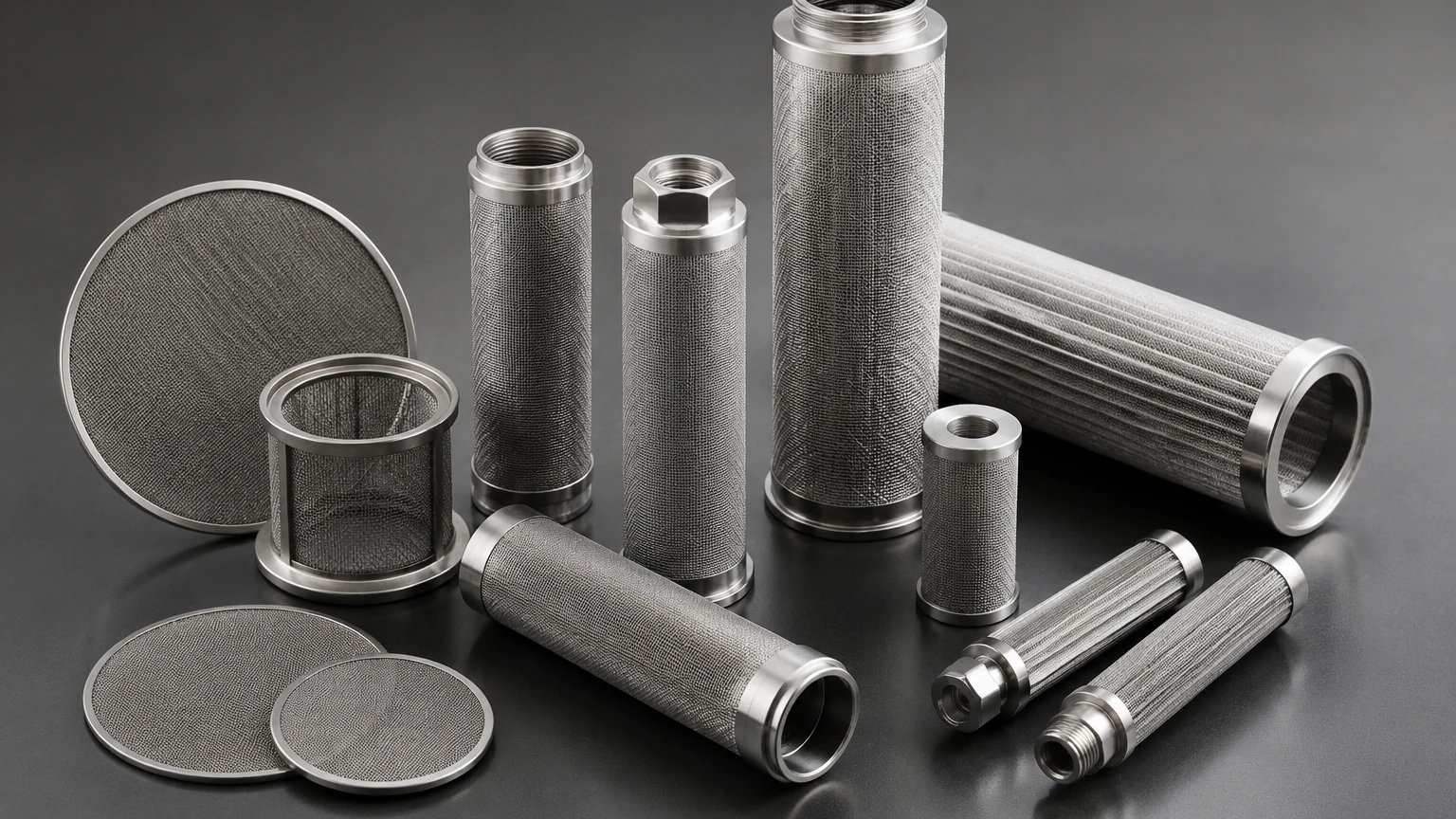
Sintered wire mesh is a preferred medium for black ink filters. This process involves layering multiple sheets of stainless steel wire cloth and bonding them through heat and pressure without the use of binders. The result is a robust, fixed-pore structure. Unlike felt or paper media, sintered mesh does not compress under pressure, ensuring that the filtration rating remains constant throughout the filter's service life.
Corrosion Resistance
Industrial inks can be acidic or alkaline depending on the application (e.g., food-grade marking vs. automotive parts coding). Using 316L stainless steel ensures that the filter remains resistant to corrosion, preventing the introduction of metallic oxides into the ink stream, which could otherwise alter the ink's electrical conductivity—a critical factor in CIJ printing.
Evaluating Filtration Performance Metrics
When specifying a black ink filter, engineers must look beyond the nominal micron rating. Several key metrics determine how a filter will perform in a real-world production line.
Absolute vs. Nominal Ratings
A "nominal" rating indicates that the filter will trap a certain percentage of particles at that size. For critical print head protection, an "absolute" rating is required. An absolute-rated filter ensures that 99.9% of particles above the specified micron size are captured. In high-resolution printing, where nozzles may be as small as 40-60 microns, a 5-micron or 10-micron absolute filter is often the standard for the last-chance stage.
Dirt Holding Capacity
Black inks, particularly high-pigment formulations, can load a filter quickly. A filter with a high surface area—achieved through pleating or multi-layered mesh—will have a higher dirt-holding capacity. This extends the interval between maintenance cycles, reducing downtime on the production floor.
Pressure Drop (ΔP)
The pressure drop across a filter is the difference in pressure between the inlet and the outlet. A high initial pressure drop indicates that the filter is too restrictive for the pump's capacity or the ink's viscosity. As the filter captures contaminants, the pressure drop increases. Monitoring this metric is essential for predictive maintenance; a sudden spike in ΔP often indicates pigment fallout or a significant contamination event.
Customization and OEM Integration
No two industrial printing systems are identical. Factors such as flow rate, operating pressure, and physical space constraints necessitate customized filtration solutions.
At Kaifil, we work closely with equipment manufacturers to develop OEM filtration components that fit specific housing designs. Customization options include:
* End Cap Configurations: Threaded, NPT, or flange connections to ensure leak-proof integration.
* Layered Media: Combining a coarse outer layer for pre-filtration with a fine inner layer for precision capture.
* Reinforced Cores: For high-pressure hydraulic ink systems where the filter must withstand significant differential pressure without collapsing.
By tailoring the filter to the specific viscosity and flow characteristics of the black ink being used, manufacturers can optimize the balance between filtration efficiency and pump load.
Maintenance and Total Cost Considerations
The true cost of a black ink filter is not its purchase price, but its impact on the entire printing system. A cheap, low-quality filter can lead to:
* Frequent Print Head Replacements: Print heads are often the most expensive component of an inkjet system. Protecting them with a high-quality filter is a high-ROI strategy.
* Production Downtime: Every minute a line is stopped to clear a clogged nozzle or replace a prematurely failed filter represents lost revenue.
* Ink Waste: Clogged filters often require system flushes, leading to the disposal of expensive ink.
Cleanability vs. Disposal
One of the primary advantages of stainless steel filters is their cleanability. Unlike synthetic filters that must be discarded, stainless steel mesh can often be cleaned using ultrasonic baths or back-flushing with compatible solvents. This sustainability factor is increasingly important for companies looking to reduce their environmental footprint and long-term consumable costs.
Conclusion: Selecting the Right Partner
Choosing a black ink filter requires a deep understanding of both fluid dynamics and material science. Whether you are designing a new coding system or seeking to improve the reliability of an existing production line, the filtration component is the first line of defense against operational failure.
Kaifil provides the engineering expertise and manufacturing precision required to produce high-performance metal filters for the most demanding industrial applications. By focusing on durable materials like 304 and 316L stainless steel and offering extensive customization capabilities, we help our clients achieve consistent, high-quality results in their filtration processes.
For more information on our full range of stainless steel filter cartridges, wire mesh solutions, and custom metal components, please visit our Main Page to review product options and application support. Our team is ready to assist with technical evaluations and OEM designs tailored to your specific industrial filtration needs.
