


Bubbling Bed
In the field of chemical engineering and industrial processing, the bubbling bed—specifically the bubbling fluidized bed (BFB)—represents a critical state of gas-solid interaction. This technology is widely utilized in reactors, dryers, and combustors where efficient heat and mass transfer are paramount. For engineers and technical procurement teams, understanding the mechanics of a bubbling bed is only the first step; the successful implementation of this technology relies heavily on the precision of the internal components, particularly the gas distribution plates and the filtration systems used for particulate recovery.
As a manufacturer specializing in custom stainless steel filtration solutions, Kaifil provides the high-performance metal components necessary to maintain the stability and efficiency of bubbling bed systems. This article explores the technical engineering considerations behind bubbling bed operations and the selection of filtration media required to withstand these demanding industrial environments.
Principles of Fluidization in Bubbling Bed Reactors
A bubbling bed is formed when a gas is passed upward through a bed of granular solid particles at a velocity that exceeds the minimum fluidization velocity ($U_{mf}$). At this stage, the drag forces exerted by the gas counteract the weight of the particles, causing the bed to behave like a fluid. As the gas velocity increases further beyond $U_{mf}$, excess gas passes through the bed in the form of bubbles, hence the term "bubbling bed."
The behavior of these bubbles is central to the process's efficiency. Large, coalescing bubbles can lead to "slugging," where the bed fluctuates violently, or "channeling," where gas bypasses the solids entirely. To prevent these issues, engineers must ensure uniform gas distribution at the base of the bed. This is where precision-engineered porous media, such as sintered wire mesh or multi-layer metal laminates, become essential. These materials provide the necessary resistance to ensure that gas is distributed evenly across the entire cross-section of the reactor, promoting a stable bubbling regime and maximizing the contact area between the gas and solid phases.
The Critical Role of Gas Distribution Media
The distributor plate, often located at the bottom of a bubbling bed vessel, is perhaps the most critical mechanical component in the system. Its primary function is to support the weight of the solid bed while ensuring the fluidizing medium (gas) enters the bed with a uniform velocity profile.
Requirements for Distributor Plates:
1. Uniform Porosity: Any variation in the permeability of the distributor plate can lead to preferential flow paths, causing localized defluidization or "dead zones."
2. Mechanical Strength: The plate must withstand the static load of the bed material, as well as the dynamic pressures and thermal stresses during operation.
3. Prevention of Weeping: The pore size must be small enough to prevent the solid particles from falling through the distributor into the windbox (plenum) during shutdown or pressure fluctuations.
Kaifil’s custom stainless steel wire mesh filters and sintered plates are frequently selected for these applications because they offer a controlled pore structure that is far superior to traditional perforated plates or nozzle-based distributors. By using sintered multi-layer mesh, engineers can achieve a high pressure drop across the distributor—a necessary condition for stable fluidization—while maintaining high flow rates.
Filtration Challenges in High-Temperature Fluidized Environments
Bubbling bed systems are often employed in exothermic or high-temperature processes, such as catalytic cracking, biomass gasification, or specialized chemical synthesis. These environments present significant challenges for filtration components, which must capture fine particles (fines) entrained in the exit gas stream to protect downstream equipment or to recycle catalysts back into the bed.
Standard polymer-based filters are unsuitable for these temperatures, which often exceed 400°C. Stainless steel filtration components, particularly those made from 316L or high-temperature alloys like Inconel, are the industry standard. These filters must contend with:
* Thermal Fatigue: Constant temperature cycling can cause expansion and contraction, leading to mechanical failure in poorly designed filter housings or elements.
* Abrasive Wear: The high velocity of particles in a bubbling bed can lead to erosion of the filter media, especially if the gas contains hard or angular solids.
* Chemical Corrosion: In chemical processing, the gas phase may contain corrosive elements that require specific metallurgical selections to prevent premature degradation.
Material Selection and Engineering Specifications for Filter Components
When selecting filtration components for a bubbling bed application, engineers must balance several competing factors. The choice of material and structure directly impacts the total cost of ownership and the frequency of maintenance cycles.
Sintered Metal Fiber vs. Wire Mesh
For fine particulate removal in the gas phase, sintered metal fiber felt offers high porosity (up to 80%) and excellent dirt-holding capacity. This results in a lower initial pressure drop and longer intervals between cleaning cycles. Conversely, woven wire mesh is often preferred for the distributor plates themselves due to its superior mechanical rigidity and precise, predictable pore geometry.
Alloy Selection
While 304 and 316L stainless steel are the most common choices due to their balance of cost and corrosion resistance, more demanding bubbling bed applications may require:
* 310S Stainless Steel: For high-temperature oxidation resistance.
* Hastelloy or Monel: For environments involving high concentrations of chlorides or acids.
* 904L: For enhanced resistance to stress corrosion cracking.
For a comprehensive overview of available materials and custom design capabilities, technical teams can refer to the Main Page of the Kaifil website, which details the specifications for various industrial filtration products.
Evaluating Performance: Pressure Drop and Filtration Efficiency
In a bubbling bed system, the pressure drop ($ΔP$) across the filter elements is a key performance indicator. A high $ΔP$ increases the energy requirements of the blower or compressor, while a $ΔP$ that is too low may indicate a breach in the filter media or inadequate gas distribution.
Engineers must specify the required filtration accuracy, often measured in microns. In catalyst recovery, for example, a 5-micron or 10-micron absolute rating may be necessary to ensure that expensive catalyst fines are not lost. Kaifil’s manufacturing process allows for precise control over the filtration rating, ensuring that the filter elements meet the exact performance expectations of the process design.
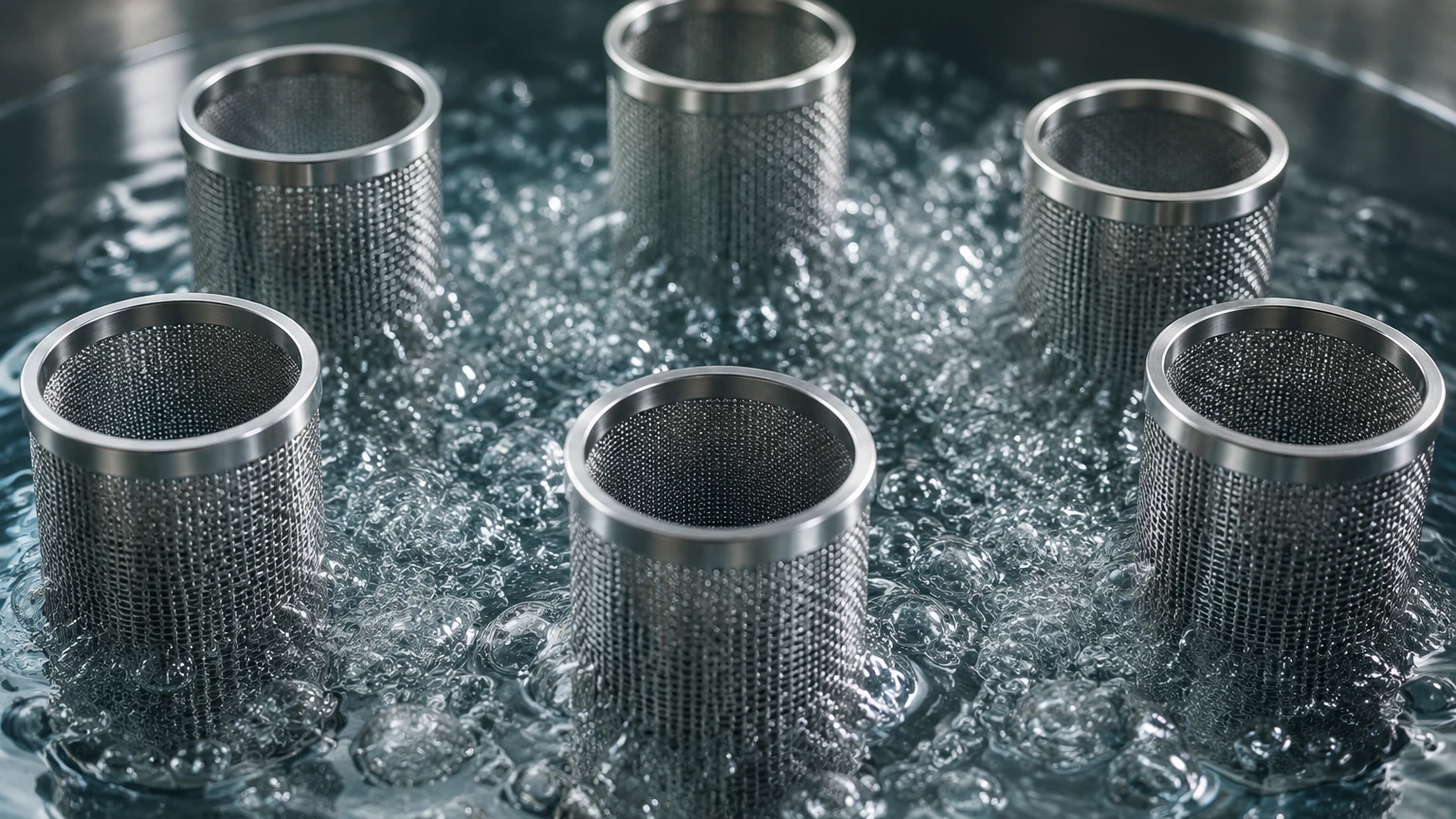
Furthermore, the "bubble point" test—a standard method for verifying the integrity and pore size of a filter—is essential for quality assurance. By measuring the pressure at which the first bubble appears when the filter is submerged in a test fluid, manufacturers can confirm that there are no oversized pores or manufacturing defects that could compromise the bubbling bed's operation.
Maintenance and Longevity of Stainless Steel Filter Elements
One of the primary advantages of using stainless steel filtration in a bubbling bed is the ability to clean and reuse the elements. Unlike disposable filters, metal cartridges can be cleaned using several methods:
1. Backpulsing: In many fluidized systems, a high-pressure pulse of gas is periodically sent through the filters in the reverse direction to dislodge the accumulated dust cake.
2. Ultrasonic Cleaning: For deep-seated particulates, removing the elements and placing them in an ultrasonic bath with specialized cleaning agents can restore the original pressure drop.
3. Chemical Cleaning: Solvents or acids can be used to dissolve specific contaminants without damaging the stainless steel structure, provided the alloy is compatible.
Understanding the replacement cycle is vital for operational planning. While the initial investment in stainless steel filters is higher than alternatives, their durability and cleanability significantly reduce the total cost of ownership over the life of the plant.
Custom OEM Solutions for Bubbling Bed Applications
Every industrial process has unique requirements regarding flow rates, vessel geometry, and environmental conditions. Off-the-shelf filtration products rarely provide the optimal performance needed for specialized bubbling bed reactors. This is where OEM (Original Equipment Manufacturer) capabilities become invaluable.
Kaifil works closely with engineering firms to develop customized filtration components, from the initial material selection to the final production of complex filter assemblies. Whether the application requires a pleated cartridge to maximize surface area in a compact space or a large-scale sintered distributor plate for a biomass gasifier, custom engineering ensures that the component integrates seamlessly with the existing system architecture.
When designing these components, factors such as the connection type (e.g., NPT, flange, or quick-connect), the reinforcement of the filter core, and the inclusion of bypass valves or sensors are all considered to ensure reliable operation in demanding industrial environments.
Conclusion
The efficiency of a bubbling bed system is inextricably linked to the quality of its internal filtration and distribution components. By selecting the correct stainless steel media and engineering the elements to withstand the specific thermal and mechanical stresses of the process, industrial operators can achieve stable fluidization, high particulate recovery rates, and extended equipment lifespans.
For engineers and purchasing managers seeking reliable, high-performance filtration solutions, Kaifil offers the technical expertise and manufacturing precision required to meet these challenges. From initial selection advice to the delivery of custom-designed components, the focus remains on providing durable and cost-effective filtration performance for the world's most demanding industries. To explore the full range of custom stainless steel filter cartridges and wire mesh solutions, please visit our Main Page.
