


Can an Erlenmeyer Flask Be Used for Vacuum Filtration
In laboratory and pilot-plant environments, vacuum filtration is a fundamental process used to separate solids from liquids with greater speed and efficiency than gravity-based methods. However, the equipment used must be specifically rated for the physical stresses involved. A common question among technicians and junior engineers is: can an Erlenmeyer flask be used for vacuum filtration?
The short answer is generally no—standard Erlenmeyer flasks are not designed to withstand the pressure differentials created by a vacuum. Using the wrong glassware can lead to catastrophic failure, equipment damage, and serious safety hazards. This article explores the engineering reasons behind this restriction, the risks involved, and the appropriate industrial-grade alternatives for scaling filtration processes.
Understanding the Mechanics of Vacuum Filtration
Vacuum filtration operates on the principle of a pressure gradient. By reducing the pressure inside a receiving vessel, atmospheric pressure on the outside forces the liquid through a filter medium (such as a wire mesh or membrane) at an accelerated rate. This process is essential in chemical processing, pharmaceuticals, and water treatment where high-throughput separation is required.
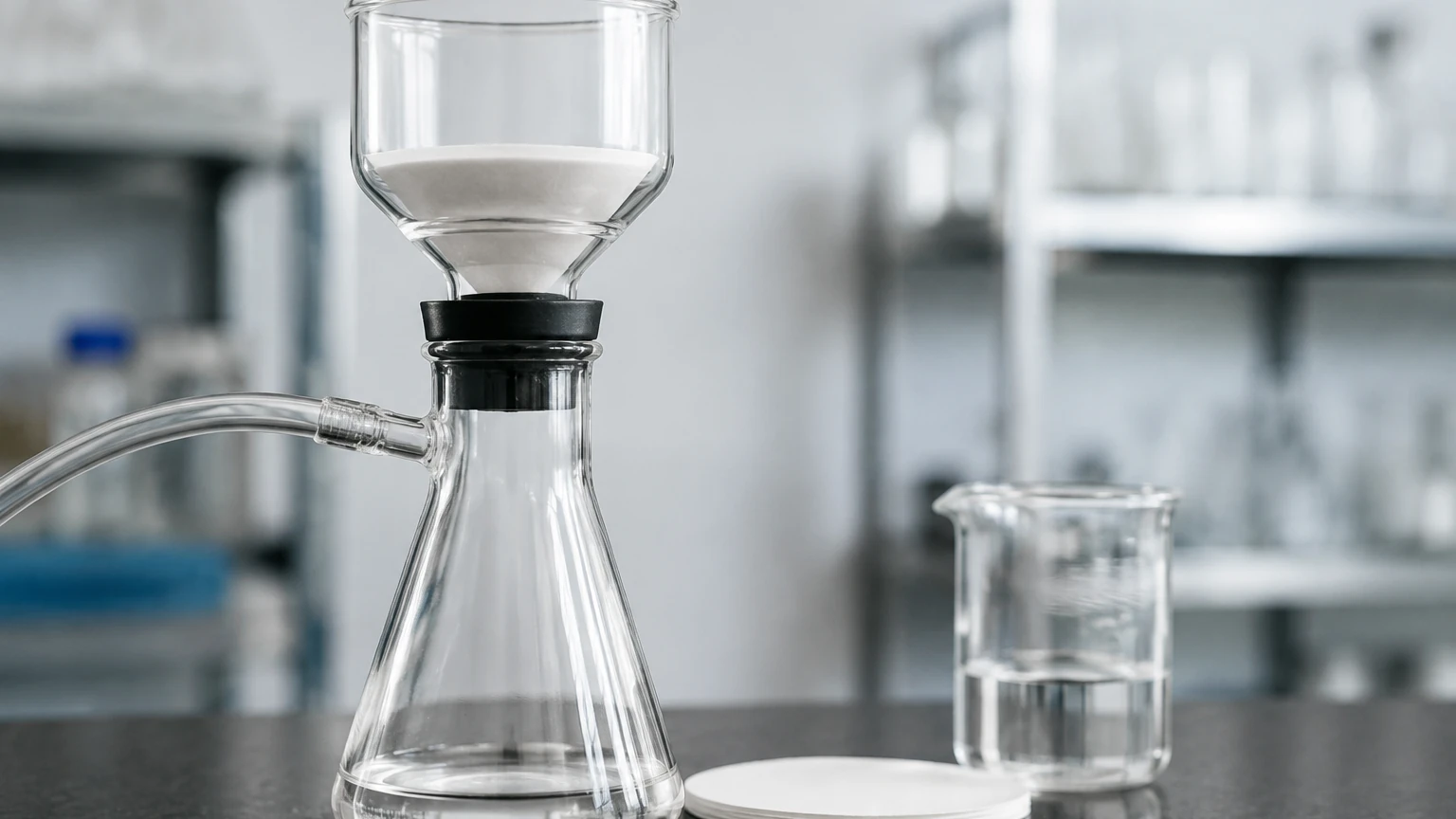
In a typical setup, a filter medium is placed in a funnel (like a Büchner funnel) seated atop a receiving flask. A vacuum pump or water aspirator is then connected to the flask to evacuate air. This creates a significant force pushing inward on the walls of the vessel. For an engineer, calculating the load on the vessel is critical. At a full vacuum, the external atmospheric pressure is approximately 14.7 pounds per square inch (psi). On a standard-sized flask, this translates to hundreds of pounds of force distributed across the glass surface.
The Structural Limitations of Standard Erlenmeyer Flasks
Standard Erlenmeyer flasks are ubiquitous in industrial labs due to their conical shape, which allows for easy mixing and minimizes splashing. However, they are typically manufactured from borosilicate glass with relatively thin walls. These walls are optimized for thermal shock resistance (heating and cooling) rather than mechanical pressure resistance.
When asking "can an Erlenmeyer flask be used for vacuum filtration," one must consider the geometry and wall thickness. The flat bottom of a standard Erlenmeyer flask is a particular point of weakness. Under vacuum, the atmospheric pressure exerts a uniform load that the thin, flat glass cannot support. Unlike a sphere or a thick-walled cylinder, the flat base of a standard flask is prone to flexing. Because glass is a brittle material with low tensile strength, even minor flexing under vacuum can lead to immediate structural failure, resulting in an implosion.
Risks of Using Improper Equipment in Filtration
The primary risk of using a standard Erlenmeyer flask for vacuum applications is an implosion. Unlike an explosion, which forces material outward, an implosion causes the vessel to collapse inward. However, the subsequent rebound and the release of the vacuum often spray glass shards and chemical contents in all directions.
Physical Safety Hazards
In an industrial or laboratory setting, an implosion can cause severe injury. Glass fragments can penetrate PPE, and the sudden release of energy can damage surrounding equipment. Furthermore, if the filtration involves hazardous chemicals or volatile solvents, an implosion increases the risk of chemical exposure and fire.
Sample Loss and Contamination
From a process efficiency standpoint, a vessel failure results in the total loss of the filtered product and the filtrate. In high-value sectors like pharmaceutical manufacturing or specialized chemical synthesis, this loss can represent thousands of dollars in materials and days of lost labor. Additionally, the introduction of glass fragments into the process stream can contaminate downstream equipment, requiring extensive cleaning and validation.
Identifying the Correct Equipment: The Filter Flask
To safely perform vacuum filtration, engineers must use a specialized vessel known as a Filter Flask (also called a Büchner flask or a vacuum flask). While it shares the conical shape of an Erlenmeyer flask, it is engineered with several key differences:
1. Increased Wall Thickness: Filter flasks are made with significantly thicker borosilicate glass. This added mass provides the structural integrity necessary to resist the inward pressure of the atmosphere when the internal environment is evacuated.
2. The Side Arm: A filter flask features a heavy-duty glass side arm (or tubulation). This is where the vacuum hose is attached. On a standard Erlenmeyer flask, there is no such port, and attempting to rig a vacuum connection through the neck is both inefficient and dangerous.
3. Pressure Rating: Manufacturers of filter flasks specifically test and rate these vessels for vacuum use. Standard Erlenmeyer flasks carry no such rating.
When selecting equipment, it is vital to verify that the flask's volume and pressure rating align with the vacuum pump's capabilities. For those looking for more robust, industrial-scale components beyond glassware, you can visit our Main Page to explore high-performance metal filtration solutions designed for demanding environments.
Transitioning from Lab-Scale to Industrial Vacuum Filtration
While glass filter flasks are suitable for benchtop testing and small-batch analysis, industrial applications often require more durable materials. As a process scales from the lab to the production floor, the limitations of glass—even thick-walled glass—become apparent. Glass is susceptible to mechanical impact, scratching (which creates stress concentrators), and limited scale.
In industrial settings, vacuum filtration is often transitioned to stainless steel systems. Stainless steel vacuum housings and filter holders offer several advantages:
* Durability: Unlike glass, stainless steel will not implode. It can withstand significant mechanical shock and high-pressure differentials without the risk of brittle failure.
* Chemical Compatibility: Stainless steel (particularly 316L grade) is resistant to a wide range of corrosive chemicals, making it ideal for chemical processing and pharmaceutical applications.
* Customization: Industrial filtration often requires specific configurations, such as multi-cartridge housings or integrated wire mesh filters. These can be custom-engineered to meet precise flow rates and micron ratings.
For engineers managing these transitions, selecting the right filter media—such as sintered wire mesh or pleated stainless steel cartridges—is just as important as the vessel itself. These components ensure that the filtration efficiency remains consistent even as the scale and pressure of the operation increase.
Engineering Considerations for Vacuum System Setup
Beyond the question of whether a standard Erlenmeyer flask can be used for vacuum filtration, engineers must consider the entire vacuum assembly. A safe and efficient system requires more than just the right flask; it requires a holistic approach to component selection.
1. Vacuum Regulation
Using a vacuum pump that is too powerful for the vessel can increase the risk of failure. Incorporating a vacuum regulator and a pressure gauge allows operators to monitor the internal environment and ensure it stays within the safe operating limits of the glassware or metal housing.
2. The Role of the Trap
In many vacuum setups, a secondary flask (a vacuum trap) is placed between the filtration flask and the vacuum pump. This prevents filtrate from being accidentally drawn into the pump, which could cause mechanical failure or contamination. The trap must also be vacuum-rated, typically using the same heavy-walled construction as the filter flask.
3. Material Selection for Filter Media
In industrial vacuum filtration, the choice of filter media affects the pressure drop across the system. Using a high-quality stainless steel wire mesh provides a stable pore structure that does not deform under vacuum, ensuring consistent particle retention. This is critical for maintaining the integrity of the process as the vacuum level increases.
Best Practices for Maintaining Filtration Integrity
To ensure long-term safety and performance in vacuum filtration, regular equipment inspections are mandatory. For glass vessels, this includes checking for "star cracks," deep scratches, or chips. Even a minor surface flaw can act as a failure point under vacuum pressure. In industrial stainless steel systems, maintenance focuses on the integrity of gaskets, seals, and the cleanliness of the filter elements.
When designing a new filtration process, it is often beneficial to consult with manufacturers who specialize in custom solutions. This ensures that every component—from the receiving vessel to the internal filter cartridge—is engineered for the specific chemical and physical demands of the application. For technical guidance on selecting durable filtration components, reviewing the resources available on our Main Page can provide valuable insights into material performance and design options.
Conclusion
In summary, while a standard Erlenmeyer flask may look similar to a filter flask, it should never be used for vacuum filtration. The structural requirements of vacuum applications demand thick-walled, pressure-rated vessels to prevent dangerous implosions. For engineers and purchasing teams, prioritizing the correct equipment is not just a matter of safety, but also a requirement for process reliability and product quality.
As processes move from the laboratory to industrial production, the shift toward stainless steel filtration components offers the durability and precision needed for high-stakes environments. By understanding the physical limitations of glassware and the advantages of engineered metal solutions, professionals can design filtration systems that are both safe and highly efficient.
Download Can an Erlenmeyer Flask Be Used for Vacuum Filtration as a PDF
