


Cartridge Dust Collector Systems
Industrial air filtration is a critical component of modern manufacturing, directly impacting worker safety, equipment longevity, and regulatory compliance. Among the various technologies available, cartridge dust collector systems have emerged as a preferred solution for handling fine, dry dust and fumes in a compact footprint. Unlike traditional baghouses, these systems utilize pleated filter media to maximize surface area, allowing for higher filtration efficiency and lower air-to-cloth ratios in a smaller physical space.
For engineers and facility managers, selecting the right components for cartridge dust collector systems requires a deep understanding of filtration mechanics, material compatibility, and the specific demands of the industrial environment. Whether the application involves chemical processing, metalworking, or pharmaceutical manufacturing, the performance of the system is fundamentally tied to the quality and design of the filter cartridges themselves.
Understanding the Mechanics of Cartridge Filtration
Cartridge dust collector systems operate on the principle of surface filtration. As dust-laden air enters the collector, it passes through the filter media, where particles are captured on the exterior surface. The cleaned air then flows through the center of the cartridge and is exhausted or recirculated.
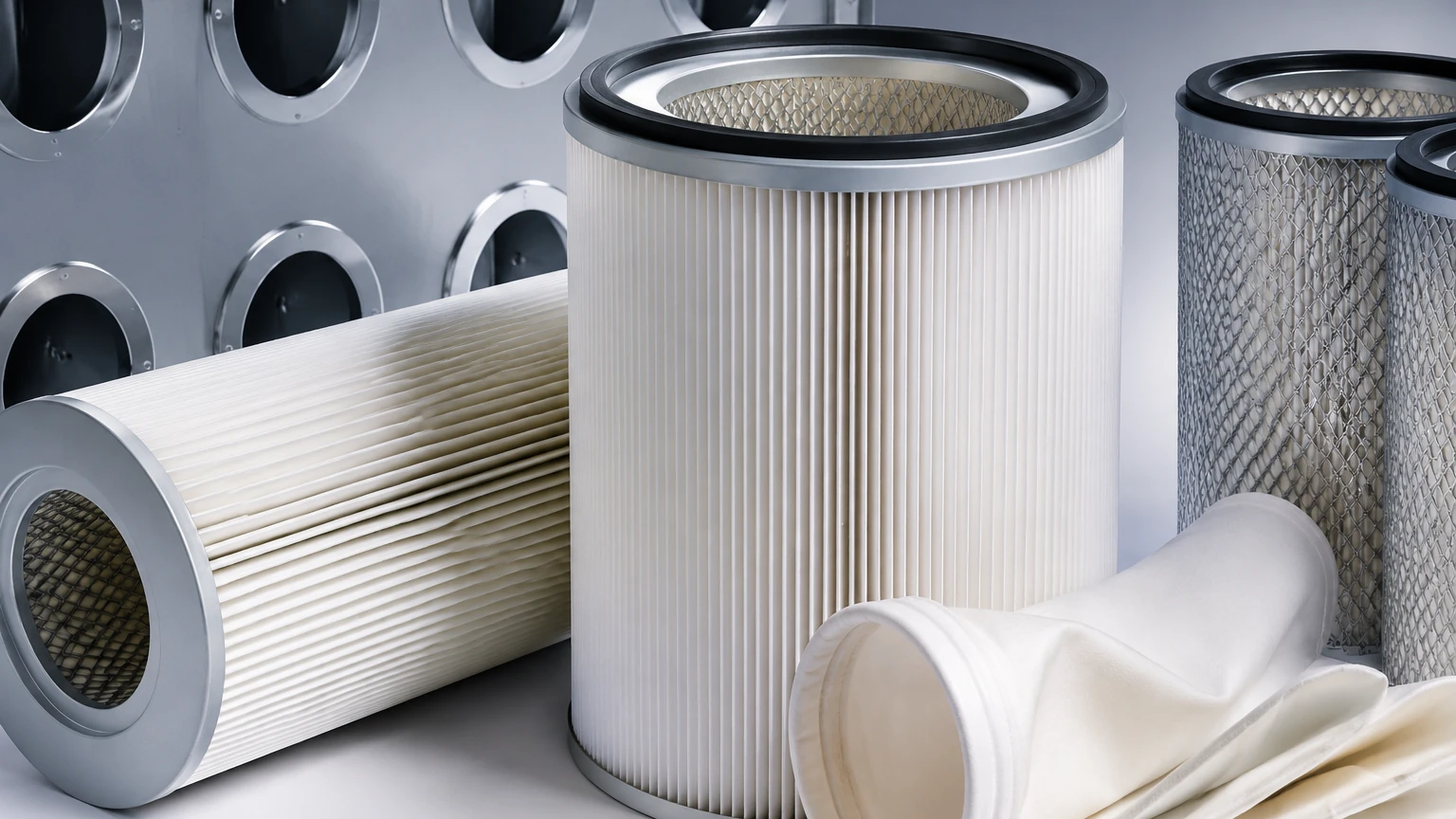
The defining characteristic of these systems is the pleated design of the filter media. By folding the material into pleats, manufacturers can pack a significantly larger filtration area into a standard cylindrical or conical cartridge. This high surface-to-volume ratio allows the system to handle larger volumes of air at lower velocities, which reduces the pressure drop across the media and extends the service life of the filter.
Pulse-Jet Cleaning Technology
To maintain continuous operation, cartridge dust collector systems typically employ an automated pulse-jet cleaning mechanism. Sensors monitor the differential pressure across the filters; when the pressure drop reaches a pre-set limit—indicating that the dust cake has become too thick—a high-pressure blast of compressed air is released down the center of the cartridge. This pulse momentarily reverses the airflow, flexing the media and dislodging the dust cake into a collection hopper below. Effective pulse cleaning is essential for preventing "blinding" of the media and ensuring consistent airflow.
Engineering Criteria for Filter Media Selection
Selecting the appropriate media is the most critical decision in the design of cartridge dust collector systems. While cellulose and polyester are common for general-purpose applications, demanding industrial environments often require more robust materials to withstand heat, moisture, or chemical exposure.
Stainless Steel and Metal Mesh Options
In applications involving high temperatures, abrasive particles, or corrosive gases, synthetic fibers often fail prematurely. This is where custom stainless steel filtration solutions become indispensable. Stainless steel wire mesh filters provide exceptional mechanical strength and thermal stability. For engineers, opting for stainless steel components ensures that the filter can be cleaned and reused multiple times, significantly reducing the total cost of ownership compared to disposable synthetic cartridges.
Key considerations for metal media include:
* Alloy Selection: Using 304 or 316L stainless steel depends on the level of corrosion resistance required by the process.
* Mesh Weave: The type of weave (plain, twilled, or Dutch weave) determines the filtration accuracy and the structural integrity of the pleats.
* Structural Support: High-pressure applications may require internal or external support cores to prevent pleat collapse during the pulse-jet cycle.
Air-to-Cloth Ratio and Interstitial Velocity
The air-to-cloth (A/C) ratio, also known as the filtration velocity, is the ratio of the air volume (CFM) to the total square footage of the filter media. For cartridge dust collector systems, maintaining a conservative A/C ratio is vital. If the ratio is too high, particles are driven deep into the media fibers, making them impossible to remove during the cleaning cycle. Similarly, high interstitial velocity—the speed of the air moving between the cartridges—can cause dust to remain suspended rather than falling into the hopper, leading to immediate re-entrainment on the filter surface.
Performance Evaluation and Pressure Drop
The efficiency of a dust collection system is often measured by its ability to meet specific emission standards, such as those defined by MERV (Minimum Efficiency Reporting Value) ratings or ISO standards. However, in an industrial B2B context, engineers must also focus on the operational pressure drop.
Initial vs. Operating Differential Pressure
When new filters are installed, the initial pressure drop is at its lowest. As the system operates, a thin layer of dust (the dust cake) builds up, which actually assists in the filtration process by capturing smaller particles. The "steady-state" operating pressure drop is the equilibrium reached after several cleaning cycles. A well-designed system using high-quality components from a professional manufacturer like Main Page will maintain a stable operating pressure, minimizing energy consumption by the system's fan.
Energy Efficiency Considerations
Because the fan must work harder to pull air through clogged filters, the pressure drop is directly linked to energy costs. High-performance cartridges with optimized pleat spacing allow for better dust release, which keeps the average differential pressure lower. For large-scale industrial facilities, even a small reduction in average pressure drop can result in thousands of dollars in annual energy savings.
Industrial Applications and Environmental Challenges
Cartridge dust collector systems are versatile, but their configuration must be tailored to the specific dust characteristics of the industry.
1. Chemical and Pharmaceutical: These sectors often deal with fine, potentially hazardous powders. Filtration components must provide high capture efficiency and often require stainless steel construction to facilitate thorough cleaning and prevent cross-contamination.
2. Food and Beverage: In environments handling flour, sugar, or spices, the filters must meet food-grade standards. Stainless steel mesh is often preferred here due to its durability and ability to withstand wash-down procedures.
3. Metalworking and Thermal Spray: These processes generate very fine, often hot, metallic dust and fumes. The filter media must be able to handle high thermal loads and potentially abrasive particles without tearing.
4. Cement and Mining: Here, the dust load is extremely high. Systems must be designed with rugged housings and heavy-duty cartridges that can withstand constant pulse-jet cleaning.
Customization and OEM Support
Standard off-the-shelf filters rarely meet the precise needs of specialized industrial machinery. This is why many engineering teams seek OEM and customized filtration solutions. Customization allows for the adjustment of cartridge dimensions, end-cap configurations (such as flange top, open/closed bottom, or bolt-on), and specialized gasket materials to ensure a leak-proof seal.
When working with a manufacturer like Kaifil, engineers can specify the exact filtration accuracy and material properties required for their unique environment. This collaborative approach ensures that the filtration components are not a weak link in the production chain but rather a contributor to system reliability.
Maintenance and Total Cost of Ownership (TCO)
While the initial purchase price of cartridge dust collector systems is a factor, the total cost of ownership is a more accurate metric for procurement. TCO includes the cost of replacement filters, labor for maintenance, energy consumption, and the potential cost of production downtime.
Extending Filter Life
To maximize the lifespan of cartridges, engineers should:
* Monitor Pulse-Jet Settings: Ensure the compressed air is clean and dry. Moisture in the pulse air can lead to "mudding" of the dust on the filter media.
* Check Gaskets Regularly: Even the highest quality filter will fail if air bypasses the media through a degraded seal.
* Evaluate Pre-Separation: For very heavy dust loads, using a cyclone pre-separator can remove larger particles before they reach the cartridges, significantly extending the life of the primary filters.
Replacement Cycles
The replacement cycle for cartridges varies by application. In light-duty environments, filters may last two years or more. In heavy-duty, 24/7 operations, they may need replacement every six months. Transitioning to durable, cleanable stainless steel components can often extend these cycles, as the media can be refurbished rather than discarded.
Conclusion: Selecting the Right Filtration Partner
Implementing effective cartridge dust collector systems is a balance of engineering precision and material science. By focusing on high-quality media, proper system sizing, and robust construction, industrial facilities can achieve superior air quality and operational efficiency. For those requiring precision-engineered components or customized metal filtration solutions, partnering with a manufacturer that understands the nuances of industrial environments is essential.
Before finalizing a system design or purchasing replacement components, engineers should confirm the chemical compatibility of the media, the expected dust loading, and the required filtration efficiency to ensure the chosen solution meets the long-term demands of the application.
