


Cartridge Filter Manufacturer
In industrial processing, filtration is a critical operation that ensures product purity, protects downstream equipment, and maintains system efficiency. Selecting a professional cartridge filter manufacturer is not merely a procurement task but a strategic engineering decision. For industries ranging from chemical processing to food and beverage production, the reliability of a filtration component depends on material integrity, precision engineering, and the ability to meet specific application demands.
As systems become more complex and regulatory requirements more stringent, the role of a specialized manufacturer like Kaifil becomes indispensable. By focusing on stainless steel and high-performance metal alloys, a manufacturer can provide solutions that withstand extreme temperatures, corrosive environments, and high-pressure differentials where polymer-based filters would fail. This guide explores the technical considerations, customization options, and evaluation criteria essential for engineers and purchasing teams when selecting a filtration partner.
Technical Engineering of Stainless Steel Cartridge Filters
The performance of an industrial filter is fundamentally tied to its construction. A leading cartridge filter manufacturer utilizes advanced materials, primarily stainless steel 304 and 316L, to ensure longevity and chemical compatibility. Unlike disposable plastic cartridges, metal filters offer structural rigidity and the ability to be cleaned and reused, significantly impacting the long-term operational budget.
Material Selection and Metallurgy
Stainless steel 316L is often the preferred choice for demanding environments due to its superior corrosion resistance, particularly against chlorides and acidic solutions. In less aggressive environments, stainless steel 304 provides a cost-effective alternative while still offering high mechanical strength. Manufacturers may also utilize specialized alloys like Monel, Hastelloy, or Inconel for extreme chemical or thermal conditions. Understanding the metallurgy is the first step in ensuring the filter will not degrade or leach contaminants into the process stream.
Filtration Media Structures
There are several types of metal filtration media, each suited for different particle separation tasks:
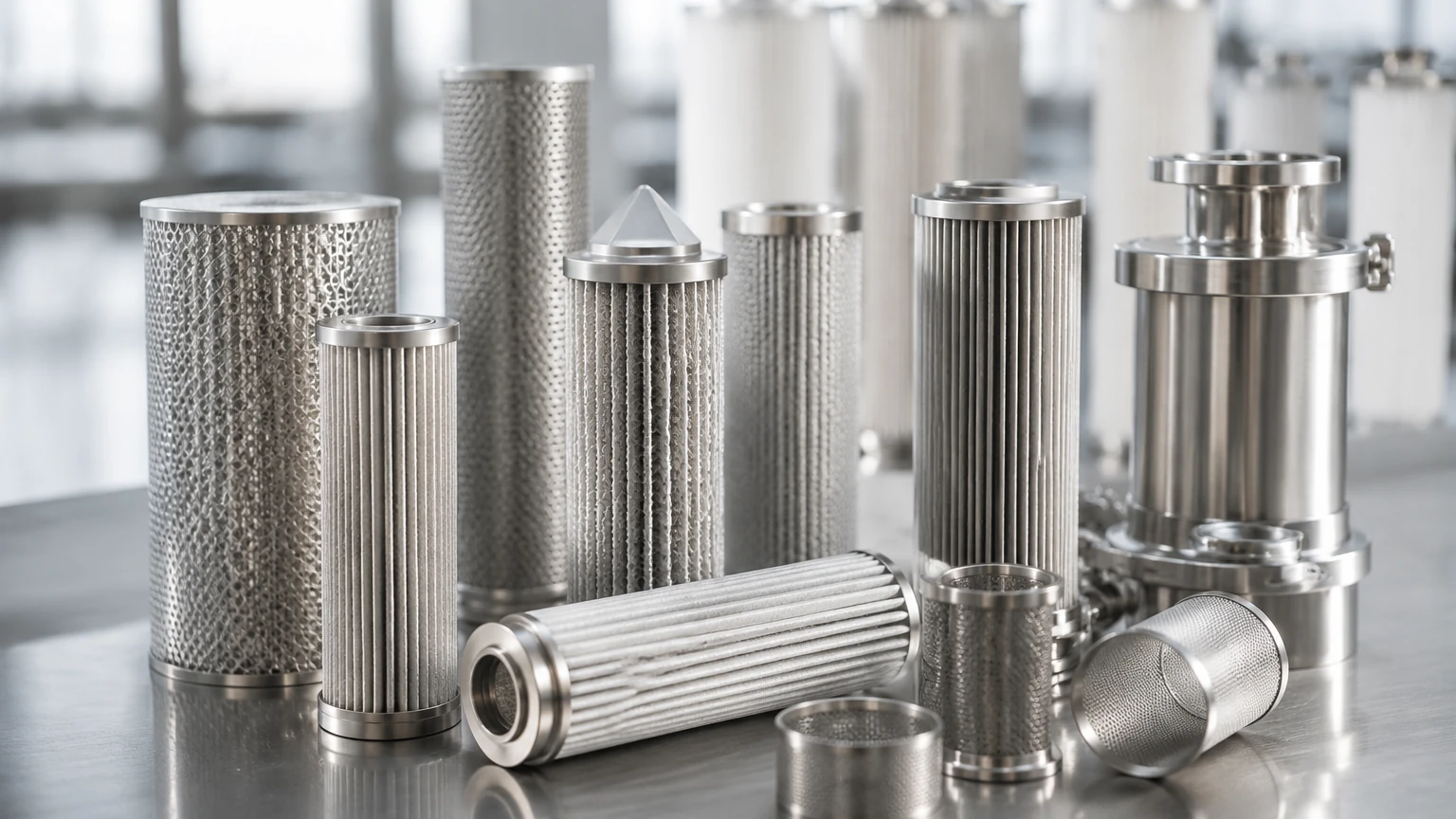
- Woven Wire Mesh: This media provides precise, two-dimensional surface filtration. It is characterized by its uniform pore size and is ideal for removing rigid particles. It is also the easiest media to clean via backwashing.
- Sintered Metal Felt: Produced from non-woven stainless steel fibers, this media offers three-dimensional depth filtration. It provides high porosity (up to 80%), which allows for high flow rates and high dirt-holding capacity.
- Sintered Powder: Created by fusing metal powders, this media is used for very fine filtration and provides a robust, self-supporting structure capable of withstanding high pressure.
Customization Capabilities: Beyond Standard Specifications
One of the primary reasons to engage directly with a cartridge filter manufacturer is the need for customized engineering. Standard off-the-shelf filters rarely meet the exact requirements of specialized industrial machinery. Customization involves more than just changing dimensions; it encompasses the entire design of the filtration element to optimize performance.
Geometric and Structural Customization
Engineers must often integrate new filtration components into existing housings. This requires precise control over the outer diameter (OD), inner diameter (ID), and overall length. Furthermore, the internal support structure—such as the perforated core—must be engineered to prevent collapse under high differential pressures. A manufacturer’s ability to provide various end-cap configurations, such as Double Open End (DOE), 222/Flat, 226/Fin, or threaded connections, ensures seamless integration into the Main Page of the facility's technical infrastructure.
Pleating vs. Cylindrical Designs
To increase the effective filtration area without increasing the footprint of the cartridge, manufacturers often employ pleating. Pleated cartridges can offer three to five times the surface area of a standard cylindrical filter. This results in lower initial pressure drops, higher dirt-holding capacity, and longer service intervals. A technical manufacturer will calculate the optimal pleat count and depth to ensure that the pleats do not "blind" or collapse against each other during high-flow conditions.
Evaluating Filtration Efficiency and Micron Ratings
When consulting a cartridge filter manufacturer, understanding the distinction between nominal and absolute micron ratings is vital for process control.
Absolute vs. Nominal Ratings
- Nominal Rating: This refers to an arbitrary micron value assigned by the manufacturer based on a percentage of solids (usually 60% to 90%) that the filter can retain. It is a general guideline rather than a guarantee of purity.
- Absolute Rating: This is a mathematically determined value representing the diameter of the largest hard spherical particle that will pass through the filter under specified test conditions. For critical applications in the pharmaceutical or semiconductor industries, an absolute rating is typically required to ensure consistent results.
Pressure Drop and Flow Rates
The "Clean Pressure Drop" is a key metric provided by the manufacturer. It indicates the resistance to flow when the filter is new. As particles accumulate, the differential pressure ($ΔP$) increases. A professional manufacturer provides flow-vs-pressure curves to help engineers size pumps and systems correctly, ensuring that the filter does not become a bottleneck in the production line.
Durability and Maintenance: The Economic Case for Metal Filters
While the initial cost of a stainless steel cartridge is higher than that of a polypropylene or paper alternative, the total cost of ownership (TCO) is often lower. A high-quality cartridge filter manufacturer designs products intended for a long lifecycle, characterized by multiple cleaning cycles.
Cleanability and Reuse
Stainless steel cartridges can be cleaned using several methods, including:
- Backwashing: Reversing the flow of fluid to dislodge particles from the surface.
- Ultrasonic Cleaning: Using high-frequency sound waves in a solvent bath to remove fine particles trapped deep within the media.
- Chemical Cleaning: Using acids or alkalis to dissolve organic or mineral deposits.
- Burn-off/Pyrolysis: Removing organic contaminants by heating the filter in a controlled atmosphere.
The ability to restore the filter to near-original pressure drop levels reduces waste and the frequency of replacement part procurement.
Structural Integrity
In high-viscosity applications or systems subject to pressure surges (water hammer), plastic filters can deform or bypass. Metal cartridges manufactured with TIG or plasma welding maintain their integrity under these stresses. This prevents "unloading," where trapped contaminants are forced through the media due to structural failure, protecting expensive downstream equipment like high-pressure pumps and spray nozzles.
Critical Application Environments for Cartridge Filtration
Different industries impose unique demands on filtration components. A versatile cartridge filter manufacturer must understand these nuances to provide the correct solution.
Chemical and Petrochemical Processing
In these sectors, filters must resist aggressive solvents and high temperatures. Stainless steel filters are used for catalyst recovery, monomer filtration, and the removal of impurities from corrosive acids. The absence of binders or adhesives in all-welded metal cartridges prevents chemical leaching and ensures process purity.
Food and Beverage Industry
Filtration in the food industry requires "sanitary design." This means the filter must have smooth surfaces, be free of dead zones where bacteria can grow, and be compatible with Clean-in-Place (CIP) procedures. Stainless steel is the industry standard for filtering steam, culinary liquids, and carbonation gases, often requiring compliance with FDA or 3A standards.
Hydraulic and Lubrication Systems
Protecting sensitive hydraulic valves and bearings requires the removal of fine metallic wear particles. Metal mesh filters are used here for their high-pressure ratings and their ability to handle high-viscosity oils without collapsing. They serve as a critical line of defense against catastrophic mechanical failure.
Selecting the Right Cartridge Filter Manufacturer
Choosing a partner for industrial filtration requires a deep dive into the manufacturer's technical capabilities and quality assurance processes. Engineers should verify several key factors before finalizing a supplier.
Quality Control and Testing
Does the manufacturer perform bubble point testing to verify pore size? Are they ISO 9001 certified? A reliable cartridge filter manufacturer will provide material mill certificates and pressure test reports upon request. This traceability is essential for industries where safety and compliance are non-negotiable.
Engineering Support and OEM Services
Technical support should extend beyond the sale. A manufacturer should be able to assist with sizing calculations, material compatibility charts, and troubleshooting performance issues in the field. For original equipment manufacturers (OEMs), the ability to produce proprietary designs with consistent quality is a prerequisite for a long-term partnership.
Lead Times and Scalability
In industrial environments, downtime is costly. Evaluating a manufacturer’s production capacity and their ability to meet delivery schedules is as important as the technical specs of the filter itself. A manufacturer with integrated production—from wire mesh weaving to final assembly—often has better control over lead times and quality than a company that out-sources components.
Conclusion
Industrial filtration is a precise science that requires high-quality components designed for specific operational stresses. By partnering with an experienced cartridge filter manufacturer like Kaifil, organizations can ensure they receive filtration solutions that are not only effective at removing contaminants but also durable enough to provide a high return on investment. Whether the application involves high-temperature steam, corrosive chemicals, or high-pressure hydraulics, the right stainless steel filter cartridge is a fundamental building block of a reliable industrial system. For more information on specific configurations and engineering support, technical teams are encouraged to review the available options on the manufacturer's Main Page.
