


Centrifugal Cyclone Separator
In the landscape of industrial fluid dynamics and particle separation, the centrifugal cyclone separator stands as a fundamental component for high-volume pre-filtration. Designed to remove solid particulates from gas or liquid streams without the use of moving parts, these units leverage centrifugal force and inertia to achieve effective phase separation. For engineers and technical procurement teams, understanding the mechanical nuances, efficiency variables, and material requirements of these systems is critical for optimizing downstream filtration processes and protecting sensitive equipment.
At its core, the centrifugal cyclone separator is a passive device that converts the velocity of an incoming fluid into a high-speed rotating vortex. This mechanical action facilitates the separation of materials based on density and mass. In many industrial workflows, these separators serve as the first line of defense, significantly reducing the particulate load before the fluid reaches precision components such as stainless steel wire mesh filters or sintered metal cartridges. To explore the full range of complementary filtration components, technical professionals can visit our Main Page to review product options and application support.
The Physics of Vortex Separation
The operation of a centrifugal cyclone separator is governed by the principles of centrifugal force, drag force, and buoyancy. As the fluid enters the cylindrical chamber through a tangential or helical inlet, it is forced into a downward spiral, creating what is known as the "outer vortex." This rotation generates centrifugal force, which pushes denser particles toward the outer wall of the separator.
Once the particles strike the wall, they lose kinetic energy and descend toward the conical section of the unit, eventually collecting in a discharge hopper or underflow outlet. Meanwhile, the cleaned fluid reaches the bottom of the cone and reverses direction, forming a tighter "inner vortex" that moves upward through the center of the chamber and exits through the vortex finder at the top.
From an engineering perspective, the efficiency of this separation is determined by the balance between the centrifugal force acting on a particle and the inward drag force exerted by the fluid. Smaller, lighter particles are more likely to be carried away by the inner vortex, while larger, denser particles are successfully captured. This threshold is typically defined as the "cut point" ($d_{50}$), representing the particle size at which 50% of the solids are removed.
Engineering Design Parameters for High-Efficiency Cyclones
Designing or selecting a centrifugal cyclone separator requires a deep dive into several geometric and operational variables. These parameters directly influence both the separation efficiency and the pressure drop across the system.
Inlet Geometry
Inlet design is crucial for minimizing turbulence. Tangential inlets are common, but helical inlets are often preferred in high-velocity applications because they pre-orient the fluid flow, reducing energy loss and wall erosion at the entry point. A smooth transition into the vortex chamber ensures that the centrifugal force is maximized immediately.
Body Diameter and Length
The diameter of the cyclone body determines the magnitude of the centrifugal force; smaller diameters generally produce higher G-forces, allowing for the capture of finer particles. However, smaller diameters also increase the pressure drop and limit the total flow capacity. The length of the cylindrical and conical sections affects the residence time of the fluid, providing more opportunity for particles to reach the outer wall.
The Vortex Finder
The vortex finder is a tube extending into the cyclone body from the top. Its primary function is to prevent the short-circuiting of the inlet fluid directly to the outlet. The depth and diameter of the vortex finder must be precisely calculated; if it is too deep, it may interfere with the vortex stability; if it is too shallow, separation efficiency drops significantly.
Material Selection: The Case for Stainless Steel
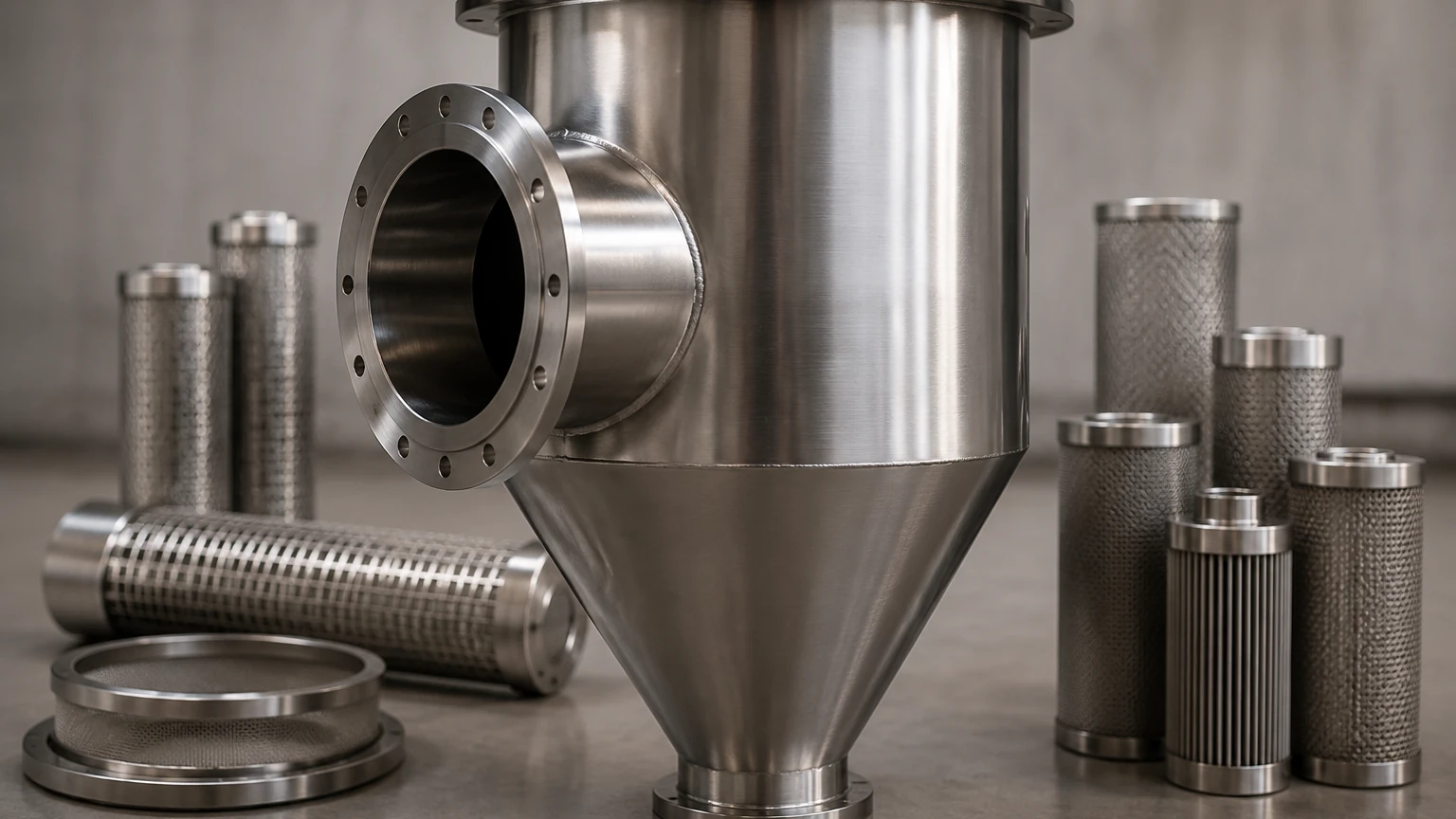
While centrifugal cyclone separators can be manufactured from various materials, stainless steel remains the gold standard for demanding industrial environments. In sectors such as chemical processing, food and beverage, and pharmaceuticals, the choice of material is dictated by corrosion resistance, thermal stability, and hygienic requirements.
1. Corrosion Resistance: Industrial fluids often contain corrosive agents or operate at pH levels that would degrade carbon steel. Utilizing SS304 or SS316L ensures long-term structural integrity and prevents metal leaching into the process stream.
2. Erosion Resistance: The high-velocity impact of abrasive particles against the cyclone walls can lead to rapid thinning of the material. High-grade stainless steel provides the necessary hardness to withstand this mechanical wear, especially when reinforced with specialized surface treatments or increased wall thickness in the conical section.
3. Thermal Stability: Many centrifugal cyclone separators operate in high-temperature gas cleaning or steam applications. Stainless steel maintains its mechanical properties at elevated temperatures, preventing warping or failure under thermal stress.
4. Hygienic Standards: In food and pharmaceutical applications, the internal surfaces must be polished to specific Ra (Roughness Average) values to prevent bacterial growth and facilitate Clean-in-Place (CIP) procedures.
Integrating Cyclones with Fine Filtration Systems
A centrifugal cyclone separator is rarely used in isolation for high-precision applications. Instead, it functions as a primary separator within a multi-stage filtration architecture. Its role is to remove the "heavy lifting"—the bulk of the solid contaminants—thereby extending the service life of secondary fine filters.
For instance, in a hydraulic system or a chemical reactor loop, a cyclone may remove particles larger than 50 microns. The fluid then passes through a stainless steel filter cartridge or a pleated wire mesh element for final polishing down to 5 or 10 microns. Without the cyclone, the fine filter would clog rapidly, leading to frequent downtime and increased operational costs. By integrating these technologies, engineers achieve a lower total cost of ownership through reduced cartridge replacement cycles and protected downstream assets.
When specifying a system, it is vital to match the flow characteristics of the cyclone with the capacity of the secondary stainless steel filters. Discrepancies in flow rates can lead to backpressure issues or inefficient separation in the cyclone stage. You can visit our Main Page to evaluate how different stainless steel filter configurations can be paired with primary separation equipment.
Operational Risks and Mitigation Strategies
Despite their lack of moving parts, centrifugal cyclone separators are subject to specific operational risks that can compromise performance. Engineers must account for these during the system design phase.
Pressure Drop (Delta P)
The energy required to create the vortex results in a pressure drop. Excessive pressure drop can strain pumps and reduce overall system efficiency. It is essential to balance the required separation efficiency with the available system pressure. If the pressure drop is too low, the centrifugal force will be insufficient to separate fine particles.
Air Leakage and Underflow Blockage
In gas-solid cyclones, any air leakage at the bottom discharge point can disrupt the vortex and cause collected dust to be re-entrained into the clean gas stream. Similarly, in liquid applications (hydrocyclones), a blockage in the underflow outlet can cause the collected solids to back up into the main chamber, effectively neutralizing the separator.
Turndown Ratio Limits
Cyclones are sensitive to changes in flow rate. If the flow rate drops significantly below the design point, the centrifugal force decreases, and separation efficiency plummets. Systems with highly variable flow rates may require multiple smaller cyclones in a manifold (multicyclones) that can be brought online or offline as needed.
Selection Guide for Technical Purchasing Teams
Before finalizing the procurement of a centrifugal cyclone separator, purchasing teams and engineers should confirm several key data points with the manufacturer to ensure the equipment meets the application's specific demands:
* Particle Size Distribution (PSD): Provide a detailed breakdown of the particles in the stream. Knowing the mean particle size and the percentage of fines is critical for predicting efficiency.
* Fluid Properties: Confirm the density, viscosity, and temperature of the carrier fluid. Higher viscosity fluids increase the drag force on particles, making centrifugal separation more difficult.
* Solids Loading: The concentration of solids (ppm or mg/L) affects the design of the discharge mechanism and the potential for erosion.
* Target Efficiency: Define the required removal rate for specific micron sizes. This helps determine if a single cyclone is sufficient or if secondary filtration is mandatory.
* Space Constraints: Industrial layouts often have limited vertical or horizontal space. Custom-designed cyclones can be oriented to fit specific footprints while maintaining hydraulic performance.
By focusing on these technical boundaries, organizations can ensure they invest in a separation solution that provides reliable performance in harsh industrial environments. Whether the goal is to protect high-pressure pumps or to recover valuable catalysts, the centrifugal cyclone separator remains an indispensable tool in the engineer's arsenal for effective fluid management.
