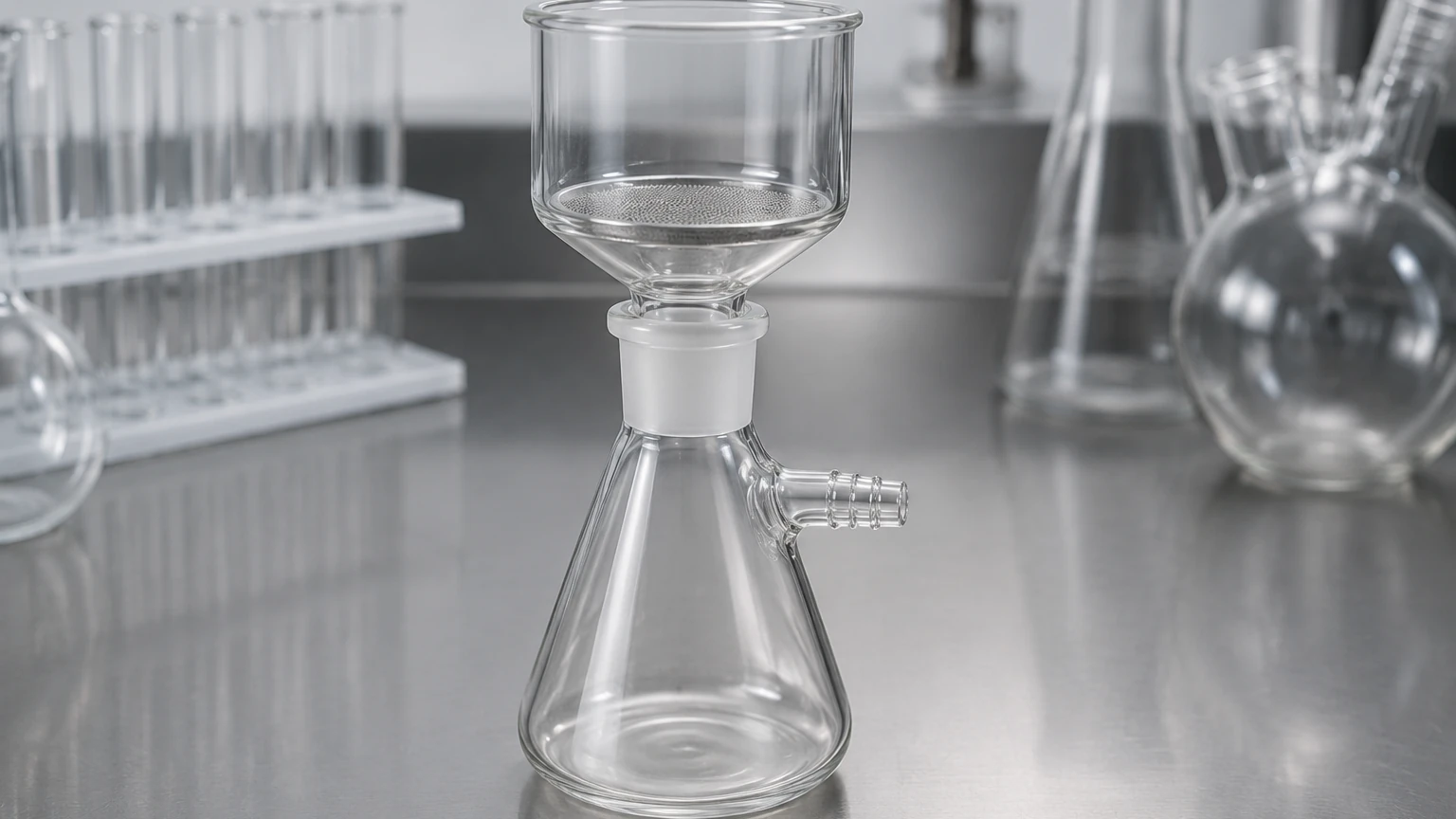
Chemistry Filter Flask
In the rigorous world of chemical engineering and laboratory research, the chemistry filter flask stands as a cornerstone of liquid-solid separation. Known variously as a Büchner flask, vacuum flask, or side-arm flask, this specialized piece of equipment is designed to facilitate rapid filtration under reduced pressure. While its presence is most common in research and development (R&D) laboratories, the principles it demonstrates are the direct precursors to high-capacity industrial filtration systems. For technical professionals and procurement managers, understanding the transition from the laboratory chemistry filter flask to industrial-scale filtration is vital for ensuring process scalability, product purity, and operational efficiency.
The Engineering Fundamentals of the Chemistry Filter Flask
The chemistry filter flask is not merely a standard Erlenmeyer flask with a side attachment; it is a precision-engineered pressure vessel designed to withstand atmospheric pressure from the outside while a vacuum is pulled from the inside. The defining feature is the side arm, or "barb," which allows for the connection of flexible tubing to a vacuum source, such as a water aspirator or a mechanical vacuum pump.
From a fluid dynamics perspective, the chemistry filter flask utilizes a pressure differential to drive the filtrate through a medium. In a standard gravity filtration setup, the only force acting on the liquid is the weight of the fluid column. In a vacuum-assisted setup using a filter flask, the pressure inside the flask is significantly lower than the ambient atmospheric pressure. This creates a powerful suction effect that pulls the liquid through the filter media, dramatically increasing the flow rate. This is particularly critical when dealing with fine precipitates that would otherwise clog a gravity filter or when processing high-viscosity liquids that resist natural flow.
Structural integrity is paramount. Chemistry filter flasks are manufactured with significantly thicker walls than standard laboratory glassware. This thickness is necessary to prevent implosion—a catastrophic failure where the external atmospheric pressure crushes the glass inward. Engineers must recognize that as the volume of the flask increases, the surface area exposed to pressure also increases, requiring even greater wall thickness and careful annealing to manage internal stresses.
Material Selection: From Borosilicate Glass to Industrial Stainless Steel
For laboratory-scale chemistry filter flask applications, borosilicate glass (typically Type I, Class A) is the material of choice. Its primary advantages include a low coefficient of thermal expansion and excellent resistance to chemical attack from acids, organic solvents, and halogens. However, borosilicate glass has limitations when a process moves from the benchtop to the pilot plant or production floor.
In industrial environments, the fragility of glass becomes a significant liability. The risk of mechanical impact or thermal shock leading to an implosion poses a safety hazard and a threat to batch integrity. Consequently, industrial filtration systems translate the principles of the chemistry filter flask into robust metal constructions. Stainless steel, specifically grades 304 and 316L, is the industry standard for these applications.
Stainless steel provides several advantages over glass in a production setting:
1. Mechanical Strength: Metal housings can withstand much higher pressure differentials and are immune to the shattering risks associated with glass.
2. Thermal Conductivity: Stainless steel allows for better temperature control of the filtrate, which is essential for processes involving temperature-sensitive compounds.
3. Corrosion Resistance: While borosilicate is excellent, 316L stainless steel offers superior resistance to pitting and crevice corrosion, especially in the presence of chlorides or high-temperature alkaline solutions.
4. Scalability: Metal components can be fabricated into much larger volumes than glass flasks, supporting the high-throughput requirements of chemical processing plants.
For those evaluating the move from laboratory glassware to industrial-grade filtration components, the Main Page offers a deep dive into the material specifications and custom engineering options available for stainless steel filtration systems.
Scaling Vacuum Filtration: From Laboratory Flasks to Industrial Cartridges
The transition from a chemistry filter flask to an industrial filtration system involves moving from batch-oriented laboratory work to continuous or semi-continuous production. In the lab, the flask serves as both the vacuum receiver and the support for the funnel. In an industrial setting, these functions are often separated into specialized components: a filter housing, a filter element (cartridge or mesh), and a separate vacuum receiver tank.
When scaling up, engineers often replace the simple paper filter used in a Büchner funnel with sophisticated stainless steel filter cartridges. These cartridges utilize pleated wire mesh or sintered metal fibers to provide a much larger surface area within a compact footprint. This increase in surface area is critical because it directly correlates to the volume of liquid that can be processed before the filter becomes blinded by solids.
Industrial systems also incorporate multi-stage filtration. While a chemistry filter flask is typically a single-stage process, industrial lines may use a series of filters with decreasing micron ratings. This protects the final, high-precision filter from premature clogging by removing larger particles in the pre-filtration stage. This modular approach, often utilizing custom-designed stainless steel components, ensures that the high-purity standards achieved in the lab are maintained at a commercial scale.
Critical Performance Metrics in Industrial Vacuum Filtration
To successfully replicate the results of a chemistry filter flask at an industrial scale, engineers must focus on several quantitative metrics. These metrics determine the selection of the filter media and the design of the overall system.
* Micron Rating (Absolute vs. Nominal): In a lab setting, filter paper is often chosen based on qualitative descriptions (e.g., "fine" or "coarse"). In industrial procurement, filters are specified by micron ratings. An absolute rating indicates the diameter of the largest spherical particle that can pass through the filter, while a nominal rating indicates a percentage of particles of a certain size that are retained. For critical chemical applications, absolute-rated stainless steel mesh is preferred for its predictability.
* Flow Rate and Flux: This is the volume of filtrate produced per unit of time per unit of filtration area. High flux rates are desirable but must be balanced against the risk of forcing particles through the media or causing premature cake compression.
* Pressure Drop (Delta P): This is the difference in pressure between the upstream and downstream sides of the filter. As solids accumulate on the filter media (forming a "filter cake"), the Delta P increases. Monitoring this is essential for determining when the filter needs cleaning or replacement.
* Cake Capacity: In many chemical processes, the solid residue is the valuable product. Industrial systems must be designed to accommodate the volume of the filter cake without restricting the flow of the vacuum, a significant upgrade over the limited capacity of a standard funnel and chemistry filter flask.
Maintenance, Durability, and the Economics of Reusable Media
One of the most significant differences between laboratory vacuum filtration and industrial filtration is the approach to consumables. In the lab, the filter media used with a chemistry filter flask is almost always a single-use paper or membrane disc. While inexpensive at a small scale, the cost and environmental impact of disposable media become prohibitive in large-scale manufacturing.
Industrial filtration solutions leverage the durability of stainless steel wire mesh and sintered metal elements. These components are designed to be cleaned and reused, providing a much lower total cost of ownership (TCO) over the life of the equipment. Cleaning methods include:
* Backwashing: Reversing the flow of fluid through the filter to dislodge the filter cake.
* Ultrasonic Cleaning: Using high-frequency sound waves in a cleaning solvent to remove fine particles trapped deep within the mesh pores.
* Chemical Cleaning (CIP): Using specific detergents or solvents to dissolve accumulated contaminants without disassembling the filtration housing.
This reusability is a key factor for engineers who must maintain high uptime in their facilities. Unlike paper filters, which can tear or bypass under high vacuum, stainless steel mesh maintains its structural integrity through thousands of cleaning cycles, ensuring consistent filtration accuracy. For more information on the durability and maintenance profiles of these industrial components, engineers can consult the Main Page for technical guidance.
Safety Protocols and Structural Integrity in Vacuum Environments
Safety is a primary concern when working with vacuum filtration, whether in the lab with a chemistry filter flask or in a factory with a 500-liter vacuum receiver. The risk of implosion is a constant factor. In the laboratory, safety protocols include using only heavy-walled glassware, inspecting for "star cracks" or scratches before use, and often wrapping the flask in plastic mesh or tape to contain shards in the event of a failure.
In the industrial sector, safety is managed through rigorous adherence to engineering codes, such as the ASME Boiler and Pressure Vessel Code. Industrial vacuum housings are hydrostatically tested to ensure they can handle the external pressure of the atmosphere. Furthermore, the use of stainless steel eliminates the risk of brittle fracture that is inherent to glass.
Another safety consideration is the management of volatile or hazardous vapors. While a chemistry filter flask often vents directly into a lab hood or a simple trap, industrial systems must be closed-loop. This involves integrating the vacuum pump with condensers or scrubbers to capture any volatile organic compounds (VOCs) that bypass the filter. Ensuring that the gaskets and seals within the filter housing are chemically compatible with the filtrate is also a critical safety step to prevent leaks and environmental contamination.
Conclusion: Bridging the Gap Between Lab and Industry
The chemistry filter flask is a fundamental tool that introduces the power of vacuum filtration to the scientific community. It allows for the rapid separation of solids and liquids, providing the clean samples necessary for chemical analysis and discovery. However, as these processes transition from the laboratory to the industrial plant, the requirements for durability, precision, and safety evolve significantly.
By moving from glass flasks to custom-engineered stainless steel filtration solutions, companies can achieve the scale and reliability required for modern manufacturing. Whether it is selecting the correct micron rating for a sintered metal filter or designing a high-capacity housing that can withstand continuous vacuum, the engineering principles remain rooted in the simple mechanics of the filter flask.
For procurement teams and engineers looking to optimize their filtration processes, understanding these technical boundaries is the first step toward achieving superior performance. To explore a wide range of industrial filtration components, from precision wire mesh to high-performance filter cartridges designed for the most demanding chemical environments, please visit our Main Page for comprehensive product data and engineering support.