


Chromatography Frits
In the field of high-performance liquid chromatography (HPLC) and other pressurized separation techniques, the efficiency of a column is determined not only by the stationary phase but also by the mechanical components that house it. Among these, chromatography frits are critical precision components. These porous disks serve a dual purpose: they retain the packing material (stationary phase) within the column and ensure a uniform distribution of the mobile phase as it enters the bed. For engineers and laboratory managers, selecting the correct frit is a balance of material science, fluid dynamics, and mechanical engineering.
As a specialized manufacturer of stainless steel filtration solutions, Kaifil provides industrial-grade chromatography frits designed to withstand the rigorous pressures and chemical environments of modern chromatography. Understanding the technical nuances of these components is essential for optimizing column longevity and separation resolution.
The Function and Importance of Frits in Chromatography
Chromatography frits are positioned at both the inlet and the outlet of a chromatography column. Their primary mechanical function is to act as a physical barrier that prevents the silica or polymer beads of the stationary phase from escaping the column. However, their impact on the chromatographic process goes far beyond simple retention.
At the inlet, the frit must distribute the injected sample and mobile phase evenly across the entire diameter of the column. Any irregularity in the pore structure of the frit can lead to "channeling," where the fluid moves faster through certain sections of the bed than others. This results in peak broadening and a loss of theoretical plates, directly degrading the quality of the analysis. At the outlet, the frit must support the packed bed against significant backpressure while allowing the separated analytes to pass through to the detector with minimal dispersion.
Material Selection and Chemical Compatibility
Material selection is the first engineering hurdle when specifying chromatography frits. Because these components are in constant contact with various solvents, buffers, and samples, they must be chemically inert to prevent sample adsorption or leaching of metal ions.
316L Stainless Steel
316L stainless steel is the industry standard for most HPLC applications. The "L" denotes low carbon content, which enhances corrosion resistance, particularly after welding or sintering. 316L provides excellent mechanical strength, allowing frits to maintain their structural integrity under pressures exceeding 10,000 psi in UHPLC applications. It is compatible with a wide range of organic solvents and aqueous buffers within a pH range of 2 to 10.
Titanium
For applications involving high-salt buffers or extreme pH levels where stainless steel might succumb to pitting or corrosion, titanium frits are preferred. Titanium offers superior biocompatibility, making it the material of choice for protein purification and other life science applications where metal-sensitive analytes are present.
Specialized Alloys and Polymers
In specific industrial environments, Hastelloy® or other nickel-based alloys may be used for extreme chemical resistance. While polymer frits (such as PEEK) are available for metal-free chromatography, they generally cannot match the pressure ratings or the precise pore uniformity of sintered metal frits.
Engineering Porosity and Micron Ratings
The "micron rating" of a chromatography frit refers to its ability to retain particles of a certain size. Selecting the correct rating is a function of the particle size of the stationary phase being used. A common rule of thumb is that the frit's pore size should be significantly smaller than the average particle size of the packing material—typically half the size or less.
* 0.5 µm Frits: Generally used for columns packed with 1.8 µm to 3 µm particles, common in UHPLC.
* 2.0 µm Frits: The standard for analytical columns packed with 5 µm particles.
* 10 µm to 20 µm Frits: Utilized in preparative chromatography or semi-prep columns where larger packing materials are used and lower backpressure is desired.
However, porosity is not just about the largest pore. Engineers must consider the "tortuous path" within the sintered structure. A well-manufactured frit provides a consistent void volume. If the porosity is too low, the backpressure will increase unnecessarily, straining the pump system. If the porosity is too high or non-uniform, the stationary phase may leak (fines migration), leading to column failure and detector contamination.
Manufacturing Processes: Sintered Metal vs. Wire Mesh
Most high-quality chromatography frits are manufactured through a process called sintering. In this process, fine metal powders are placed into a mold and heated to a temperature below their melting point. The metal particles bond together at their contact points, creating a rigid, porous structure.
Sintered Powder Frits
Sintered powder frits offer the highest degree of uniformity. Because the powder can be graded very precisely, the resulting pore distribution is tight. This uniformity is essential for analytical chromatography where flow consistency is paramount. Sintered frits also offer high mechanical stability, as the depth of the porous structure provides multiple points of contact for the stationary phase particles.
Sintered Wire Mesh Frits
In some preparative or large-scale industrial applications, frits may be constructed from multiple layers of stainless steel wire mesh that are sintered together. While these provide excellent flow rates and are easier to clean, they generally do not offer the same level of fine particle retention as sintered powder disks. For precision analytical work, sintered powder remains the gold standard.
Impact on Fluid Dynamics and Peak Shape
One of the most overlooked aspects of frit selection is the "dead volume" or extra-column volume. In a perfectly engineered system, the volume within the frit should be as small as possible while still performing its filtration and distribution functions.
If a frit is too thick or has excessive internal volume, it can cause sample dispersion. As the sample band passes through the frit, different molecules may take paths of varying lengths through the porous matrix. This causes the band to spread out before it even reaches the stationary phase, a phenomenon known as "extracolumn band broadening."
To mitigate this, Kaifil focuses on precision thickness control. By manufacturing frits with tight dimensional tolerances, we ensure that the volume remains consistent across batches, allowing for reproducible chromatographic results. Furthermore, the surface finish of the frit edge is critical. Any gaps between the frit and the column wall can create stagnant zones where the sample can linger, leading to tailing peaks.
Customization and OEM Integration
Industrial chromatography systems often require bespoke filtration solutions that standard catalog items cannot satisfy. Customization typically involves three variables: geometry, porosity, and integration.
1. Geometry: Beyond standard diameters (e.g., 2.1mm, 4.6mm, 10mm), industrial systems may require rectangular or large-scale circular frits for process-scale purification. Thickness must also be customized to fit specific hardware designs.
2. Porosity Mapping: Some advanced applications require gradient porosity, where the frit structure varies from the center to the edge to compensate for flow velocity profiles in large-diameter columns.
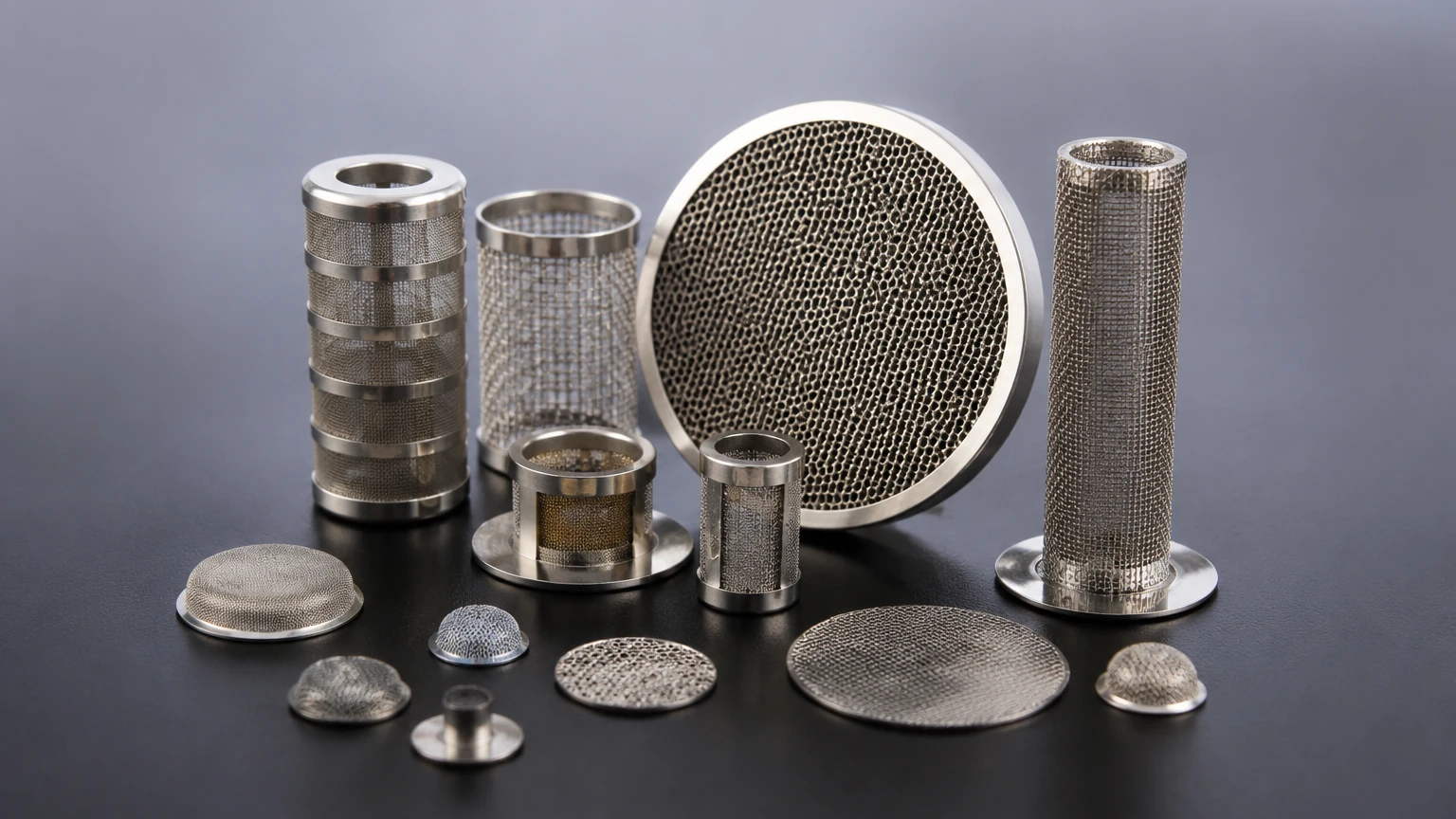
3. Encapsulation: To ensure a leak-free seal, frits are often encapsulated in a ring of inert material, such as PEEK, PTFE, or even a softer metal gold-plating. This "frit assembly" simplifies installation and ensures that the mobile phase is forced through the porous matrix rather than around it.
For engineers developing new chromatography hardware, partnering with a manufacturer that understands these variables is essential. You can Review product options and application support on our Main Page to see how custom metal components are integrated into complex fluidic systems.
Maintenance, Clogging, and Replacement Cycles
Chromatography frits are essentially depth filters, and like all filters, they have a finite lifespan. Clogging is the most common cause of frit failure, typically manifesting as a gradual or sudden increase in system backpressure.
Identifying the Source of Clogging
Clogging can occur from two directions. Inlet frits usually clog due to particulates in the sample or the mobile phase (e.g., precipitated buffers or pump seal wear). Outlet frits may clog due to "fines"—small fragments of the stationary phase that break off over time and become lodged in the frit's pores.
Cleaning vs. Replacement
In analytical HPLC, it is generally recommended to replace frits rather than attempt to clean them. The cost of a new frit is negligible compared to the cost of a ruined column or the labor required for troubleshooting. However, in large-scale preparative chromatography, frits may be cleaned using ultrasonic baths and aggressive solvents (such as nitric acid passivation for stainless steel). If cleaning does not return the backpressure to baseline levels, the frit must be replaced to prevent pump damage.
Total Cost of Ownership (TCO) in Industrial Filtration
When evaluating chromatography frits for B2B procurement, the purchase price is only one component of the total cost. Engineers must consider:
* Consistency: A cheaper frit with inconsistent pore size can lead to batch-to-batch variation in chromatography results, leading to expensive re-testing or product loss in pharmaceutical manufacturing.
* Durability: High-quality sintered 316L frits resist compression and deformation, maintaining their flow characteristics over thousands of injection cycles.
* System Protection: A frit that fails and allows stationary phase to enter the detector or valves can cause thousands of dollars in hardware damage.
By sourcing frits from a manufacturer with a focus on precision metal filtration, organizations can reduce the risk of downtime and ensure the integrity of their analytical and preparative processes.
Conclusion: Selecting the Right Partner for Filtration
Chromatography frits are small components that carry a heavy burden in the analytical laboratory and the industrial processing plant. From ensuring uniform flow distribution to protecting sensitive stationary phases, their performance is central to the success of any chromatographic separation.
When selecting a supplier, engineers should look for technical expertise in sintered metal technology, a deep understanding of chemical compatibility, and the ability to provide customized solutions for unique hardware requirements. Kaifil’s commitment to quality and precision in stainless steel filtration makes us a reliable partner for the most demanding chromatography applications.
Whether you are designing a new UHPLC system or maintaining a fleet of preparative columns, understanding the engineering behind your frits is the first step toward optimized performance. For more information on our full range of stainless steel filters and custom components, visit our Main Page.
