


Coalescer Meaning
In the landscape of industrial fluid processing, the term "coalescer" refers to a specialized separation technology designed to merge small droplets of a discontinuous phase into larger droplets, facilitating their removal from a continuous phase. While standard filtration typically focuses on the removal of solid particulate matter, the coalescer meaning in an engineering context is rooted in the separation of immiscible liquids or the removal of liquid aerosols from gas streams. Understanding the technical nuances of coalescence is critical for engineers and procurement teams tasked with maintaining system integrity in chemical processing, oil and gas, and high-precision hydraulic applications.
At its core, a coalescer operates on the principle of phase separation. Whether the goal is to remove water from aviation fuel or oil from industrial wastewater, the efficiency of the process depends on the physical properties of the fluids and the mechanical design of the coalescing media. For manufacturers like Kaifil, providing high-performance stainless steel filtration solutions requires a deep understanding of how material science influences these separation outcomes.
Understanding Coalescer Meaning in Industrial Filtration
To define the coalescer meaning accurately, one must distinguish between mechanical separation and chemical separation. A coalescer is a mechanical device. It does not rely on chemical reactions to break an emulsion; instead, it uses a medium—often a combination of specialized fibers or precision-engineered wire mesh—to force small, suspended droplets to collide and grow.
In a typical B2B industrial environment, coalescence is used when gravity alone is insufficient to separate two phases within a reasonable timeframe. For example, in a stable emulsion, droplets may be so small (often in the sub-micron range) that Brownian motion or slight fluid turbulence keeps them suspended indefinitely. The coalescer provides a surface and a flow path that encourages these droplets to aggregate until they reach a size where gravity or centrifugal force can effectively pull them out of the carrier fluid.
For engineers, the coalescer meaning also extends to the "coalescing element," which is the consumable or cleanable component within a housing. These elements are engineered with specific porosity and surface energy characteristics to ensure that as the mixture passes through, the internal phase is captured and merged without significantly impeding the flow of the external phase.
The Mechanics of the Coalescence Process
The physical process of coalescence within an industrial filter occurs in three distinct stages: interception, attachment, and release. Each stage is influenced by the design of the filter media and the velocity of the fluid.
1. Interception and Collision
As the contaminated fluid flows through the tortuous path of a coalescing medium, such as a stainless steel wire mesh or a sintered metal fiber matrix, the small droplets are forced into close proximity. The goal of the media design is to maximize the probability of collision between these droplets. This is where the precision of the manufacturing process becomes vital; if the pore structure is too open, droplets pass through without colliding. If it is too tight, the pressure drop (differential pressure) becomes excessive.
2. Attachment and Wetting
Once a droplet contacts the media surface, it must attach. The "wetting" characteristic of the material is a primary factor here. In water-from-oil separation, the media is often designed to be hydrophilic (water-attracting). This allows the water droplets to spread across the surface of the fibers, forming a thin film. As more droplets follow, they merge into this film, increasing the volume of the liquid held on the media.
3. Growth and Release
As the film of the separated phase grows, it eventually forms large droplets. When these droplets reach a critical size—where the drag force of the flowing fluid or the force of gravity exceeds the surface tension holding them to the media—they are released. Because these droplets are now significantly larger than the original dispersed particles, they quickly settle to the bottom of the vessel (if they are denser than the continuous phase) or rise to the top (if they are lighter), where they can be drained or skimmed off.
Liquid-Liquid vs. Gas-Liquid Coalescers
The application of the coalescer meaning varies depending on the states of matter involved. Industrial systems generally categorize these into two types:
Liquid-Liquid Coalescers
These are most common in the petrochemical and fuel industries. A primary example is the removal of water from diesel or jet fuel. Water in fuel can lead to microbial growth, corrosion of engine components, and icing at high altitudes. A liquid-liquid coalescer uses a primary stage to merge the water and a secondary "separator" stage—often made of a hydrophobic material like Teflon-coated stainless steel mesh—to block the large water droplets while allowing the clean fuel to pass through.
Gas-Liquid Coalescers
Also known as mist eliminators or moisture separators, these are used to remove liquid aerosols from gas streams. In compressed air systems or natural gas processing, liquid droplets can damage compressors and foul downstream catalysts. The gas-liquid coalescer forces the gas through a dense media where the liquid droplets aggregate and drain away, leaving a dry gas stream. This is a critical step in protecting high-value industrial equipment.
Material Selection and Engineering Specifications
When evaluating filtration solutions, the material of the coalescing element is the most significant factor in long-term performance. While disposable fiber elements are common, many demanding industrial applications require the durability of metal.
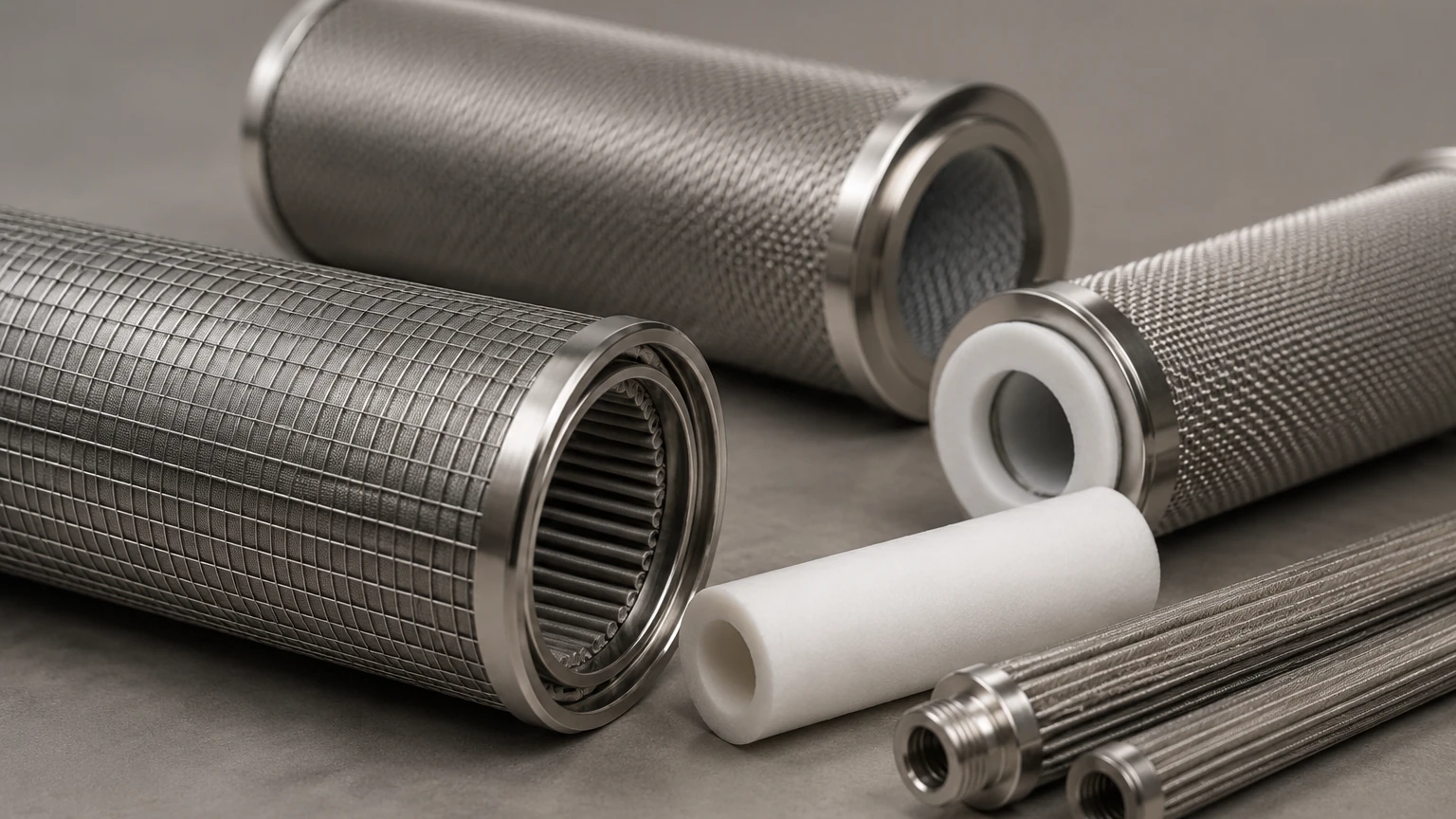
Kaifil specializes in custom stainless steel filtration solutions that address the limitations of traditional media. Stainless steel wire mesh and sintered metal components offer several advantages in coalescing applications:
* Chemical Compatibility: Stainless steel (304, 316L) is resistant to a wide range of corrosive chemicals, making it ideal for the pharmaceutical and chemical processing sectors.
* Temperature Resistance: Unlike polymer-based fibers, metal media can operate in high-temperature environments without losing structural integrity or changing its surface tension properties.
* Mechanical Strength: In high-pressure hydraulic systems, the media must withstand significant differential pressures. Stainless steel provides the necessary rigidity to prevent media migration or collapse.
* Cleanability: For many B2B operations, the total cost of ownership is reduced when a coalescing element can be cleaned and reused rather than replaced. Sintered mesh elements can often be backwashed or ultrasonically cleaned.
Engineers must also consider the "Beta Ratio" and the efficiency rating of the coalescer. A high-efficiency coalescer might be rated to remove 99.9% of droplets larger than 0.3 microns. Achieving this requires a precise balance between the fiber diameter of the media and the overall depth of the filter bed.
Key Performance Indicators for Coalescing Systems
To ensure a coalescing system is performing as intended, technical teams should monitor several key performance indicators (KPIs):
1. Downstream Concentration: The most direct measure of success is the concentration of the dispersed phase in the effluent. In fuel systems, this is often measured in parts per million (ppm). A high-quality coalescer should consistently meet or exceed industry standards (e.g., less than 15 ppm of water in fuel).
2. Differential Pressure (ΔP): As the coalescer captures solid contaminants (which often coexist with liquid contaminants), the pressure drop across the element will increase. Monitoring ΔP is essential for determining the optimal replacement or cleaning cycle.
3. Flow Rate Stability: Coalescers are sized based on specific flow velocities. If the flow rate exceeds the design capacity, the velocity may be too high to allow for effective droplet growth and release, leading to "carryover" where the separated phase is re-entrained into the clean stream.
4. Surface Tension and Viscosity: The "coalescer meaning" in practice is heavily influenced by the fluid's physical properties. Changes in temperature can alter viscosity, which in turn affects the ease with which droplets can move through the media and merge.
Common Risks and Selection Pitfalls
One of the primary risks in implementing a coalescing system is the presence of surfactants (surface-active agents). Surfactants lower the interfacial tension between two liquids, essentially "stabilizing" the emulsion. When surfactants are present, droplets are less likely to merge upon collision, which can render a standard coalescer ineffective. In such cases, specialized media treatments or additional pre-filtration stages are required.
Another common error is the neglect of pre-filtration. Because coalescing media often has a very fine pore structure, it can easily be blinded by solid particulate matter. To protect the coalescing element and extend its service life, it is standard engineering practice to install a high-efficiency particulate filter upstream. This ensures that the coalescer can focus solely on phase separation rather than solids removal.
Total Cost of Ownership and Customization
For purchasing teams, the initial price of a coalescing element is only one part of the financial equation. The total cost of ownership (TCO) includes the frequency of replacement, the cost of system downtime, and the potential damage to downstream equipment if the coalescer fails.
Customized filtration solutions often provide a better ROI than off-the-shelf components. By tailoring the wire mesh weave, the number of layers in a sintered element, and the specific alloy used, manufacturers can create a solution that matches the exact flow conditions and chemical environment of the application. This precision reduces the risk of premature failure and optimizes the separation efficiency.
Kaifil’s expertise in OEM and customized filtration allows for the development of components that meet these rigorous industrial demands. Whether the application requires a specific filtration accuracy or a unique housing configuration, working with a manufacturer that understands the technical depth of the coalescer meaning ensures a more reliable and cost-effective outcome.
Conclusion
Understanding the coalescer meaning is essential for any technical professional involved in fluid management. It is a process that goes beyond simple filtration, requiring a sophisticated grasp of fluid dynamics, material science, and mechanical design. By selecting the right media—particularly durable, high-precision options like stainless steel—and monitoring key performance metrics, industries can achieve superior phase separation, protect their equipment, and maintain the purity of their products.
For those looking to optimize their industrial filtration processes, reviewing technical specifications and performance data is the next logical step. You can Review product options and application support on our Main Page to learn more about how custom-engineered stainless steel solutions can enhance your coalescing and filtration systems.
