


Coalescing Filter Elements
In industrial fluid management, the separation of immiscible liquids or the removal of liquid aerosols from gas streams is a critical process requirement. Coalescing filter elements are specialized components designed to perform this task by merging small droplets into larger ones, which can then be easily removed by gravity. Unlike standard particulate filters that simply trap solid contaminants, coalescing technology addresses the complexities of phase separation, ensuring the purity of process fluids and protecting downstream equipment from moisture and oil contamination.
For engineers and procurement teams, selecting the right coalescing filter elements involves a deep understanding of fluid dynamics, material compatibility, and the specific physical properties of the contaminants being targeted. This guide examines the technical principles, engineering considerations, and selection criteria essential for implementing effective coalescing solutions in demanding industrial environments.
Understanding the Mechanics of Coalescence
Coalescence is a multi-stage physical process that occurs within a specialized filter medium. The primary objective is to take finely dispersed droplets—often in the sub-micron range—and force them to collide and unite. This process is generally broken down into three distinct phases:
1. Interception and Capture
As the contaminated fluid (the continuous phase) passes through the filter media, the dispersed droplets (the discontinuous phase) come into contact with the fibers or mesh of the element. This occurs through three mechanisms: direct interception, where the droplet hits a fiber; inertial impaction, where the droplet's mass prevents it from following the fluid streamlines around a fiber; and Brownian diffusion, which affects the smallest particles (typically under 0.1 microns) as they move erratically and eventually strike the filter surface.
2. Coalescence (Merging)
Once captured, the droplets travel along the fibers of the media. Because the media is typically designed to be "wetted" by the discontinuous phase (hydrophilic or oleophilic, depending on the application), the droplets spread across the fibers. As more droplets are captured, they collide with one another at the fiber intersections, merging into larger masses. The structure of the media must provide sufficient surface area and tortuosity to maximize these collisions without creating an excessive pressure drop.
3. Drainage and Separation
When the merged droplets reach a critical size, the drag force of the fluid stream and the force of gravity overcome the adhesive forces holding the liquid to the filter media. These large droplets then migrate toward the outer surface of the element (in out-to-in flow) or the inner surface (in in-to-out flow) and drain into a collection sump. Because the droplets are now significantly larger and heavier than the original aerosols, they settle out of the continuous phase effectively.
Material Engineering in Coalescing Filter Elements
The performance of coalescing filter elements is heavily dependent on the materials used in their construction. In industrial applications where high temperatures, corrosive chemicals, or high pressures are present, material selection becomes the defining factor in service life and efficiency.
Stainless Steel and Metal Media
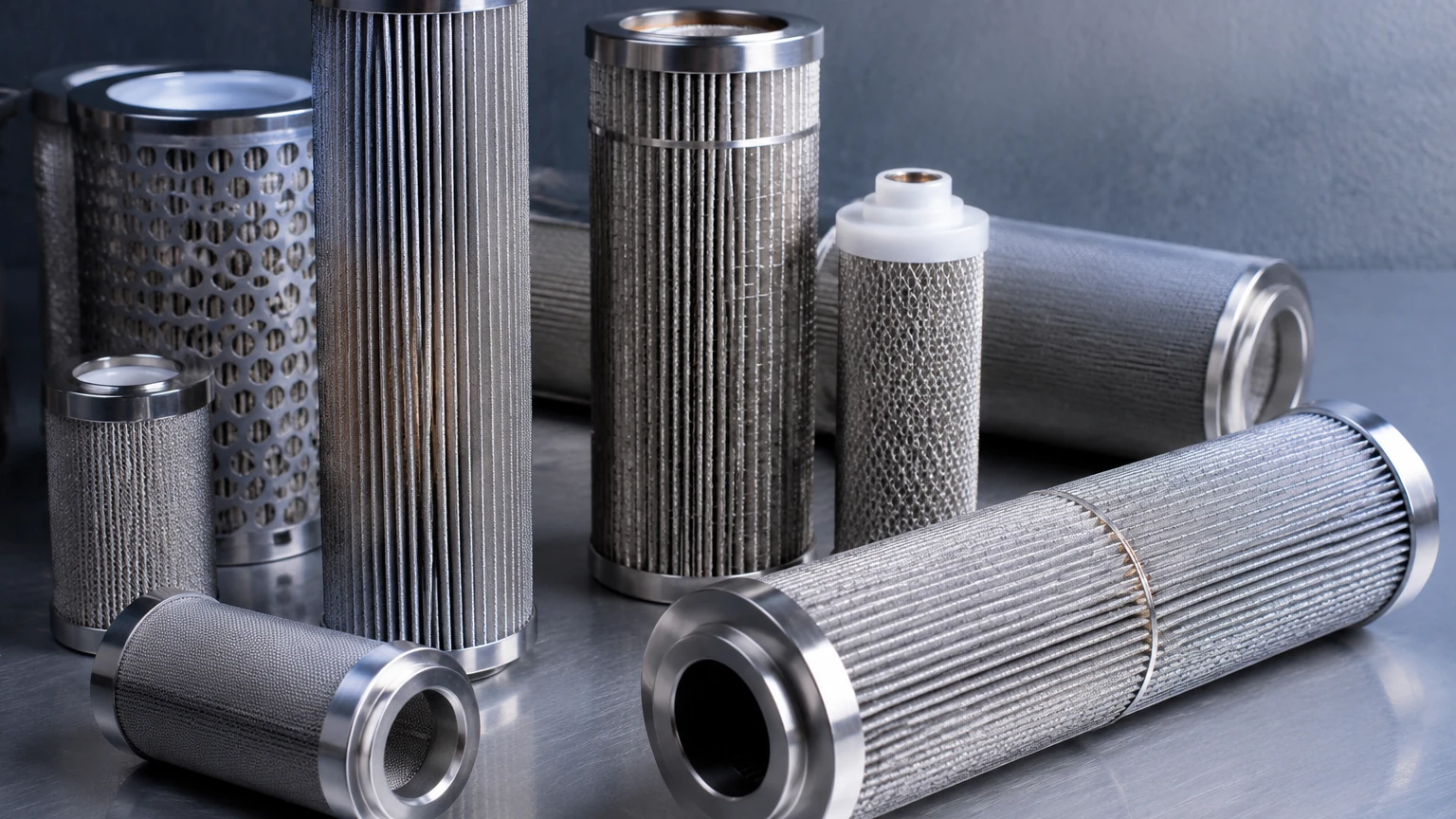
As a manufacturer specializing in high-performance filtration, Kaifil emphasizes the use of stainless steel (typically Grades 304 or 316L) in coalescing systems. Stainless steel wire mesh and sintered metal fibers offer several advantages:
* Thermal Stability: Metal elements can operate in environments exceeding 250°C, where synthetic fibers would melt or degrade.
* Chemical Resistance: Stainless steel is resistant to a wide range of hydrocarbons, solvents, and acidic or alkaline process fluids.
* Structural Rigidity: Unlike glass fiber or paper media, stainless steel elements can withstand high differential pressures without collapsing or shedding fibers into the process stream.
* Cleanability: In many liquid-liquid separation applications, metal coalescing elements can be cleaned and reused, reducing the total cost of ownership.
Composite and Borosilicate Media
For gas-liquid coalescence, such as removing oil mist from compressed air, borosilicate micro-glass fibers are often used. These fibers are exceptionally thin, allowing for a high void volume and high efficiency in capturing sub-micron aerosols. Often, these media are supported by stainless steel inner and outer cages to provide the necessary mechanical strength for industrial use.
Technical Selection Parameters for Engineers
When specifying coalescing filter elements for a new system or as replacements, several technical parameters must be evaluated to ensure performance expectations are met.
Interfacial Tension (IFT)
Interfacial tension is a measure of the force between two immiscible liquids. In liquid-liquid separation (such as water from diesel), a low IFT (below 20 dynes/cm) makes coalescence difficult because the droplets do not merge easily. In such cases, specialized surface treatments or multi-stage systems may be required.
Flow Velocity and Flux Rate
Coalescence is a velocity-sensitive process. If the fluid velocity through the media is too high, the drag forces will strip droplets away before they have a chance to grow large enough to drain. This leads to "re-entrainment," where the contaminant is carried downstream despite the filter's presence. Engineers must calculate the optimal flux rate (flow per unit area) to maintain laminar flow conditions within the media.
Micron Rating and Efficiency
While particulate filters are rated by their ability to stop solids, coalescing elements are rated by their separation efficiency. A high-quality coalescer can often achieve 99.9% removal of droplets down to 0.3 microns. It is important to confirm whether the efficiency rating is based on a single pass or a recirculating system.
Differential Pressure ($ΔP$)
The pressure drop across the element is a critical indicator of system health. A clean coalescing element will have a baseline $ΔP$. As the element captures solids (which often coexist with liquid contaminants), the $ΔP$ will rise. If the $ΔP$ becomes too high, it can compromise the coalescing process or damage the element. Most industrial systems include a pre-filter to remove solids, allowing the coalescer to focus solely on liquid separation.
Critical Applications in Industrial Processing
Coalescing filter elements are utilized across various sectors where fluid purity is paramount. Understanding these applications helps in selecting the appropriate configuration.
Compressed Air and Gas Systems
In pneumatic systems, oil and water aerosols can cause corrosion in piping and failure of sensitive valves. Coalescing elements are placed after the compressor to remove these contaminants. In the oil and gas industry, large-scale coalescers are used to remove liquid hydrocarbons from natural gas streams to prevent damage to turbines and compressors.
Hydrocarbon and Fuel Filtration
Water is a common contaminant in jet fuel, diesel, and insulating oils. Even small amounts of water can lead to microbial growth, fuel system corrosion, and engine flameouts. Coalescing elements are the industry standard for removing free and emulsified water from these fuels, often used in conjunction with a separator element that blocks the drained water from re-entering the stream.
Chemical and Petrochemical Processing
In chemical manufacturing, coalescers are used to recover expensive catalysts or to separate reaction products. The ability to customize the metallurgy of the filter element, a core capability of the Main Page solutions, is essential here to handle aggressive chemical environments.
Optimizing Service Life and Maintenance
The total cost of ownership for coalescing systems is determined not just by the initial purchase price, but by the frequency of replacement and the protection offered to downstream components. To maximize the life of coalescing filter elements, the following maintenance practices are recommended:
1. Strict Pre-filtration: Coalescing media is designed to handle liquids. If solid particulates reach the coalescer, they will plug the fine pore structure rapidly. Installing a high-efficiency particulate filter upstream can extend the life of a coalescer by 3 to 5 times.
2. Differential Pressure Monitoring: Continuous monitoring of $ΔP$ is the most effective way to determine when an element needs replacement. Sudden drops in pressure may indicate a ruptured element or "channeling," where fluid bypasses the media.
3. Regular Sump Drainage: For coalescers with manual drains, regular removal of the collected liquid is necessary. If the sump overfills, the collected liquid will be re-entrained into the fluid stream.
4. Compatibility Checks: Ensure that any additives in the process fluid (such as surfactants or detergents) do not lower the interfacial tension to a point where the coalescer becomes ineffective.
Custom OEM Solutions for Complex Filtration
Standard off-the-shelf coalescing elements may not meet the requirements of specialized industrial processes. Factors such as non-standard housing dimensions, extreme chemical exposure, or unique flow requirements necessitate a customized approach.
Kaifil specializes in the engineering and manufacturing of custom stainless steel filtration components. By working directly with a manufacturer, engineers can specify exact dimensions, end-cap configurations, and media layers to optimize separation performance for their specific application. Whether it is a pleated wire mesh design for high surface area or a sintered fiber structure for fine aerosol removal, customization ensures that the filtration system operates at peak efficiency with minimal maintenance overhead.
For more information on technical specifications, material options, and customized filtration designs, please visit the Main Page to review product options and application support. Selecting the right coalescing filter elements is a balance of science and engineering; partnering with an experienced manufacturer ensures that this balance is achieved for every industrial challenge.
