


Coalescing Filter vs Water Separator
In industrial fluid and gas management, the presence of liquid contaminants—specifically water and oil—can lead to catastrophic equipment failure, corrosion, and compromised product quality. To mitigate these risks, engineers rely on two primary technologies: water separators and coalescing filters. While both are designed to remove liquids from a stream, they operate on different physical principles and target different sizes of contaminants. Understanding the nuances of a coalescing filter vs water separator is essential for designing an efficient filtration stage that balances performance with operational costs.
Selecting the wrong component or placing it incorrectly in the system can result in premature filter clogging, downstream moisture carryover, or excessive pressure drops. This guide examines the technical distinctions, engineering considerations, and application-specific requirements for these two critical filtration components.
Understanding the Water Separator: Mechanical Removal of Bulk Liquids
A water separator, often referred to as a moisture separator or centrifugal separator, is typically the first line of defense in a compressed air or gas system. Its primary function is to remove "bulk" or "free" liquid—water that has already condensed into droplets large enough to be influenced by mechanical forces.
Mechanical Principles
Most industrial water separators utilize mechanical separation techniques rather than filter media. The most common designs include:
1. Centrifugal/Cyclonic Separation: The incoming gas or fluid enters a cylindrical chamber at high velocity, often through a tangential inlet. This creates a vortex. The denser liquid droplets are flung outward against the chamber walls by centrifugal force, where they lose velocity and drain into a collection sump.
2. Baffle Separation: The stream is forced through a series of internal plates or baffles. The rapid changes in direction cause heavier liquid particles to collide with the surfaces, coalescing into larger drops that fall out of the stream.
Performance Characteristics
Water separators are highly effective at removing large volumes of liquid, often achieving 90% to 99% efficiency for droplets larger than 10 microns. However, they are generally ineffective against fine aerosols or sub-micron mists. Because they lack a fine porous medium, they exhibit a very low pressure drop (Delta P) and require minimal maintenance beyond ensuring the condensate drain is functioning correctly.
The Role of the Coalescing Filter: Capturing Sub-Micron Aerosols
While a water separator handles the "heavy lifting" of bulk liquid removal, a coalescing filter is a precision instrument designed to remove liquid aerosols and fine mists that remain suspended in the gas stream. These aerosols are often smaller than 1 micron and cannot be removed by mechanical separation alone.
How Coalescence Works
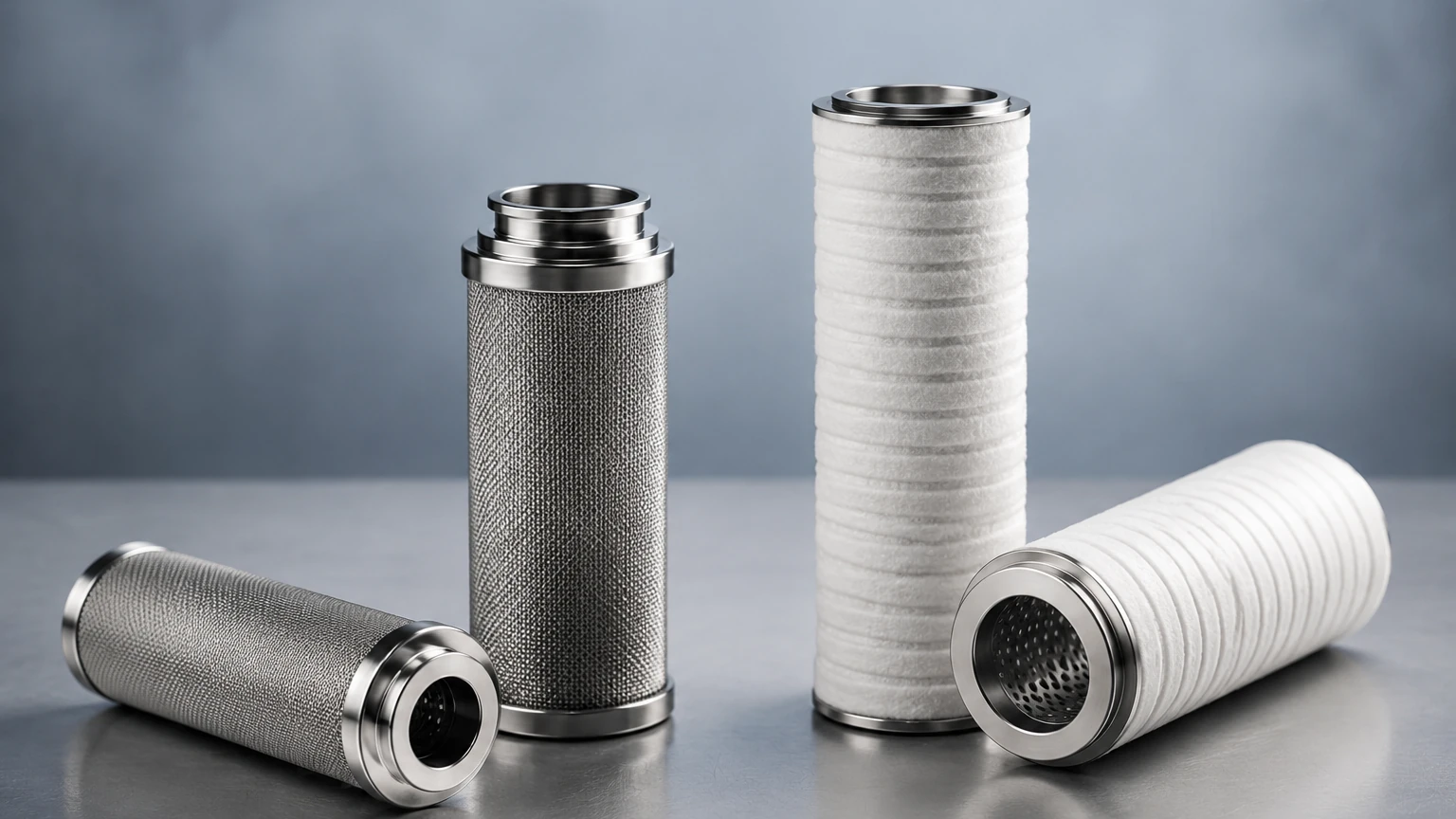
Coalescing filters utilize a specialized filter medium, often composed of borosilicate micro-fibers or high-grade stainless steel mesh layers. The process occurs in three distinct stages as the gas moves from the inside of the filter element to the outside:
* Direct Interception: Larger particles (typically >1 micron) collide with the filter fibers and stick to them.
* Inertial Impaction: Particles with higher mass cannot follow the tortuous path of the gas through the fibers; they strike the fibers and are captured.
* Brownian Diffusion: For extremely small particles (<0.1 micron), random molecular motion causes them to collide with fibers despite their small mass.
As these tiny droplets are captured on the fibers, they merge (coalesce) with other droplets to form larger drops. These larger drops eventually migrate to the outer surface of the filter element, where they become heavy enough to fall into the filter bowl for drainage.
Efficiency and Limitations
Coalescing filters can achieve incredible efficiency, often removing 99.99% of oil and water aerosols down to 0.01 microns. However, they are susceptible to "slugs" of bulk liquid. If a large volume of water hits a coalescing element, it can saturate the media, causing a massive pressure drop and potentially rupturing the element. This is why they are almost always placed downstream of a water separator.
Key Differences: Coalescing Filter vs Water Separator
When evaluating a coalescing filter vs water separator, engineers must look at the specific state of the contaminant and the required downstream purity.
| Feature | Water Separator | Coalescing Filter |
| :— | :— | :— |
| Primary Target | Bulk liquid, large droplets (>10μm) | Liquid aerosols, fine mists (<1μm) |
| Mechanism | Mechanical (Centrifugal/Baffles) | Media-based (Interception/Diffusion) |
| Pressure Drop | Very Low | Moderate to High (increases with saturation) |
| System Position | Upstream (Point of entry) | Downstream (Point of use/Pre-dryer) |
| Maintenance | Low (Drain cleaning) | High (Periodic element replacement) |
| Solids Removal | Limited (Heavy particles only) | Excellent (Acts as a high-efficiency particulate filter) |
Fluid State and Particle Size
The most significant differentiator is the particle size. If the liquid is visible as a spray or puddle, a separator is required. If the liquid appears as a fog or smoke (aerosol), a coalescing filter is necessary. In many industrial environments, the gas stream contains both, necessitating a multi-stage approach.
Engineering Considerations for Material Selection
In demanding industrial environments, such as chemical processing, pharmaceutical manufacturing, or offshore oil and gas, the material of the filter housing and element is as critical as the filtration mechanism itself.
Stainless Steel Durability
Standard aluminum or plastic housings may suffice for simple shop air, but for corrosive gases or high-pressure hydraulic systems, stainless steel is the industry standard. Stainless steel (304 or 316L) provides the structural integrity needed to withstand high differential pressures and prevents the introduction of rust or scale into the system, which could happen with carbon steel components.
For those seeking high-performance filtration components, visiting the Main Page of a specialized manufacturer like Kaifil provides insights into how custom stainless steel mesh and cartridges can be engineered to meet specific chemical compatibility and temperature requirements.
Pressure Drop and Flow Rates
Every filter introduces a restriction to the flow. Engineers must calculate the "Total Cost of Ownership" (TCO) by considering the energy cost associated with the pressure drop. A coalescing filter that is undersized will saturate quickly, leading to a high Delta P and increased compressor energy consumption. Conversely, an oversized water separator may lose its centrifugal efficiency if the velocity of the gas is too low to create a proper vortex.
Application-Specific Implementation
The choice between a coalescing filter vs water separator often depends on the specific industry standards and the sensitivity of downstream equipment.
Food and Beverage Industry
In food-grade applications, compressed air often comes into direct contact with products. Here, a water separator removes bulk condensate from the compressor, followed by a series of coalescing filters to ensure the air is free of oil aerosols (which could taint flavor) and microorganisms. Using stainless steel filter elements is mandatory here to allow for Steam-In-Place (SIP) sterilization.
Hydraulic Systems
In high-pressure hydraulic circuits, water separators (often in the form of vacuum dehydrators or specialized centrifugal units) are used to remove free water that can cause oil oxidation and pump cavitation. Coalescing elements are then used in kidney-loop systems to remove emulsified water that has integrated into the oil, which standard separators cannot touch.
Chemical Processing
When dealing with aggressive gases, the coalescing media must be chemically inert. Borosilicate glass is common, but in some cases, specialized multi-layered stainless steel wire mesh is used to provide both coalescence and particulate filtration in a single, robust element that can be cleaned and reused.
Maintenance and Performance Monitoring
To ensure the longevity of both water separators and coalescing filters, a proactive maintenance strategy is required.
1. Drain Management: Both components rely on drains. If an automatic drain fails in a water separator, the collected liquid will eventually be re-entrained into the gas stream. In a coalescing filter, a failed drain will lead to "carryover," where the liquid mists pass straight through the saturated media.
2. Differential Pressure Monitoring: Coalescing filters should be equipped with differential pressure gauges. A sudden rise in pressure usually indicates particulate loading, while a steady, high pressure indicates the media is nearing the end of its service life.
3. Element Replacement: Unlike water separators, which are often "fit and forget" mechanical devices, coalescing elements have a finite lifespan. As they capture solid particulates alongside liquid aerosols, the pores eventually block. Engineers should establish replacement cycles based on hours of operation or pressure drop thresholds.
Conclusion: A Complementary Relationship
In the debate of coalescing filter vs water separator, the conclusion is rarely "one or the other." Instead, they are complementary components of a well-engineered filtration system. The water separator protects the coalescing filter from liquid loading, while the coalescing filter provides the high-purity output that the separator cannot achieve.
When specifying these components, engineers must prioritize material compatibility, flow dynamics, and the specific nature of the contaminants. By selecting high-quality stainless steel filtration solutions and adhering to proper system placement, industrial operations can significantly reduce downtime and extend the life of their downstream equipment.
