


Coalescing Oil Separator
In industrial fluid management, the efficiency of a coalescing oil separator is critical for protecting downstream equipment, ensuring product purity, and meeting environmental compliance standards. Whether used in compressed air systems, refrigeration cycles, or wastewater treatment, these components serve a singular primary purpose: the removal of entrained oil droplets from a gas or liquid stream. For engineers and procurement professionals, understanding the underlying physics and material requirements of these separators is essential for selecting a solution that balances performance with long-term operational costs.
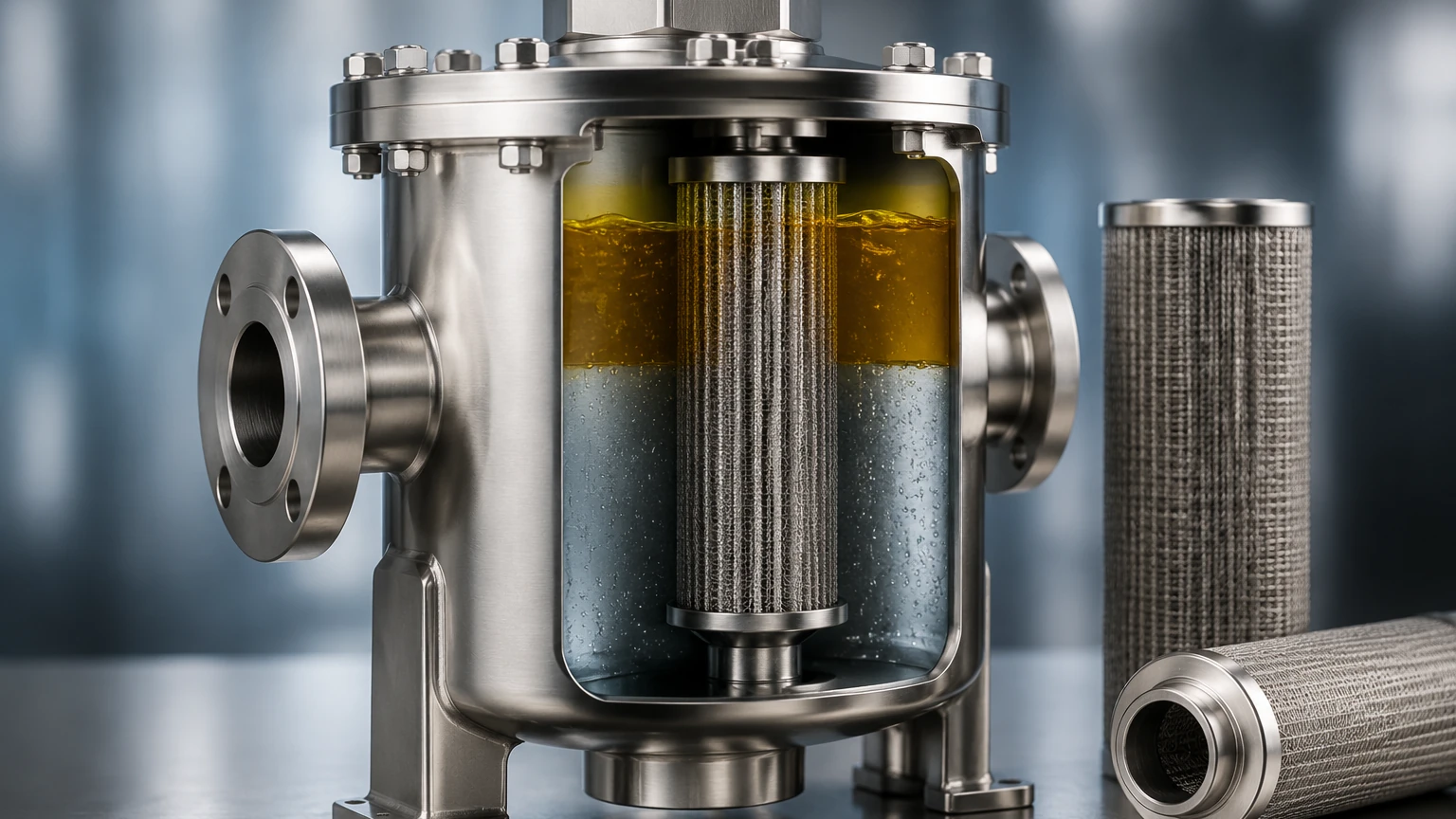
A coalescing oil separator operates on the principle of merging small, sub-micron droplets into larger masses that can be more easily removed by gravity. Unlike standard particulate filters that simply block solids, a coalescer must manage the complex dynamics of surface tension, flow velocity, and media saturation. As a specialized manufacturer, Kaifil provides the technical foundation for these systems through high-precision stainless steel filtration components designed for demanding industrial environments.
Understanding the Mechanics of Coalescence
The process of coalescence within an industrial separator occurs in three distinct stages: capture, coalescence, and drainage. To select the right equipment, it is necessary to evaluate how the internal media facilitates these stages under specific operating conditions.
1. The Capture Phase
As the contaminated fluid passes through the filter media, tiny oil droplets are captured via three physical mechanisms:
* Direct Interception: Occurs when a droplet follows a fluid streamline and comes into contact with a media fiber or wire. This is most effective for droplets in the 1 to 10-micron range.
* Inertial Impaction: Larger droplets, possessing higher momentum, cannot follow the rapid changes in fluid direction around the media fibers. They strike the fibers and adhere to them.
* Brownian Diffusion: For extremely small sub-micron droplets, random molecular movement causes them to collide with the media. This is critical for high-efficiency air/oil separation.
2. The Coalescence Phase
Once captured, the droplets reside on the surface of the media fibers. As more droplets are intercepted, they merge (coalesce) with existing ones. The choice of material is vital here; the media must have specific wetting characteristics to allow droplets to migrate along the fibers and form larger beads without prematurely detaching.
3. The Drainage Phase
When the coalesced droplets reach a sufficient mass, the forces of gravity or fluid flow overcome the surface tension holding them to the media. The oil then drains to a collection sump, while the cleaned fluid continues through the system. In a vertical configuration, the oil typically moves downward, whereas in some horizontal designs, it may be pushed toward a dedicated discharge port.
Material Selection: The Role of Stainless Steel
The environment in which a coalescing oil separator operates often dictates the material of construction. While synthetic fibers are common in standard applications, industrial processes involving high temperatures, corrosive chemicals, or stringent hygiene requirements necessitate metal filtration media.
Stainless steel wire mesh and sintered metal fibers are the preferred choices for heavy-duty coalescers. These materials offer several distinct advantages:
* Thermal Stability: In applications like steam recovery or high-temperature gas filtration, synthetic media may melt or degrade. Stainless steel maintains structural integrity at temperatures exceeding 400°C.
* Corrosion Resistance: For chemical processing or offshore oil and gas applications, 316L stainless steel provides the necessary resistance to acidic or saline environments.
* Cleanability: Unlike disposable glass fiber elements, stainless steel mesh filters can often be cleaned and reused, reducing the total cost of ownership and environmental waste.
* Structural Rigidity: High-pressure hydraulic systems or vacuum pumps can subject filter elements to significant mechanical stress. Precision-welded stainless steel cartridges prevent media migration and bypass.
For those evaluating custom configurations, Kaifil offers extensive expertise in developing specialized stainless steel filter cartridges that serve as the core of high-performance coalescing systems. You can explore these capabilities on our Main Page.
Key Engineering Evaluation Criteria
When specifying a coalescing oil separator, engineers must look beyond the initial purchase price and focus on performance metrics that impact the entire system's efficiency.
Flow Rate and Velocity
Coalescence is highly sensitive to flow velocity. If the velocity is too high, the fluid may "strip" droplets off the media before they have grown large enough to drain, leading to oil carryover. Conversely, if the velocity is too low, the inertial impaction mechanism is weakened. Designers must ensure the separator is sized for the maximum anticipated flow rate while maintaining an optimal velocity profile across the media surface.
Differential Pressure (ΔP)
Every filter introduces a pressure drop. In a coalescing oil separator, the differential pressure will increase as the media becomes saturated with oil. A high initial ΔP indicates an undersized unit or overly restrictive media, which increases energy consumption for pumps and compressors. Monitoring the ΔP over time is the primary method for determining when maintenance or element replacement is required.
Filtration Efficiency and Beta Ratio
Efficiency is typically expressed as the percentage of oil removed at a specific micron rating (e.g., 99.9% at 0.3 microns). For critical applications, such as food-grade compressed air or pharmaceutical processing, the Beta ratio provides a more detailed look at the filter's performance across various particle sizes. It is essential to confirm that the separator can handle the specific oil aerosol distribution present in the influent stream.
Common Risks and Operational Challenges
Failure to properly maintain or specify a coalescing oil separator can lead to several industrial risks:
1. Oil Carryover: If the coalescing element is saturated or damaged, oil will pass through the separator. In compressed air systems, this can contaminate pneumatic tools, ruin paint finishes, or spoil food products.
2. Emulsification: In water/oil separation, if the fluid is subjected to high shear (such as through a high-speed centrifugal pump) before entering the separator, the oil may become emulsified. Standard coalescers struggle to break chemical emulsions, requiring specialized pre-treatment or ultrafiltration.
3. Pressure Surges: Sudden spikes in pressure can collapse filter elements or force captured oil through the media. Utilizing reinforced stainless steel support cores within the filter cartridge can mitigate this risk.
4. Incompatibility: Using a separator designed for mineral oils with synthetic lubricants (like PAG or POE oils) can lead to seal failure or media degradation if the materials are not compatible.
Customization and OEM Solutions
Many industrial applications do not fit a "one-size-fits-all" approach. A coalescing oil separator integrated into a specialized vacuum pump or a custom hydraulic power unit often requires a bespoke design. This is where manufacturing partnerships become valuable.
Customization options typically include:
* Custom Micron Ratings: Adjusting the density of the wire mesh or fiber layers to target specific droplet sizes.
* End Cap Configurations: Designing specialized fittings (threaded, flanged, or bayonet-style) to ensure a leak-proof seal within existing housings.
* Multi-Stage Filtration: Combining a particulate pre-filter and a coalescing stage within a single cartridge to save space and reduce maintenance complexity.
By working directly with a manufacturer like Kaifil, engineering teams can ensure that the filtration components are optimized for the specific fluid dynamics of their equipment. This collaborative approach helps in achieving the desired filtration accuracy while maintaining durability in demanding industrial environments.
Pre-Purchase Checklist for Technical Teams
Before finalizing a purchase or contract for coalescing oil separators, the following information should be confirmed:
* Fluid Properties: What is the viscosity, density, and surface tension of both the continuous phase (gas/water) and the dispersed phase (oil)?
* Operating Conditions: What are the maximum and minimum operating pressures and temperatures?
* Contamination Levels: What is the expected oil concentration in the inlet, and what is the maximum allowable concentration in the outlet?
* Space Constraints: Does the separator need to fit within a specific footprint or height requirement?
* Regulatory Compliance: Are there specific certifications required, such as ASME pressure vessel codes or FDA-compliant materials for food contact?
Conclusion
The coalescing oil separator is a sophisticated piece of engineering that relies on the precise interaction between fluid dynamics and material science. By focusing on high-quality stainless steel media and robust design principles, industrial operations can achieve superior separation efficiency, protect expensive downstream assets, and reduce long-term maintenance costs. For engineers seeking reliable, customized filtration components, reviewing the technical options and manufacturing capabilities available on the Main Page is a productive next step in optimizing system performance.
