


Compressed Air Muffler
In industrial pneumatic systems, the rapid exhaust of compressed air is a primary source of high-frequency noise pollution. A compressed air muffler, also commonly referred to as a pneumatic silencer, is a critical engineering component designed to reduce the decibel levels of exhaust air while managing the resulting backpressure. For engineers and maintenance professionals, selecting the correct muffler is not merely a matter of noise reduction; it involves a complex balance of fluid dynamics, material science, and operational efficiency.
Kaifil specializes in the manufacturing of high-performance stainless steel filtration and exhaust solutions. Understanding the technical nuances of compressed air mufflers—from their internal mechanics to material compatibility—is essential for optimizing the lifespan of pneumatic components and ensuring a safe working environment compliant with international noise standards.
The Mechanics of Pneumatic Noise Reduction
Pneumatic noise is generated when high-pressure air is released into the atmosphere, causing extreme turbulence and pressure fluctuations. This process typically produces sound levels exceeding 100 dB(A), which far surpasses the safe limits established by organizations like OSHA (Occupational Safety and Health Administration). A compressed air muffler mitigates this noise through two primary physical mechanisms: expansion and diffusion.
Expansion and Velocity Reduction
When compressed air enters the muffler, it moves from a narrow exhaust port into a larger internal chamber. This increase in volume allows the air to expand rapidly, which significantly reduces its velocity. Since the intensity of aerodynamic noise is proportional to the sixth or eighth power of the air velocity, even a moderate reduction in speed leads to a substantial decrease in sound pressure levels.
Diffusion and Surface Area
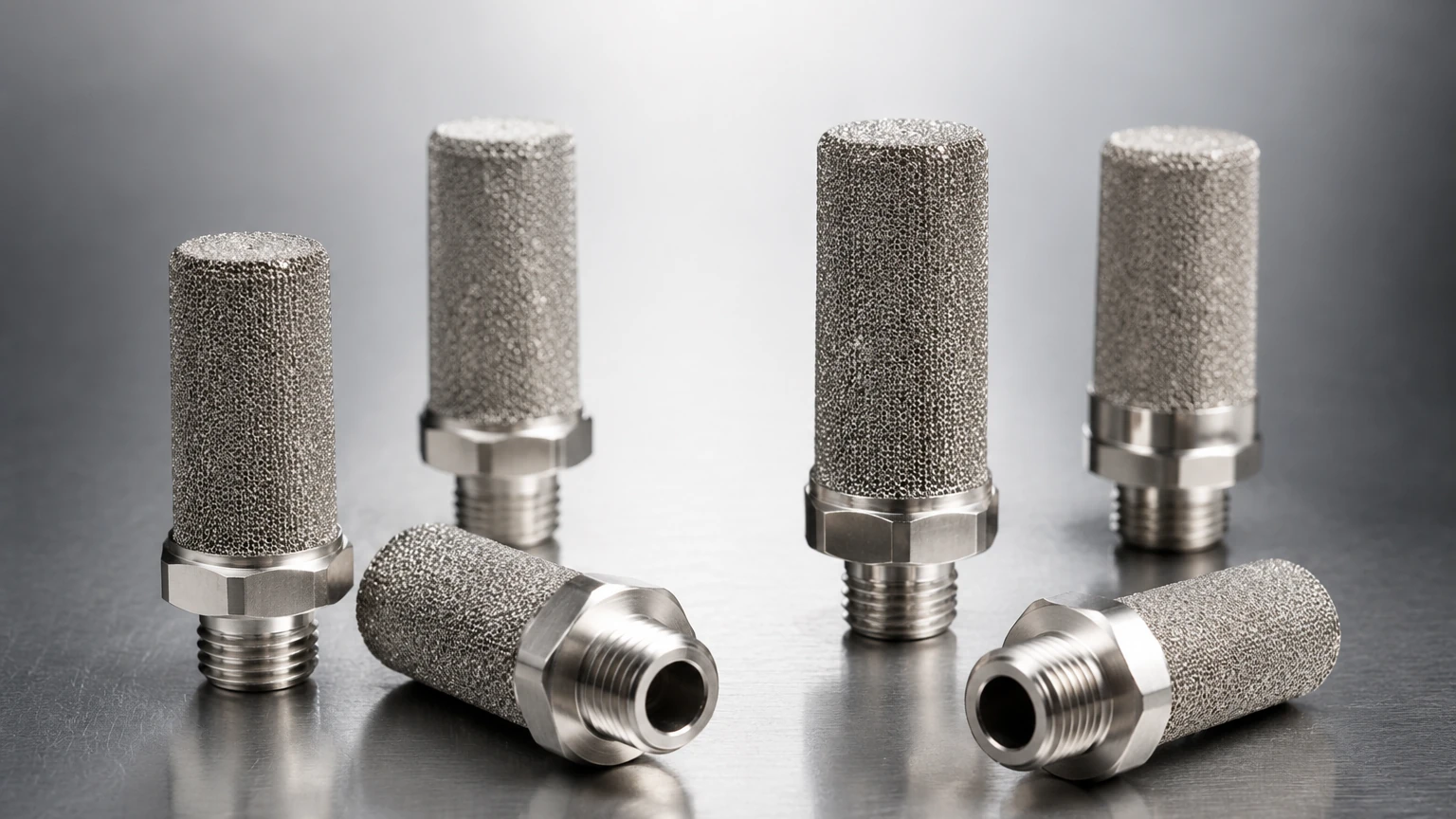
After expansion, the air is forced through a porous medium—often sintered wire mesh or sintered metal powder. This medium breaks the single, high-velocity air stream into thousands of tiny, low-velocity jets. By increasing the surface area through which the air must pass, the muffler dissipates the energy of the sound waves. The tortuous path within the porous structure further absorbs acoustic energy, converting it into negligible amounts of heat.
Material Engineering: Why Stainless Steel Matters
While compressed air mufflers are available in plastic, brass, and aluminum, stainless steel remains the gold standard for demanding industrial environments. Kaifil’s focus on stainless steel filtration components stems from the material's superior mechanical properties and chemical resistance.
Corrosion Resistance and Chemical Compatibility
In industries such as chemical processing and pharmaceutical manufacturing, exhaust air may contain trace amounts of corrosive gases or be exposed to harsh cleaning agents. 304 and 316L stainless steel provide exceptional resistance to oxidation and chemical attack. Unlike plastic mufflers, which can embrittle and crack when exposed to certain synthetic lubricants or UV light, stainless steel maintains its structural integrity over long operational cycles.
Thermal Stability
Pneumatic systems operating in high-temperature environments, such as glass manufacturing or metal forging, require components that can withstand thermal cycling. Stainless steel mufflers can operate at temperatures exceeding 400°C (752°F), far beyond the melting point or deformation temperature of polymer-based silencers. This thermal stability ensures that the pore structure of the filtration medium remains consistent, preventing unexpected changes in backpressure.
Structural Integrity under High Pressure
In high-pressure pneumatic applications, the mechanical stress on a muffler can be significant. Sintered stainless steel wire mesh provides high mechanical strength and impact resistance. This prevents the "blowout" phenomenon where the internal silencing element is ejected from the housing due to a sudden pressure spike—a common failure mode in lower-quality brass or plastic alternatives.
Critical Performance Metrics for Engineers
When specifying a compressed air muffler, engineers must evaluate several performance metrics to ensure the component does not negatively impact the efficiency of the pneumatic circuit.
Noise Reduction (Insertion Loss)
The primary metric is the decibel reduction, often measured as "insertion loss." A high-quality stainless steel muffler can typically reduce noise levels by 20 dB(A) to 35 dB(A). It is important to note that the decibel scale is logarithmic; a 10 dB reduction represents a 90% reduction in sound intensity. Engineers should look for test data that shows noise reduction across a range of frequencies, as high-frequency "hiss" is often more damaging to hearing than low-frequency thumps.
Backpressure and Flow Capacity (Cv)
Every muffler introduces some level of restriction to the exhaust flow, known as backpressure. Excessive backpressure can slow down the cycle time of pneumatic cylinders, reduce the force output of air motors, and cause erratic valve behavior. The flow capacity is often expressed as a Cv value (flow coefficient).
To minimize the impact on system performance, the muffler's flow capacity should ideally exceed the flow capacity of the valve it is attached to. Engineers must balance the need for high noise attenuation (which usually requires a denser porous medium) with the need for low backpressure (which requires a more open structure).
Filtration Efficiency
In many applications, a compressed air muffler also serves as a final filter. As air is exhausted, it can carry oil mist from lubricated lines or particulate matter from pipe scale. A sintered mesh muffler can capture these contaminants, preventing them from being atomized into the factory air. This is particularly vital in food and beverage applications where air quality is a primary concern for product safety.
Selection Guide for Industrial Applications
Selecting the right compressed air muffler involves more than matching thread sizes. Engineers should follow a systematic approach to ensure long-term reliability.
1. Identify the Connection Type: Most industrial mufflers use NPT (National Pipe Thread) or BSP (British Standard Pipe) threads. Ensuring a leak-free, secure fit is the first step in installation. For high-vibration environments, mufflers with integrated hex heads are preferred for secure torquing.
2. Determine the Environmental Hazards: Is the muffler located in a washdown area? If so, 316L stainless steel is required to resist the caustic chemicals used in sanitation. Is there a risk of external clogging from ambient dust? In such cases, a muffler with a larger surface area or a "self-cleaning" design may be necessary.
3. Calculate Required Flow Rates: Use the system's maximum SCFM (Standard Cubic Feet per Minute) to size the muffler. Sizing for the peak flow rather than the average flow prevents intermittent backpressure spikes that can disrupt sensitive timing in automated assembly lines.
4. Evaluate Space Constraints: In compact manifold blocks, space is at a premium. "Flat" or "button" style mufflers provide noise reduction in a low-profile form factor, though they may offer less total noise attenuation than cylindrical "high-flow" models.
For technical professionals seeking specific performance data or custom configurations, visiting the Main Page of a specialized manufacturer like Kaifil provides access to detailed material specifications and engineering support.
Maintenance and Operational Longevity
One of the most common issues with compressed air mufflers is clogging. Over time, the porous medium traps oil, moisture, and particulates. As the pores fill, backpressure increases, leading to a gradual degradation of machine performance.
Identifying a Clogged Muffler
Signs of a clogged muffler include:
* Slowed cylinder retraction or extension speeds.
* Increased heat generation at the exhaust port.
* A change in the pitch or volume of the exhaust noise.
* System "stuttering" or failure to complete a cycle.
Cleaning vs. Replacement
Unlike plastic mufflers, which are generally considered disposable, stainless steel mufflers can often be cleaned and reused. Ultrasonic cleaning is the most effective method for removing oil and fine particulates from sintered mesh. However, if the medium has been blinded by carbonized oil or heavy scale, replacement is the more cost-effective and reliable option. Establishing a preventative maintenance schedule—typically every 6 to 12 months depending on air quality—can prevent unexpected downtime.
Customization and Specialized Filtration Solutions
Standard off-the-shelf mufflers do not always meet the rigorous requirements of specialized OEM equipment. In these instances, custom-engineered filtration components are necessary. Kaifil works closely with engineering teams to develop bespoke compressed air mufflers that integrate specific features:
* Integrated Check Valves: Some mufflers are designed with internal check valves to prevent the ingress of ambient contaminants when the system is not under pressure.
* Adjustable Flow Control: Certain designs allow for the manual adjustment of exhaust flow, effectively combining a muffler and a speed control valve into a single component.
* Multi-Stage Silencing: For extremely loud applications, multi-stage mufflers use multiple expansion chambers and different grades of sintered mesh to achieve superior noise reduction without a massive increase in footprint.
By focusing on precision manufacturing and material purity, Kaifil ensures that every filtration component contributes to the overall reliability and safety of the industrial system. Whether for a standard pneumatic exhaust or a complex chemical processing vent, the right muffler is a fundamental building block of industrial engineering.
In conclusion, the compressed air muffler is a sophisticated tool that protects both human hearing and mechanical efficiency. By prioritizing high-quality materials like stainless steel and considering the critical balance between noise attenuation and backpressure, engineers can significantly improve the performance and safety of their pneumatic operations. For more information on custom stainless steel filtration and exhaust components, explore the resources available on the Kaifil Main Page.
