


Wound Filter Cartridge
In the landscape of industrial liquid processing, the wound filter cartridge remains a fundamental component for depth filtration. Often referred to as string-wound filters, these components are engineered to remove suspended solids from a process stream by trapping particles throughout the entire thickness of the filter media. Unlike surface filters, which capture contaminants on a single plane, the wound filter cartridge utilizes a graduated density structure to provide high dirt-holding capacity and extended service life. For engineers and procurement specialists, understanding the technical nuances of yarn selection, winding patterns, and core materials is essential for optimizing filtration efficiency in demanding environments.
As a manufacturer specializing in high-precision stainless steel filtration solutions, Kaifil recognizes that the selection of a wound filter cartridge is often the first step in a multi-stage filtration strategy. Whether used as a standalone solution for coarse clarification or as a pre-filter to protect expensive downstream membranes and custom metal filter cartridges, the performance of these units directly impacts the total cost of ownership (TCO) and the integrity of the final product. Detailed technical specifications and custom filtration options can be explored on the Main Page of the Kaifil website.
The Engineering Principles of Depth Filtration
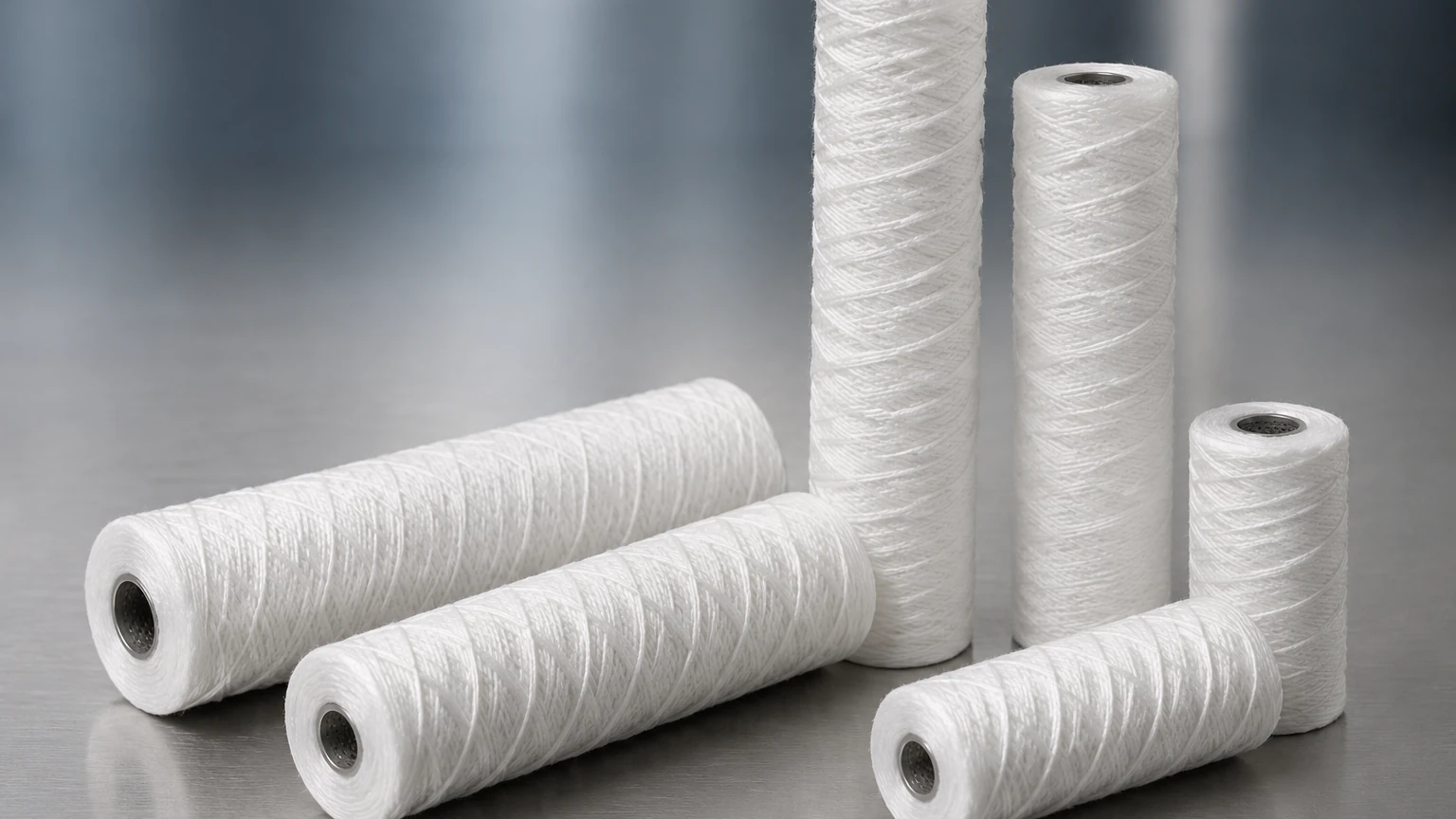
The primary function of a wound filter cartridge is depth filtration. This process relies on a tortuous path created by winding specialized yarn around a central perforated core. As the fluid passes from the outer layers toward the center, the winding pattern creates increasingly smaller diamond-shaped openings. This geometric progression allows larger particles to be trapped in the outer layers while finer particles are captured deeper within the media.
Gradient Density and Winding Tension
The effectiveness of a wound filter is largely determined by the winding tension and the precision of the winding pattern. In high-quality manufacturing, the tension is carefully controlled to ensure that the inner layers are more tightly packed than the outer layers. This creates a true gradient density. If the tension is inconsistent, the filter may suffer from "channeling," where the fluid finds a path of least resistance, bypassing the filtration media and allowing contaminants to pass through to the clean side.
The Role of Yarn "Nap"
The yarn used in a wound filter cartridge is not a simple smooth string. It is often brushed or processed to create a "nap"—a fuzzy surface consisting of micro-fibers. These fibers extend into the diamond-shaped openings, acting as a secondary trap for fine particulates. The density and length of this nap are critical variables that engineers must consider when specifying a filter for a particular micron rating. A higher nap density generally improves filtration efficiency but may increase the initial pressure drop across the cartridge.
Material Selection and Chemical Compatibility
Selecting the correct material for both the yarn and the core is the most critical decision in the procurement process. Industrial applications often involve aggressive chemicals, high temperatures, or strict sanitary requirements that dictate the material composition of the wound filter cartridge.
Yarn Media Options
1. Polypropylene (PP): This is the most common material for general industrial applications. It offers excellent chemical resistance to most acids, alkalis, and salts. However, it is limited by temperature, typically losing structural integrity above 140°F (60°C). PP is often used in water treatment, plating solutions, and food and beverage pre-filtration.
2. Cotton: Bleached or natural cotton is preferred for applications involving oils, alcohols, and certain solvents. Cotton can withstand higher temperatures than polypropylene, often rated up to 250°F (121°C). In the pharmaceutical and food industries, bleached cotton is used to ensure no natural waxes or oils leach into the process fluid.
3. Fiberglass: For extreme high-temperature applications or aggressive chemical environments where organic fibers would fail, fiberglass is the standard. It can operate at temperatures exceeding 750°F (400°C) when paired with a stainless steel core. It is commonly found in petrochemical processing and high-temperature gas filtration.
4. Polyester and Nylon: These materials are selected for specific chemical compatibilities where PP or cotton might degrade. Nylon is particularly effective for aromatic solvents and high-viscosity fluids.
Core Material Considerations
The core provides the structural backbone of the wound filter cartridge, preventing it from collapsing under the pressure of the fluid flow.
* Polypropylene Cores: Economical and chemically resistant, suitable for low-temperature water and chemical applications.
* Tin-Plated Steel Cores: Provide higher structural strength for general industrial use at moderate temperatures.
* Stainless Steel (304/316) Cores: Essential for high-temperature applications, high-pressure differentials, or corrosive environments. Stainless steel cores are a hallmark of high-performance filtration, ensuring that the cartridge maintains its geometry even as the pressure drop increases due to contaminant loading.
Performance Evaluation: Micron Ratings and Pressure Drop
When evaluating a wound filter cartridge, engineers must distinguish between "nominal" and "absolute" micron ratings. Most wound filters are nominally rated, meaning they are designed to capture a high percentage (typically 60% to 90%) of particles at a specific micron size.
Understanding Micron Ratings
Because of the nature of depth filtration, a wound filter cartridge does not have a single pore size. Instead, it has a range of openings. A 5-micron nominal wound filter will capture many 5-micron particles, but some may still pass through. For applications requiring 99.9% removal efficiency, engineers often transition from wound cartridges to pleated media or precision-engineered stainless steel mesh filters. However, as a pre-filter, the nominal rating of a wound cartridge is ideal for removing the bulk of the solids loading, thereby extending the life of the more expensive absolute-rated filters downstream.
Pressure Drop and Flow Rate
The "clean pressure drop" is the initial resistance to flow when a new filter is installed. As the filter captures particles, the pressure drop (differential pressure, or ΔP) increases. Engineers must size the filtration housing and select the number of cartridges based on the maximum allowable flow rate and the viscosity of the fluid.
High-viscosity fluids, such as heavy oils or resins, require a lower flux (flow per unit area) to prevent excessive pressure drop. In these cases, using a wound filter cartridge with a more open winding pattern or a larger surface area is necessary. Monitoring ΔP is the primary method for determining when a cartridge has reached the end of its functional life. Typically, a wound filter should be replaced when the differential pressure reaches 25–35 PSI (1.7–2.4 bar), depending on the structural limits of the core.
Technical Challenges: Media Migration and Bypass
While the wound filter cartridge is a reliable tool, it is not without technical challenges. Two primary concerns in industrial applications are media migration and bypass.
Media Migration
Media migration occurs when individual fibers from the yarn break loose and enter the filtrate. This is a significant risk in high-velocity flows or when the filter is subjected to pressure surges. To mitigate this, manufacturers may use continuous filament yarns or heat-set the fibers. In critical pharmaceutical or microelectronics applications, engineers often prefer stainless steel wire mesh filters or thermally bonded depth filters to eliminate the risk of fiber shedding entirely.
Bypass and Seal Integrity
Bypass occurs when fluid flows around the ends of the filter cartridge rather than through the media. This is often caused by poor seal integrity between the cartridge and the housing. Wound filters are available with various end-cap configurations, including double open-ended (DOE) with gaskets, or single open-ended (SOE) with O-rings (such as 222 or 226 fittings). For high-purity applications, SOE configurations with O-ring seals provide a much more secure positive seal than simple DOE compression seals.
Integration with Stainless Steel Filtration Systems
In many advanced industrial processes, a wound filter cartridge serves as the sacrificial layer in a multi-stage system. Kaifil’s expertise in custom stainless steel filtration components often involves designing systems where metal filters handle the final, high-precision stage, while disposable wound filters manage the heavy lifting of primary solids removal.
When to Transition to Metal Filters
While wound cartridges are cost-effective for one-time use, certain conditions necessitate the use of stainless steel filter cartridges:
* Extreme Temperatures: Beyond the limits of fiberglass and stainless steel cores.
* High Pressure: Where the risk of core collapse or media compression is too high.
* Cleanability: When the cost of disposing of spent wound cartridges becomes prohibitive, or when the process requires a clean-in-place (CIP) solution.
* Absolute Precision: When a specific, non-negotiable micron cutoff is required.
By integrating these two technologies, facilities can achieve a balance between low operational costs and high filtration reliability. Engineers looking for guidance on this integration can find technical resources and product data on the Main Page.
Total Cost of Ownership and Maintenance
The true cost of a wound filter cartridge is not just the purchase price; it includes the cost of labor for change-outs, the cost of disposal (especially if the filtrate is hazardous), and the potential cost of downstream equipment damage if a filter fails.
Optimization Strategies
1. Proper Sizing: Oversizing a filter housing can significantly extend the time between change-outs, reducing labor costs and downtime.
2. Staged Filtration: Using a 20-micron wound filter followed by a 5-micron wound filter is often more efficient than using a single 5-micron filter, as it prevents the finer filter from blinding prematurely.
3. Quality Control: Not all wound filters are created equal. Inconsistent winding tension or low-quality yarn can lead to premature failure or poor filtrate quality. Purchasing from a manufacturer with rigorous quality standards ensures predictable performance.
Conclusion
The wound filter cartridge remains an indispensable tool in the industrial filtration toolkit. Its ability to provide high-capacity depth filtration at a relatively low cost makes it the go-to choice for a wide array of pre-filtration and clarification tasks. However, its effectiveness depends entirely on the correct matching of material science, winding geometry, and operational parameters to the specific needs of the application.
For engineers tasked with designing or maintaining complex filtration systems, understanding the limitations and strengths of the wound filter cartridge is the first step toward process optimization. Whether the goal is to protect a high-pressure pump, ensure the clarity of a chemical batch, or extend the life of a custom stainless steel filter, the strategic use of wound media is essential. For more information on professional-grade filtration components and customized engineering support, visit the Main Page to connect with technical experts who can assist in selecting the optimal filtration solution for your specific industrial requirements.
