


Cyclone Sand Separator
In industrial fluid management, the removal of suspended solids is a critical prerequisite for protecting downstream equipment and ensuring process integrity. The cyclone sand separator, often referred to as a centrifugal separator or hydrocyclone, serves as a primary filtration stage designed to remove sand, grit, and other high-density particles from liquid streams. Unlike barrier-based filters that utilize mesh or membranes, these devices rely on centrifugal force and gravity, offering a low-maintenance solution for high-solids applications.
For engineers and facility managers, understanding the technical nuances of cyclone separation is essential for optimizing system performance. While these separators are highly effective at removing bulk contaminants, they are frequently integrated into a multi-stage filtration architecture where precision components, such as those found on the Kaifil Main Page, handle the finer particulate matter that remains.
The Mechanics of Centrifugal Separation
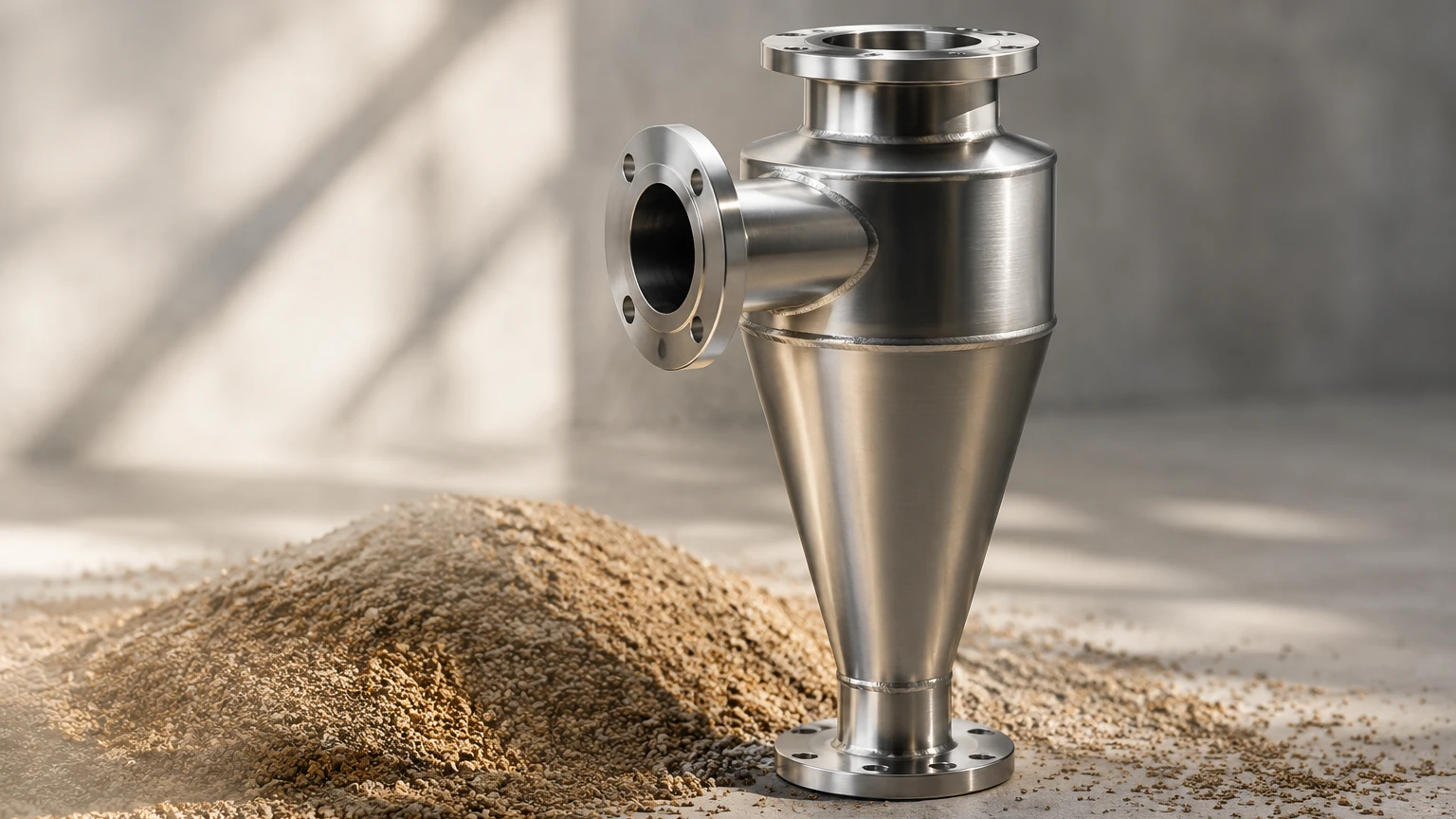
The operation of a cyclone sand separator is governed by the principles of fluid dynamics, specifically the interaction between centrifugal force and fluid drag. The process begins when the influent enters the cylindrical chamber through a tangential inlet. This entry method forces the liquid into a rapid downward spiral, creating a primary vortex.
As the fluid rotates, particles with a higher specific gravity than the carrier liquid—such as sand, scale, or metal fines—are accelerated toward the outer wall of the separator. The centrifugal force overcomes the fluid's inward drag, causing these heavier solids to migrate to the perimeter and eventually slide down the tapered cone toward the collection chamber at the base.
Simultaneously, the liquid moves toward the center of the vortex. As the flow reaches the bottom of the cone, it encounters a pressure differential that reverses its direction, forming a secondary, upward-moving inner vortex. This clean fluid then exits through the top of the device via a vortex finder. Because there are no moving parts and no internal filter media to clog in this stage, the cyclone sand separator can handle significant solids loading without the frequent downtime associated with traditional media filters.
Key Performance Indicators for Industrial Separators
When evaluating a cyclone sand separator for industrial use, engineers must look beyond simple flow rates and focus on specific performance metrics that define the unit's efficiency and compatibility with the overall system.
Separation Efficiency and Cut Point
The efficiency of a separator is typically defined by its "cut point" or d50, which represents the particle size at which 50% of the solids are removed. For most industrial sand separators, the removal efficiency for sand-sized particles (typically 74 microns and larger) is exceptionally high, often exceeding 98%. However, efficiency is heavily dependent on the difference in specific gravity between the solid and the liquid. If the solids have a density close to that of the fluid, centrifugal separation becomes less effective.
Pressure Drop (Delta P)
Every filtration component introduces a pressure drop into the system. In a cyclone separator, the pressure drop is a function of the flow velocity. While a higher velocity increases centrifugal force and separation efficiency, it also results in a higher pressure loss. Engineers must balance the desired filtration performance with the available pump head to ensure the system remains energy-efficient.
Flow Range Stability
Cyclone separators are sensitive to flow fluctuations. If the flow rate drops below the design minimum, the centrifugal force will be insufficient to drive particles to the outer wall, leading to a sharp decline in efficiency. Conversely, exceeding the maximum flow rate can cause excessive turbulence and pressure drop. Selecting a unit that matches the actual operating flow range of the application is paramount.
Material Engineering and Durability
Because cyclone sand separators are frequently used in abrasive environments, the choice of construction material directly impacts the total cost of ownership and service life. While carbon steel is common in basic agricultural or water well applications, industrial sectors—including chemical processing, pharmaceuticals, and food production—require more robust materials.
Stainless steel (specifically grades 304 and 316L) is the preferred material for high-performance separators. Stainless steel provides superior resistance to corrosion, which is essential when handling aggressive process water or chemicals. Furthermore, the smooth internal surface finish of a precision-manufactured stainless steel separator reduces fluid friction and minimizes the risk of particle adhesion or "bridging" within the cone.
In applications involving highly abrasive solids, such as mining tailings or industrial grinding fluids, the internal walls of the separator may be reinforced with specialized coatings or liners. However, for most B2B industrial applications, a high-quality stainless steel housing provides the necessary balance of structural integrity and chemical compatibility.
Integrating Cyclone Separators with Precision Filtration
A common misconception in filtration design is that a cyclone sand separator can serve as a standalone solution for all particulate removal. In reality, while the cyclone is excellent at removing heavy solids, it is less effective at capturing low-density organic matter or fine silt.
To achieve comprehensive fluid purity, the cyclone separator should be viewed as a "pre-filter." By removing the bulk of the sand and grit, the separator protects more sensitive downstream components. This integration significantly extends the life of precision stainless steel filter cartridges and wire mesh filters.
For example, in a hydraulic or cooling water system, a cyclone sand separator might remove 95% of the heavy solids, allowing a secondary Kaifil stainless steel mesh filter to focus on removing the remaining fine contaminants without becoming prematurely blinded. This multi-stage approach reduces the frequency of manual cleaning and lowers the replacement costs of filter media. Engineers should consult technical resources like the Kaifil Main Page to match the micron rating of secondary filters with the expected effluent quality of the primary cyclone stage.
Operational Maintenance and Purge Strategies
One of the primary advantages of the cyclone sand separator is its simplicity, but it is not entirely "set and forget." The solids collected in the bottom chamber must be removed to prevent them from re-entering the fluid stream.
Manual vs. Automatic Purging
In low-load applications, a manual ball valve at the base of the collection chamber may suffice. Operators periodically open the valve to flush out the accumulated sand. However, in most industrial settings, automatic purge systems are recommended. these systems use timers or sensors to trigger a flush cycle, ensuring consistent performance without requiring constant operator intervention.
Wear Monitoring
Over time, the high-velocity movement of abrasive particles can cause wear, particularly in the lower section of the cone and the apex. Regular inspections should focus on wall thickness and the integrity of the vortex finder. If the internal geometry of the separator is compromised by erosion, the vortex will lose its stability, and separation efficiency will plummet.
Application-Specific Selection Criteria
Engineers must confirm several variables before finalizing the selection of a cyclone sand separator to ensure it meets the specific needs of their industry:
1. Particle Distribution: What is the size and density of the target contaminants? If the particles are primarily light organics, a different separation technology may be required.
2. Fluid Viscosity: High-viscosity fluids dampen the movement of particles toward the wall, reducing the effectiveness of centrifugal separation. Cyclone separators work best with water-like viscosities.
3. System Pressure: Ensure the separator housing is rated for the maximum system pressure, including potential surges or water hammer events.
4. Space Constraints: Cyclone separators are typically vertical units. Ensure there is adequate overhead clearance for installation and bottom clearance for the purge piping.
5. Environmental Regulations: In some regions, the purge water (which contains a high concentration of solids) must be treated before disposal. This may require an additional settling tank or dewatering bag.
Total Cost of Ownership and System Longevity
While the initial purchase price is a factor, the total cost of ownership (TCO) for a cyclone sand separator is generally lower than that of other filtration methods. Because there are no consumable cartridges or bags associated with the cyclone itself, the ongoing operational costs are limited to the energy required to overcome the pressure drop and the small volume of water lost during purging.
By effectively removing heavy solids at the start of the process, the cyclone separator reduces the wear on pumps, seals, and valves throughout the entire facility. When paired with high-quality stainless steel filtration components for fine polishing, the result is a robust, reliable system that minimizes downtime and maximizes fluid quality. For engineers designing these systems, focusing on the synergy between primary centrifugal separation and secondary precision filtration is the key to long-term operational success.
