


Cyclone Separator for Air Pollution Control
In industrial environments where gas streams carry high concentrations of particulate matter, the implementation of a cyclone separator for air pollution control serves as a critical first line of defense. These mechanical separators utilize centrifugal force to remove large to medium-sized particles from air or gas streams without the use of moving parts or replaceable filter media. For engineers and facility managers, understanding the technical nuances of cyclone design, material selection, and integration into broader filtration systems is essential for maintaining operational efficiency and meeting environmental compliance standards.
As a primary separation stage, the cyclone reduces the particulate load on downstream high-efficiency filters, such as the precision components found on the Main Page. By capturing the bulk of the dust and debris, these units extend the service life of secondary filtration stages and reduce the overall total cost of ownership (TCO) for air pollution control systems.
The Fundamental Physics of Centrifugal Separation
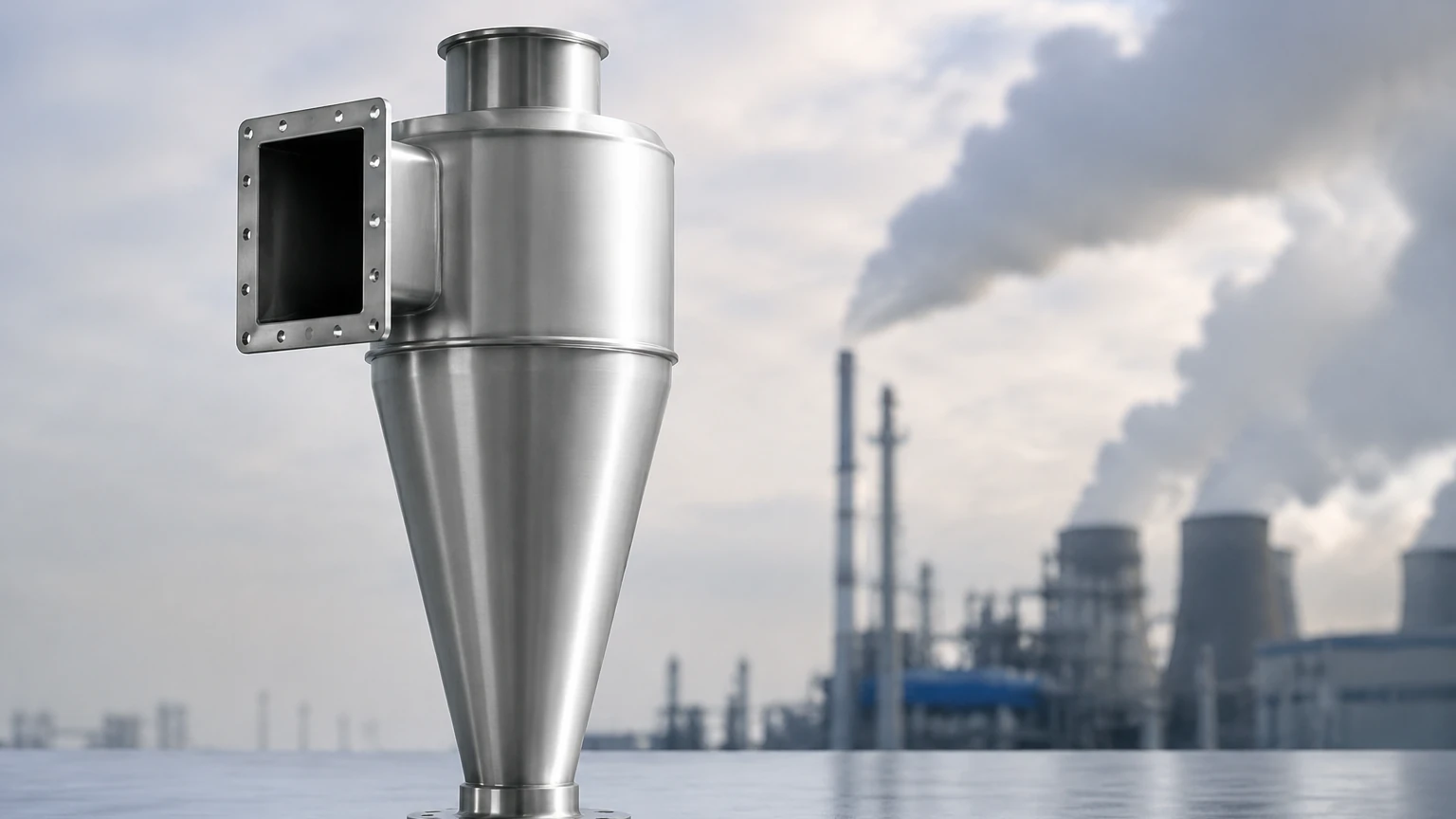
A cyclone separator for air pollution control operates on the principle of inertial separation. When a particle-laden gas enters the cylindrical chamber of the cyclone at a high velocity, it is forced into a downward spiral or "vortex." This rotational motion generates centrifugal forces that act upon the suspended particles.
Because the particles possess significantly higher mass than the gas molecules, they are driven outward toward the interior walls of the cyclone. Upon striking the wall, the particles lose their kinetic energy and slide down the conical section of the unit into a collection hopper. Meanwhile, the cleaned gas, reaching the bottom of the cone, reverses direction and forms a smaller inner vortex that travels upward through the center of the chamber to the exit duct.
Efficiency Factors and the "Cut Diameter"
The performance of a cyclone is typically measured by its collection efficiency across various particle sizes. The most critical metric for an engineer is the "cut diameter" ($d_{50}$), which represents the particle size at which the cyclone is 50% efficient. Particles larger than the $d_{50}$ are captured with higher efficiency, while smaller particles often remain entrained in the gas stream.
Efficiency is influenced by several design variables:
* Inlet Velocity: Higher velocities increase centrifugal force but also increase pressure drop and potential for particle re-entrainment.
* Cyclone Diameter: Smaller diameter cyclones generate higher centrifugal forces, leading to better separation of fine particles.
* Gas Viscosity: As temperature increases, gas viscosity rises, which can decrease separation efficiency by increasing the drag force on the particles.
Engineering Parameters and Selection Criteria
When specifying a cyclone separator for air pollution control, engineering teams must evaluate several interconnected parameters to ensure the unit matches the specific requirements of the application. A mismatch in sizing or material can lead to excessive energy consumption or premature equipment failure.
Pressure Drop and Energy Consumption
The pressure drop across a cyclone is the difference in static pressure between the inlet and the outlet. This is a vital consideration because it directly impacts the power requirements of the system's fan or blower. While a higher pressure drop often correlates with higher collection efficiency, it also increases operational costs. Engineers must find the optimal balance between the required filtration accuracy and the energy budget. Standard industrial cyclones typically operate within a pressure drop range of 2 to 6 inches of water column (w.c.).
Particle Size Distribution (PSD)
A cyclone is most effective when the particle size distribution of the contaminant is known. If the majority of the dust is below 10 microns, a standard single cyclone may only serve as a pre-cleaner. In such cases, high-efficiency multicyclones—which consist of multiple small-diameter cyclones in parallel—or a combination of a cyclone and a secondary stainless steel filter cartridge may be required to meet emission standards.
Gas Stream Characteristics
The chemical composition, temperature, and moisture content of the gas stream dictate the materials used in construction. In chemical processing or pharmaceutical applications, the gas may be corrosive or require high-purity handling. This necessitates the use of high-grade stainless steel (such as 304 or 316L) to prevent oxidation and contamination.
Material Selection and Construction Standards
For industrial filtration solutions, the durability of the cyclone is as important as its separation efficiency. Kaifil specializes in custom stainless steel filtration solutions that address the specific challenges of demanding industrial environments. When a cyclone separator for air pollution control is constructed from stainless steel, it offers several technical advantages over carbon steel or plastic alternatives.
Corrosion and Heat Resistance
Many air pollution control applications involve flue gases or chemical vapors that would rapidly degrade standard materials. Stainless steel 316L, for instance, provides superior resistance to pitting and crevice corrosion in chloride-rich environments. Furthermore, in high-temperature applications such as kiln exhaust or catalytic cracking, metal separators maintain structural integrity and dimensional stability where synthetic materials would fail.
Surface Finish and Particle Release
In the food and beverage or pharmaceutical industries, the internal surface finish of the cyclone is critical. A high-precision, smooth internal surface prevents particle buildup (bridging) and facilitates easier cleaning. Custom-manufactured cyclones can be polished to specific Ra (Roughness Average) values to meet sanitary standards and ensure that the unit does not become a source of cross-contamination.
Strategic Integration with Secondary Filtration
While a cyclone separator for air pollution control is highly effective at removing the bulk of particulate matter, it is rarely used as a standalone solution for modern environmental compliance. Instead, it is integrated into a multi-stage filtration architecture.
Protecting Downstream Components
The primary role of the cyclone in a multi-stage system is to protect sensitive downstream components. By removing 90% or more of the heavy dust load, the cyclone prevents the "blinding" or rapid clogging of fine wire mesh filters or pleated cartridges. This staged approach allows the secondary filters to operate at a lower differential pressure for a longer duration, significantly extending the interval between maintenance cycles.
Custom OEM Solutions
For manufacturers of industrial equipment, integrating a cyclone directly into the machine design can optimize space and performance. Custom-engineered metal filter components can be designed to fit the specific geometry of the cyclone's outlet, providing a final "polishing" stage for the air before it is recirculated or exhausted. This level of customization ensures that the filtration system is perfectly tuned to the specific particle characteristics of the process.
Maintenance, Troubleshooting, and Operational Reliability
To maintain the performance of a cyclone separator for air pollution control, regular monitoring and preventative maintenance are required. Unlike baghouses, cyclones do not have filters that need frequent replacement, but they are subject to mechanical wear and operational issues.
Managing Abrasion
In industries handling abrasive dust, such as mining or cement production, the high-velocity impact of particles against the cyclone walls can lead to erosion. Engineers should specify thicker wall gauges or sacrificial liners in high-wear zones, such as the inlet scroll and the lower conical section. Monitoring the wall thickness through ultrasonic testing can prevent unexpected blowouts.
Ensuring Air-Tight Discharge
The most common cause of efficiency loss in a cyclone is air leakage at the dust discharge point. If air leaks into the bottom of the cone, it can disrupt the vortex and re-entrain captured dust, carrying it out through the exhaust. Using high-quality rotary valves or double-dump valves is essential to maintain a pressure seal while allowing for continuous dust removal.
Cleaning and Inspection Cycles
Although cyclones are largely self-cleaning due to the high-velocity gas flow, sticky or hygroscopic dust can accumulate on the walls. Periodic inspections should check for buildup that could alter the internal geometry and degrade performance. For applications requiring frequent cleaning, custom-designed access hatches and CIP (Clean-In-Place) systems can be integrated into the stainless steel structure.
Conclusion: Selecting the Right Filtration Partner
Implementing an effective cyclone separator for air pollution control requires a deep understanding of fluid dynamics, material science, and the specific demands of the industrial process. By focusing on precision engineering and high-quality material selection, facilities can achieve reliable particulate separation that protects both the environment and their downstream equipment.
When designing a comprehensive filtration strategy, it is important to consider how each component—from the initial cyclone to the final precision metal filter—works in unison. For more information on custom stainless steel filtration components and engineering support for industrial applications, visit the Main Page. Selecting a partner with expertise in custom manufacturing ensures that your filtration system is not only compliant with current regulations but also optimized for long-term durability and cost-effective operation.
Download Cyclone Separator for Air Pollution Control as a PDF
