


Cycloonfilters
Industrial filtration processes often require a multi-stage approach to manage high particle loads while maintaining system efficiency. Cycloonfilters, also known as cyclonic separators or centrifugal separators, serve as a critical primary stage in these systems. By utilizing centrifugal force to separate solids from fluid or gas streams, these components reduce the burden on downstream precision filters. For engineers and procurement teams, understanding the integration of cycloonfilters with high-performance stainless steel filtration media is essential for optimizing the total cost of ownership and ensuring process continuity.
In demanding industrial environments—such as chemical processing, food and beverage production, and hydraulic systems—the selection of a cycloonfilter involves more than just sizing a vessel. It requires a technical evaluation of particle dynamics, material compatibility, and the structural integrity of internal components. This guide examines the engineering principles behind cycloonfilters and the role of precision metal components in enhancing their performance.
Understanding the Mechanics of Cyclonic Separation
The fundamental operation of cycloonfilters relies on the principle of inertia. When a fluid or gas enters the cylindrical chamber of the separator at a high velocity, it is directed into a tangential or helical flow pattern. This creates a powerful vortex. As the medium spins, particles with higher density than the carrier fluid are forced outward toward the wall of the chamber by centrifugal force.
Once the particles strike the wall, they lose kinetic energy and descend toward a collection cone or discharge port at the bottom. The cleaned medium then reverses direction, forming an inner vortex that exits through the top or center of the unit.
From an engineering perspective, the efficiency of this separation is governed by several factors:
* Inlet Velocity: Higher velocities generally increase centrifugal force but also lead to higher pressure drops.
* Particle Density and Size: Cycloonfilters are most effective for relatively large, dense particles. The "cut-point" (d50) represents the particle size at which 50% of the solids are removed.
* Vessel Geometry: The ratio of the cylinder diameter to the cone length dictates the residence time and the strength of the vortex.
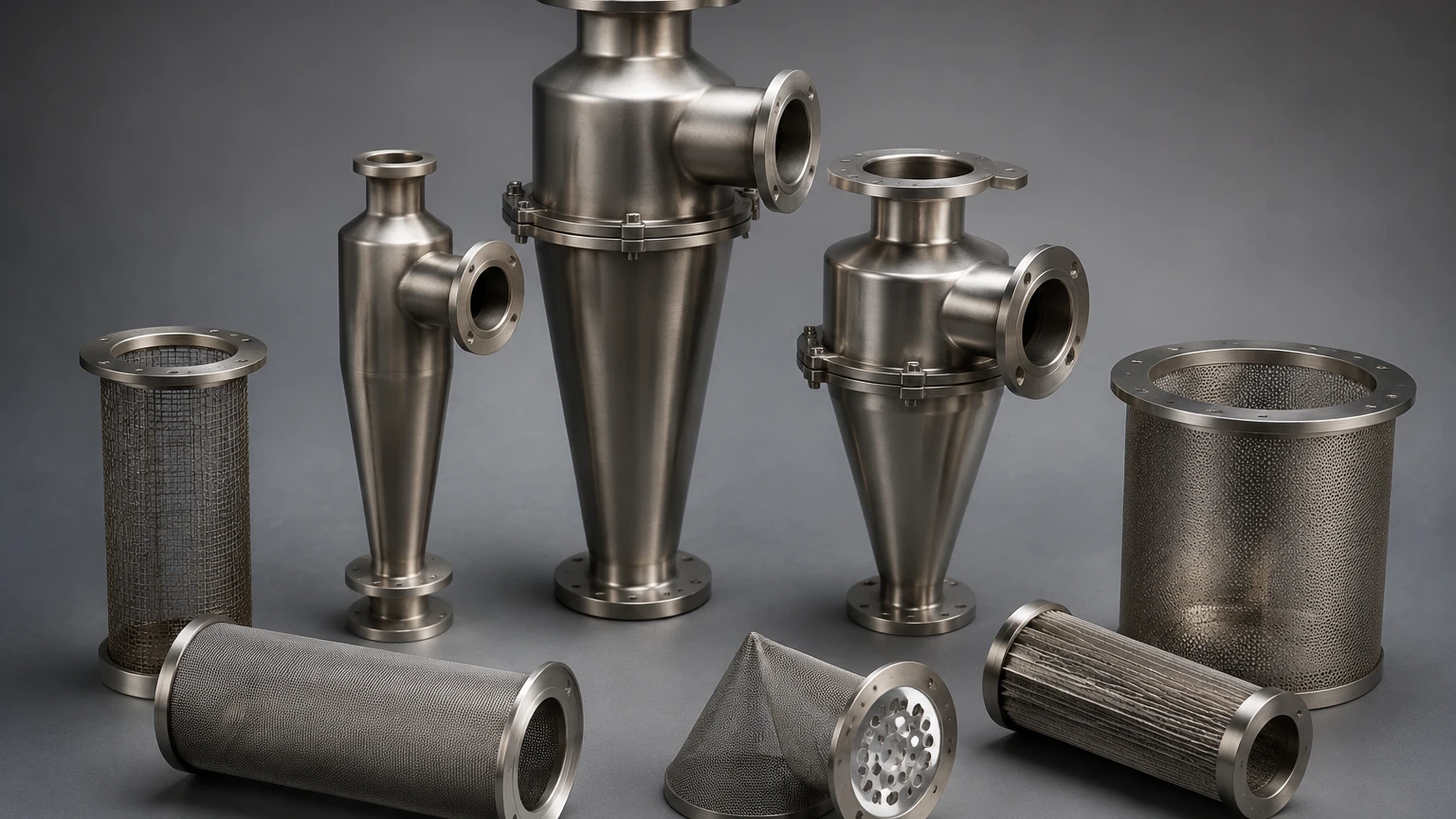
While cycloonfilters are excellent for bulk removal, they are rarely used in isolation for high-purity applications. Instead, they are paired with secondary Main Page components, such as stainless steel wire mesh or sintered metal cartridges, to capture the finer fractions that the centrifugal force cannot displace.
The Role of Stainless Steel Components in Cycloonfilters
While the outer shell of a cycloonfilter might be constructed from various materials, the internal components—including the vortex finder, inlet vanes, and secondary filter elements—are frequently fabricated from high-grade stainless steel. In many industrial configurations, a cycloonfilter is designed as a hybrid unit where a centrifugal stage is immediately followed by a precision metal filter element.
Material Selection: 304 vs. 316L
In chemical and pharmaceutical applications, the choice of stainless steel is paramount. Grade 304 stainless steel offers excellent strength and basic corrosion resistance. However, for environments involving chlorides or high temperatures, 316L is the industry standard due to its superior resistance to pitting and intergranular corrosion. As a manufacturer of custom filtration solutions, Kaifil emphasizes the importance of matching the alloy to the chemical profile of the process fluid to prevent premature failure of the internal filter structures.
Durability Against Erosion
Cycloonfilters are inherently high-energy environments. The constant impact of abrasive particles against the internal surfaces can lead to erosion. Using precision-engineered stainless steel components ensures that the internal geometry remains consistent over time. Unlike plastic or lower-grade metal alternatives, stainless steel maintains its structural integrity under the stress of high-velocity particulate flow.
Key Evaluation Criteria for Industrial Selection
When specifying cycloonfilters for a new or existing system, engineers must look beyond the initial purchase price. The following technical criteria are essential for a successful implementation:
1. Pressure Drop (Delta P)
Every filtration stage introduces resistance to flow. In cycloonfilters, the pressure drop is a function of the inlet velocity and the internal design. A high pressure drop increases the energy requirements of the pump or compressor. It is critical to balance the desired separation efficiency with an acceptable Delta P to maintain system energy efficiency.
2. Separation Efficiency and Cut-Point
Technical specifications should clearly state the expected removal rate for specific particle sizes. If a process requires 99% removal of particles above 10 microns, a standard cycloonfilter may act only as a pre-filter, necessitating a high-precision stainless steel cartridge to meet the final requirement.
3. Maintenance and Solids Handling
How the separated solids are removed is a major operational consideration. Automated purge valves, manual blow-down ports, or collection chambers must be sized appropriately for the expected solids loading. If the cycloonfilter includes a secondary mesh stage, the ease of cleaning (such as backwashing or ultrasonic cleaning) must be evaluated.
Applications Across Demanding Industries
Cycloonfilters are utilized across a broad spectrum of sectors where liquid or gas streams contain significant particulate matter.
* Chemical Processing: Protecting expensive catalysts and downstream reactors by removing bulk contaminants from raw material streams.
* Food and Beverage: Used in the initial stages of water treatment or ingredient processing to remove sand, grit, or heavy sediment before the fluid reaches fine polishing filters.
* Hydraulic and Lube Oil Systems: In large-scale industrial machinery, cycloonfilters help remove wear particles from oil, extending the life of high-precision hydraulic components and reducing the frequency of cartridge replacements.
* Water Treatment: Acting as a sand separator in well water systems or as a pre-filter in desalination plants to protect sensitive reverse osmosis (RO) membranes.
In each of these applications, the integration of custom stainless steel filtration components allows for a tailored approach to specific flow rates and contaminant profiles.
Common Risks and Engineering Considerations
Implementing cycloonfilters is not without challenges. Engineers should be aware of several common risks that can impact performance:
* Vortex Instability: If the flow rate is too low, the centrifugal force will be insufficient to maintain the vortex, causing particles to remain entrained in the exit stream. Conversely, excessively high flow rates can cause "re-entrainment," where settled particles are picked back up by the inner vortex.
* Abrasive Wear: As mentioned, the high-velocity impact of solids can wear down internal vanes. Regular inspection of these components is necessary, and utilizing hardened or precision-machined stainless steel parts can mitigate this risk.
* Bypass and Sealing: In hybrid cycloonfilters that contain a secondary filter element, the seal between the element and the housing is a common failure point. Ensuring high-quality gaskets and precision-machined seats is vital to prevent unfiltered fluid from bypassing the precision stage.
Customization and Total Cost of Ownership
Standard, off-the-shelf cycloonfilters may not always meet the unique requirements of a specific industrial process. Customization often provides a better long-term value proposition. This includes tailoring the filtration accuracy of the secondary mesh, adjusting the housing dimensions to fit existing piping, or selecting specialized alloys for extreme environments.
By focusing on high-quality materials and precise manufacturing, the total cost of ownership is reduced through:
1. Extended Service Life: Durable stainless steel components resist corrosion and wear.
2. Reduced Downstream Loading: Efficient primary separation extends the life of more expensive secondary filter cartridges.
3. Lower Maintenance Costs: Cleanable metal filters reduce the need for frequent disposable filter purchases and disposal fees.
For technical teams looking to optimize their filtration systems, consulting with a manufacturer that understands the nuances of wire mesh and precision metal fabrication is a strategic advantage. Whether the goal is to improve the purity of a chemical product or to protect sensitive industrial equipment, the correct application of cycloonfilters and secondary stainless steel filtration is a proven solution.
To explore specific technical specifications for stainless steel filter cartridges and custom filtration components that complement cyclonic separation systems, engineers can review product options and application support on the Main Page.
Conclusion
Cycloonfilters remain a cornerstone of industrial filtration due to their mechanical simplicity and effectiveness in bulk separation. However, their true value is realized when they are integrated into a comprehensive filtration strategy that includes high-precision stainless steel components. By understanding the mechanics of centrifugal separation and the importance of material science, engineering and purchasing teams can implement solutions that are both durable and cost-effective. Selecting the right combination of primary cyclonic action and secondary metal filtration ensures that even the most demanding industrial environments can maintain high levels of process purity and equipment protection.
