


Demister Mist Eliminator
In industrial process engineering, the separation of entrained liquid droplets from gas or vapor streams is a critical operation for protecting downstream equipment, reducing product loss, and ensuring environmental compliance. The demister mist eliminator, also known as a mesh pad or entrainment separator, is a specialized component designed to achieve this separation with high efficiency and minimal pressure drop. As a manufacturer specializing in stainless steel filtration solutions, Kaifil provides precision-engineered demisters that meet the rigorous demands of chemical, pharmaceutical, and oil and gas processing.
Understanding the technical nuances of a demister mist eliminator is essential for engineers tasked with optimizing vessel design or troubleshooting separation inefficiencies. This guide explores the engineering principles, material considerations, and performance metrics necessary for effective mist elimination.
Understanding the Mechanics of Gas-Liquid Separation
The operation of a demister mist eliminator relies on the principle of inertial impaction. When a gas stream containing liquid mist passes through a tortuous path—typically a knitted wire mesh—the gas flows around the wire filaments while the heavier liquid droplets, possessing greater momentum, cannot change direction as quickly. These droplets strike the surface of the wire and adhere to it.
As more droplets collect on the wire surfaces, they coalesce into larger globules. When the gravitational force acting on these accumulated drops exceeds the combined forces of gas velocity and surface tension, the liquid drains away from the mesh and falls to the bottom of the vessel. This process effectively removes droplets ranging from 3 to 10 microns in diameter with efficiencies often exceeding 99%.
Beyond inertial impaction, two other mechanisms play a role in mist elimination:
1. Direct Interception: Occurs when a droplet follows a gas streamline but comes within one droplet radius of the wire surface, making contact and becoming trapped.
2. Brownian Diffusion: Primarily relevant for sub-micron particles (less than 0.1 microns), where random molecular motion causes particles to deviate from the streamline and collide with the fiber surface. While standard mesh demisters are not primarily designed for Brownian diffusion, high-density configurations can capture smaller particles than standard designs.
Design and Construction of Wire Mesh Demisters
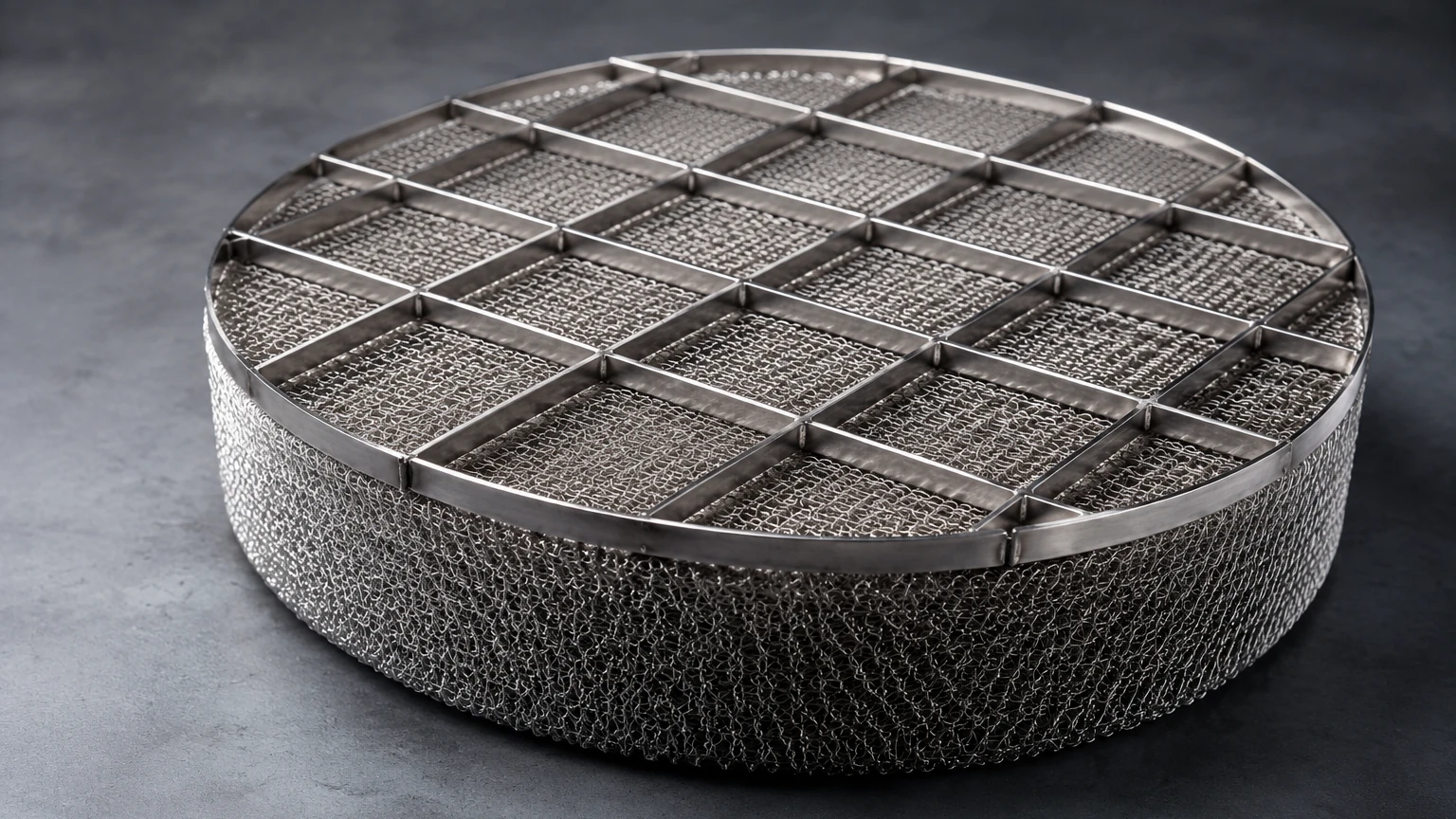
The construction of a wire mesh demister mist eliminator involves knitting metal or plastic wires into a tubular structure, which is then flattened and crimped to create a specific volume and surface area. These layers are stacked to form a pad of a predetermined thickness, usually between 100mm and 150mm (4 to 6 inches).
Mesh Density and Void Volume
One of the most critical engineering parameters is the mesh density, typically measured in kilograms per cubic meter (kg/m³). A higher density provides more surface area for droplet impaction but increases the resistance to gas flow (pressure drop). Conversely, a lower density mesh allows for higher gas velocities but may allow smaller droplets to pass through.
Void volume, or porosity, refers to the percentage of open space within the mesh pad. Most industrial demisters maintain a void volume between 97% and 99%. This high porosity ensures that the gas flow remains relatively unobstructed while providing ample surface area for liquid capture.
Support Grids and Structural Integrity
To maintain the shape and position of the mesh pad within a separator vessel, the mesh is held between top and bottom support grids. These grids are engineered to withstand the differential pressure across the pad and the weight of the accumulated liquid. They are typically constructed from flat bars and round rods, welded into a rigid frame. For large-diameter vessels, the demister is manufactured in sections (manway-sized) to allow for easy installation through standard access ports.
Comparing Wire Mesh and Vane-Type Mist Eliminators
While the wire mesh demister mist eliminator is the most common choice due to its versatility and cost-effectiveness, engineers must sometimes choose between mesh pads and vane-type (chevron) eliminators.
* Wire Mesh Demisters: These offer the highest efficiency for small droplets (down to 3 microns). They provide a massive surface area and are suitable for most standard gas-liquid separation tasks. However, they are more susceptible to fouling if the gas stream contains solids or highly viscous liquids.
* Vane-Type Mist Eliminators: These consist of a series of parallel zigzag plates. They rely on centrifugal force to throw droplets against the vane walls. Vanes are better suited for high-velocity applications, high liquid loads, and environments where fouling is a concern, as they have larger passages that are less likely to clog. However, they are generally less effective at capturing droplets smaller than 10-20 microns.
In many complex systems, a two-stage approach is used: a vane-type eliminator serves as a pre-separator to remove bulk liquid and solids, followed by a wire mesh demister to capture the remaining fine mist.
Material Engineering for Corrosive and High-Temperature Environments
The longevity and performance of a demister mist eliminator depend heavily on material compatibility. Because these components are often exposed to aggressive chemicals and high temperatures, selecting the correct alloy is paramount. Kaifil specializes in manufacturing these components from high-grade stainless steels and specialty alloys to ensure durability.
* 304/304L Stainless Steel: The standard choice for general industrial applications where moderate corrosion resistance is required.
* 316/316L Stainless Steel: Preferred for pharmaceutical and food processing due to its superior resistance to pitting and crevice corrosion, especially in chloride-rich environments.
* 904L and Duplex Steels: Utilized in highly acidic environments, such as sulfuric acid production or phosphoric acid concentration.
* Specialty Alloys (Monel, Inconel, Hastelloy): Reserved for extreme conditions involving high temperatures or highly reactive chemical compounds.
In addition to metallic options, demisters can be fabricated from fluoropolymers like PTFE or ETFE for applications where even high-grade alloys might fail due to chemical attack.
Performance Optimization: Velocity, Pressure Drop, and Efficiency
The sizing of a demister mist eliminator is governed by the Souders-Brown equation, which determines the maximum allowable gas velocity ($v$) to prevent the re-entrainment of captured liquid:
$$v = K \sqrt{\frac{\rho_L – \rho_G}{\rho_G}}$$
Where:
* $v$ = Design gas velocity
* $K$ = Capacity factor (typically ranging from 0.1 to 0.35 m/s depending on mesh type and pressure)
* $\rho_L$ = Liquid density
* $\rho_G$ = Gas density
*
If the gas velocity is too high, the drag force of the gas will strip the liquid film off the wires, carrying it downstream (re-entrainment). If the velocity is too low, the droplets may not have enough inertia to strike the wires, leading to bypass.
Pressure Drop Considerations
A well-designed demister should operate with a pressure drop between 0.1 and 1.0 inches of water column (25 to 250 Pa). An escalating pressure drop is usually a primary indicator of fouling or plugging, necessitating maintenance. Engineers must balance the desire for high separation efficiency with the energy costs associated with higher pressure drops across the system.
Industrial Applications and Selection Criteria
Demister mist eliminators are ubiquitous across various industrial sectors. Their role is often essential for both process efficiency and equipment protection.
1. Chemical Processing: Used in absorption towers, distillation columns, and evaporation units to prevent product loss and protect vacuum pumps.
2. Oil and Gas: Essential in knock-out drums and gas scrubbers to remove liquid hydrocarbons and water from natural gas streams, preventing damage to compressors.
3. Power Generation: Employed in flue gas desulfurization (FGD) systems to remove limestone slurry mist before the treated gas is released into the atmosphere.
4. Pharmaceutical and Food: Used in concentration and drying processes where maintaining product purity is critical.
When selecting a demister, engineers should confirm the following data points with the manufacturer:
* Gas flow rate (minimum, normal, and maximum).
* Operating temperature and pressure.
* Liquid and gas densities and viscosities.
* Target droplet size for removal.
* Potential for solids or contaminants that could cause fouling.
Maintenance, Cleaning, and Replacement Protocols
While demisters are generally low-maintenance, they are not "install and forget" components. Fouling occurs when solids or polymers accumulate in the mesh, reducing the void volume and increasing gas velocity and pressure drop.
Inspection Cycles
Regular inspection should be part of scheduled plant turnarounds. Technicians should look for signs of physical damage, corrosion of the wire filaments, and accumulation of debris. If the mesh feels "crunchy" or shows visible buildup, cleaning is required.
Cleaning Methods
Depending on the nature of the contaminant, demisters can be cleaned using:
* Steam Cleaning: Effective for removing waxes or organic residues.
* Chemical Soaking: Using mild acids or bases to dissolve mineral scales (ensuring the chemical is compatible with the mesh material).
* High-Pressure Washing: Must be done carefully to avoid deforming the knitted mesh structure.
If the mesh pad is significantly corroded or if the wire diameter has thinned, the unit should be replaced. Thinning wires reduce the structural integrity of the pad and can lead to wire fragments breaking off and entering the downstream process, which can be catastrophic for high-speed rotating equipment like turbines or compressors.
Customization and Engineering Support
Every industrial application presents unique challenges, from space constraints in existing vessels to specific chemical compatibilities. Kaifil provides comprehensive OEM and customized filtration solutions, ensuring that each demister mist eliminator is tailored to the specific operating parameters of the facility. By focusing on precision manufacturing and material quality, Kaifil helps engineering teams achieve reliable separation performance and extended service life.
For more information on material selection, technical specifications, or to request a quote for custom filtration components, please visit our Main Page to review product options and application support. Our team of experts is available to assist in calculating the optimal K-factor and mesh density for your specific gas-liquid separation requirements.
