


Depth Filter Cartridges
In the landscape of industrial process engineering, the selection of filtration media is a critical decision that directly impacts product purity, equipment longevity, and overall operational efficiency. Depth filter cartridges represent one of the most versatile and widely utilized categories of filtration components across the chemical, pharmaceutical, food and beverage, and hydraulic sectors. Unlike surface filters, which capture contaminants on a single plane, depth filters utilize the entire volume of the filter medium to trap particles. This multi-layered approach provides a "tortuous path" that enhances dirt-holding capacity and extends the service interval between replacements.
For engineers and procurement professionals, understanding the technical nuances of depth filter cartridges—ranging from material science to fluid dynamics—is essential for optimizing system performance. Kaifil, as a specialist in custom stainless steel filtration solutions, provides the engineering expertise required to navigate these complexities. For more information on our full range of industrial solutions, you may visit our Main Page.
The Engineering Principles of Depth Filtration
Depth filtration operates on the principle of volumetric retention. As a fluid passes through the filter medium, particles are trapped within the matrix of the material. This process is governed by several distinct physical mechanisms that differentiate depth filter cartridges from standard screen or mesh filters.
Mechanical Entrapment and the Tortuous Path
The primary mechanism is mechanical entrapment. The internal structure of a depth filter is composed of a complex, three-dimensional network of fibers or grains. As fluid navigates this "tortuous path," particles are caught in the interstices of the media. Because the path is long and winding, the probability of a particle coming into contact with the filter media is significantly higher than in a thin-film surface filter.
Graded Density Construction
High-performance depth filter cartridges often feature a graded density construction. In this design, the outer layers of the cartridge have a coarser pore structure, while the inner layers become progressively tighter. This allows larger particles to be captured near the surface, while smaller particles penetrate deeper into the core before being trapped. Without this grading, the outer surface would quickly become "blinded" by large particles, rendering the inner volume of the filter useless. Graded density ensures that the entire depth of the cartridge is utilized, which maximizes the dirt-holding capacity (DHC) and reduces the frequency of system downtime for filter changes.
Adsorption and Electrokinetic Attraction
Beyond simple mechanical sieving, depth filters can also capture particles smaller than the physical pore size through adsorption. This occurs via Van der Waals forces or electrokinetic attraction (Zeta potential). In certain applications, such as the removal of sub-micron haze in beverages or pyrogens in pharmaceutical processes, these molecular-level interactions are vital for achieving the required filtrate clarity.
Material Configurations: From Polymers to Sintered Metal
The performance of depth filter cartridges is largely dictated by the material of construction. While many disposable options use polymers, industrial applications often require the robustness of metal media.
Polypropylene and Synthetic Fibers
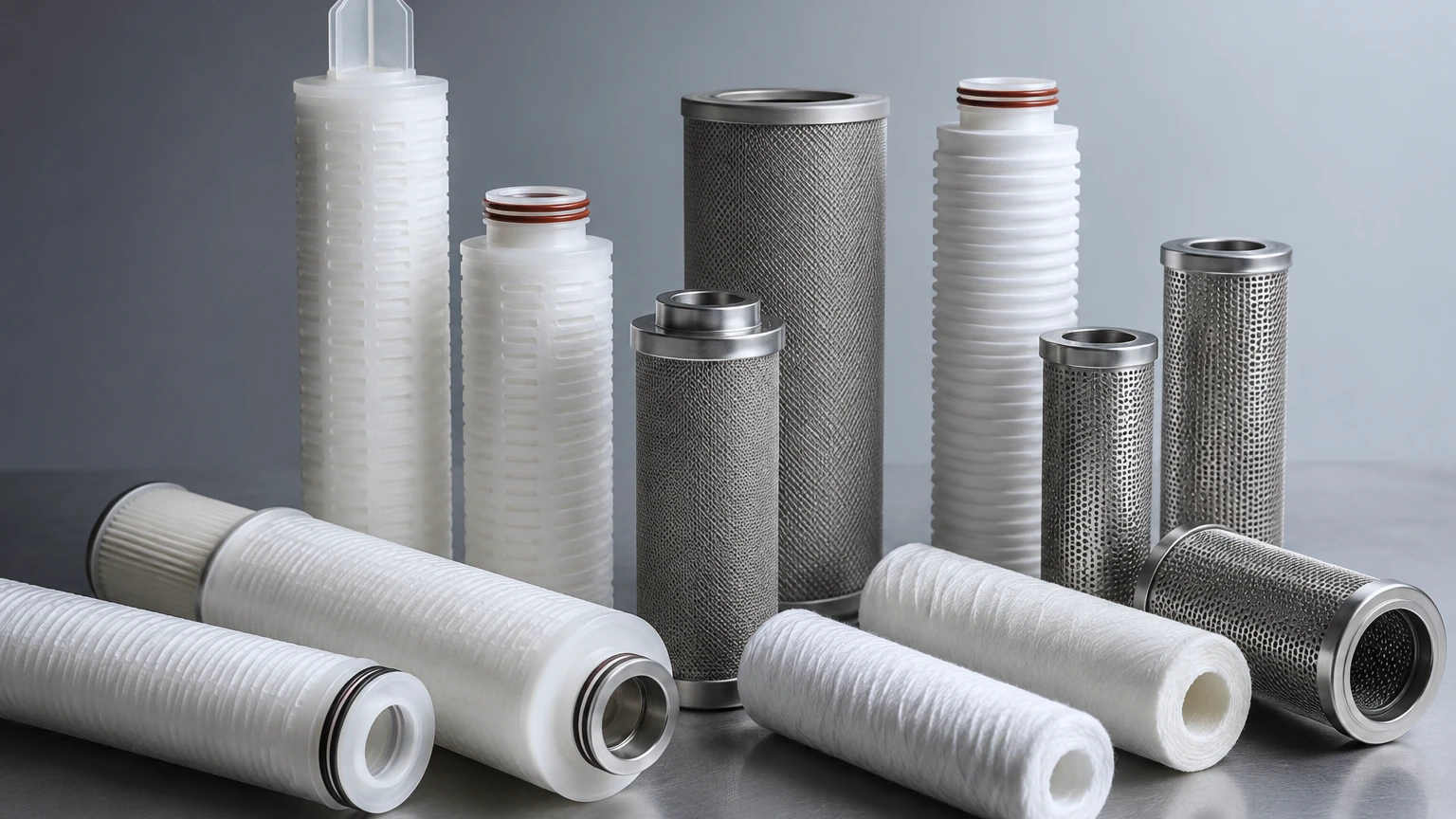
Polypropylene is the most common material for standard depth filters due to its broad chemical compatibility and low cost. These are typically manufactured as melt-blown or string-wound cartridges. While effective for general water treatment and pre-filtration, they are limited by temperature constraints and potential fiber migration, where small pieces of the filter media may break off and enter the filtrate.
Sintered Stainless Steel Fiber Felt
For demanding industrial environments, Kaifil specializes in stainless steel depth media. Sintered metal fiber felt is a high-performance depth medium produced by sintering fine stainless steel fibers into a porous, non-woven structure.
Unlike polymer filters, stainless steel depth filter cartridges offer:
* High Temperature Resistance: Capable of operating in environments exceeding 300°C.
* Chemical Durability: Resistant to aggressive solvents, acids, and bases that would degrade synthetic fibers.
* Structural Integrity: Metal depth filters do not suffer from media migration or unloading under high differential pressure ($ΔP$).
* Cleanability: While most depth filters are disposable, sintered metal depth cartridges can often be cleaned via ultrasonic baths or chemical circulation, lowering the total cost of ownership over time.
Performance Evaluation and Technical Metrics
When specifying depth filter cartridges, engineers must look beyond nominal micron ratings to understand how the filter will behave under real-world process conditions.
Absolute vs. Nominal Ratings
A "nominal" rating is an industry-standard term that indicates the filter can trap a certain percentage (often 60% to 90%) of particles at a specific micron size. However, for critical processes, an "absolute" rating is required. This is usually defined by a Beta Ratio ($β$). A Beta Ratio of 5000 signifies that for every 5000 particles of a certain size entering the filter, only one passes through, representing 99.98% efficiency. Depth filters typically provide excellent efficiency for a wide range of particle sizes due to their thick capture zone.
Differential Pressure and Flow Rates
The relationship between flow rate and differential pressure is a key design consideration. A depth filter naturally creates a pressure drop as fluid moves through the dense matrix. Engineers must calculate the "Clean $ΔP$" to ensure the pump system can handle the resistance. As the filter loads with contaminants, the $ΔP$ increases. The "Terminal $ΔP$" is the point at which the filter must be replaced or cleaned to prevent bypass or structural failure.
Dirt Holding Capacity (DHC)
DHC refers to the total mass of contaminants a filter can retain before reaching its terminal pressure drop. Depth filter cartridges generally offer superior DHC compared to pleated surface filters when dealing with deformable particles or a wide distribution of particle sizes. This makes them the ideal choice for clarifying viscous liquids like resins, syrups, or heavy oils.
Customization and Engineering Considerations
No two industrial processes are identical, which is why customization is a core component of the Kaifil service model. When designing a filtration system, several physical and chemical factors must be confirmed.
End-Cap Configurations
To ensure a leak-proof seal within the filter housing, various end-cap styles are available. Common configurations include:
* DOE (Double Open End): Utilizes flat gaskets on both ends.
* Code 7 (226 O-ring/Fin): Features a locking tab and double O-rings for high-purity applications.
* Code 3 (222 O-ring/Flat): A standard O-ring seal for many industrial housings.
Seal Material Selection
The choice of O-ring or gasket material is as important as the filter media itself. Common options include EPDM for steam and water, Viton (FKM) for high temperatures and chemicals, and PTFE-encapsulated seals for maximum chemical inertness. Incorrect seal selection can lead to bypass, where unfiltered fluid escapes around the edges of the cartridge.
Sizing and Scalability
Properly sizing a depth filter system requires balancing the flux rate (flow per unit of surface area) with the expected solids loading. Over-sizing a system leads to unnecessary capital expenditure, while under-sizing leads to frequent filter changes and high operational costs. Kaifil works with technical teams to determine the optimal number of cartridges and housing dimensions to achieve the desired service life.
Total Cost of Ownership and Maintenance
In a B2B procurement context, the initial purchase price of depth filter cartridges is only one part of the economic equation. The Total Cost of Ownership (TCO) includes several factors:
1. Change-out Frequency: A higher-quality depth filter with better graded density may cost more upfront but last three times longer, significantly reducing labor costs and downtime.
2. Product Loss: Filters with high internal hold-up volume can lead to significant product loss during change-outs. Engineering the cartridge to minimize residual volume is critical for high-value fluids.
3. Disposal Costs: In industries dealing with hazardous chemicals, the cost of disposing of used cartridges can be substantial. This is where cleanable stainless steel depth filters provide a strategic advantage, as they generate less waste.
4. Energy Consumption: As filters clog, pumps must work harder to maintain flow. Monitoring $ΔP$ and replacing filters at the optimal economic point (rather than waiting for total blockage) saves energy.
Industry-Specific Applications
Chemical Processing
In the production of polymers and specialty chemicals, depth filter cartridges are used to remove gels and oversized aggregates. The ability of depth media to retain deformable particles (which would simply squeeze through a surface mesh) is invaluable here.
Food and Beverage
From clarifying fruit juices to removing yeast cells in brewing, depth filtration provides the high flow rates and fine retention needed for consumer safety and product clarity. Stainless steel variants are often preferred for their ability to withstand CIP (Clean-in-Place) cycles using hot caustic or steam.
Hydraulic and Lube Oils
Depth filters are the gold standard for removing "silt" and oxidation by-products (varnish) from hydraulic fluids. By maintaining low particle counts, these filters protect sensitive valves and actuators from premature wear.
Conclusion
Depth filter cartridges are a fundamental technology for achieving high-efficiency separation in complex industrial environments. By leveraging the principles of graded density and volumetric capture, these components offer a robust solution for high-solids applications. Whether the requirement is for standard polymer media or custom-engineered stainless steel sintered fiber felt, selecting the right depth filter involves a deep dive into material compatibility, micron efficiency, and total lifecycle costs.
For engineers seeking to optimize their filtration processes or develop OEM solutions, Kaifil offers the manufacturing precision and technical support necessary to meet demanding specifications. To explore our capabilities and view our full product catalog, please visit our Main Page.
