


Design of Screening in Wastewater Treatment
In the hierarchy of wastewater treatment processes, screening stands as the critical first line of defense. The primary objective in the design of screening in wastewater treatment is to remove large solids, rags, and debris that could otherwise damage downstream mechanical equipment, clog pipes, or interfere with biological treatment processes. For engineers and plant operators, the selection of screening technology is not merely a matter of sizing a grate; it involves a complex analysis of hydraulic flow, material durability, and the specific characteristics of the influent.
As a specialized manufacturer of stainless steel filtration components, Kaifil understands that the efficacy of a treatment plant often hinges on the precision of its primary filtration stage. This article examines the technical parameters, material considerations, and engineering principles essential for optimizing screening systems in industrial and municipal wastewater environments.
The Role and Classification of Screening Systems
Screening is categorized based on the size of the openings and the method of cleaning. The design of screening in wastewater treatment typically involves a multi-stage approach to ensure that debris is removed progressively without causing excessive head loss or system bypass.
Coarse Screens
Coarse screens, often referred to as bar screens or trash racks, typically feature openings ranging from 6 mm to 150 mm. Their primary function is to protect pumps and valves from large objects like wood, plastic containers, and heavy rags. These are usually installed at the headworks of a treatment facility. Depending on the flow volume, they may be manually cleaned or equipped with automated mechanical rakes.
Fine Screens
Fine screens utilize openings smaller than 6 mm, often reaching as low as 0.5 mm. These are increasingly common in modern facilities to reduce the organic load on secondary treatment stages or to protect sensitive membrane bioreactors (MBR). Fine screens often employ wedge wire, perforated plates, or wire mesh. Because they capture a higher volume of solids, automated cleaning mechanisms—such as rotating drums or continuous belts—are mandatory to prevent blinding.
Micro Screens
Micro screening involves apertures smaller than 0.5 mm. These are typically used for tertiary treatment or specific industrial applications, such as polishing effluent or recovering valuable materials in food and beverage processing. At this level, the precision of the filter media, often made from high-grade stainless steel wire mesh, is paramount to ensure consistent performance under pressure.
Hydraulic Design and Engineering Parameters
The efficiency of a screening system is governed by several hydraulic variables. Engineers must balance the need for high solids capture with the requirement to maintain flow velocity and minimize head loss.
Approach and Through-Screen Velocity
The velocity of the wastewater as it approaches the screen (approach velocity) should ideally be maintained between 0.3 m/s and 0.6 m/s. If the velocity is too low, grit and heavy solids may settle in the channel before reaching the screen. Conversely, if the through-screen velocity (the speed at which water passes through the openings) exceeds 0.9 m/s, flexible debris may be forced through the screen, and the head loss will increase exponentially.
Head Loss Calculations
Head loss is the difference in water level upstream and downstream of the screen. It is a critical indicator of screen performance and clogging. Engineers often use the Kirschmer equation or modified Bernoulli equations to estimate head loss. Factors influencing this include the shape of the bars (circular bars create more turbulence than rectangular or teardrop-shaped bars), the angle of inclination, and the percentage of open area. A well-executed design of screening in wastewater treatment accounts for a "clogging factor," usually assuming that 50% of the screen area may be blocked during peak events.
Angle of Inclination
Screens are rarely installed vertically. Most mechanical bar screens are inclined at an angle between 60° and 85° to the horizontal. Inclination increases the effective surface area of the screen, which reduces the velocity through the openings and facilitates the mechanical removal of screenings by the rake mechanism.
Material Selection: The Case for Stainless Steel
In wastewater environments, the choice of material is a primary determinant of the system's total cost of ownership. The presence of hydrogen sulfide (H2S), chlorides, and varying pH levels creates a highly corrosive atmosphere that can rapidly degrade carbon steel or inferior alloys.
Corrosion Resistance
Stainless steel 304 and 316L are the industry standards for screening media. 304 stainless steel offers excellent resistance to general corrosion and is suitable for many municipal applications. However, in industrial wastewater—particularly in chemical processing or coastal municipal plants with high salinity—316L is preferred due to its molybdenum content, which provides superior resistance to pitting and crevice corrosion.
Structural Integrity
Unlike plastic or composite alternatives, stainless steel filtration components maintain their structural integrity under high hydraulic loads. In the design of screening in wastewater treatment, the rigidity of the bars or mesh ensures that the aperture size remains constant, preventing "bypass" where solids slip through deformed openings. Kaifil’s focus on precision metal filter components ensures that these tolerances are met, providing reliable performance in demanding environments.
Mechanical vs. Manual Cleaning Mechanisms
The method of removing captured solids is as important as the screen itself. The choice between manual and mechanical cleaning is usually dictated by the expected volume of screenings and the available labor force.
1. Manual Screens: These are low-cost and simple to install but require frequent operator intervention. They are typically reserved for small plants or as emergency bypass channels.
2. Mechanical Raked Screens: These use a motorized rake to pull debris up a dead plate into a discharge hopper. They are highly effective for coarse screening.
3. Step Screens: These consist of two sets of thin, stepped plates (one stationary, one mobile) that lift solids up the screen in a "stair-step" fashion. They are excellent for fine screening and have self-cleaning properties.
4. Wedge Wire Drum Screens: These utilize a rotating cylinder of wedge wire. As the drum rotates, solids are captured on the surface and scraped off, while the water flows through the V-shaped openings. This design is highly resistant to clogging and is a staple in industrial pretreatment.
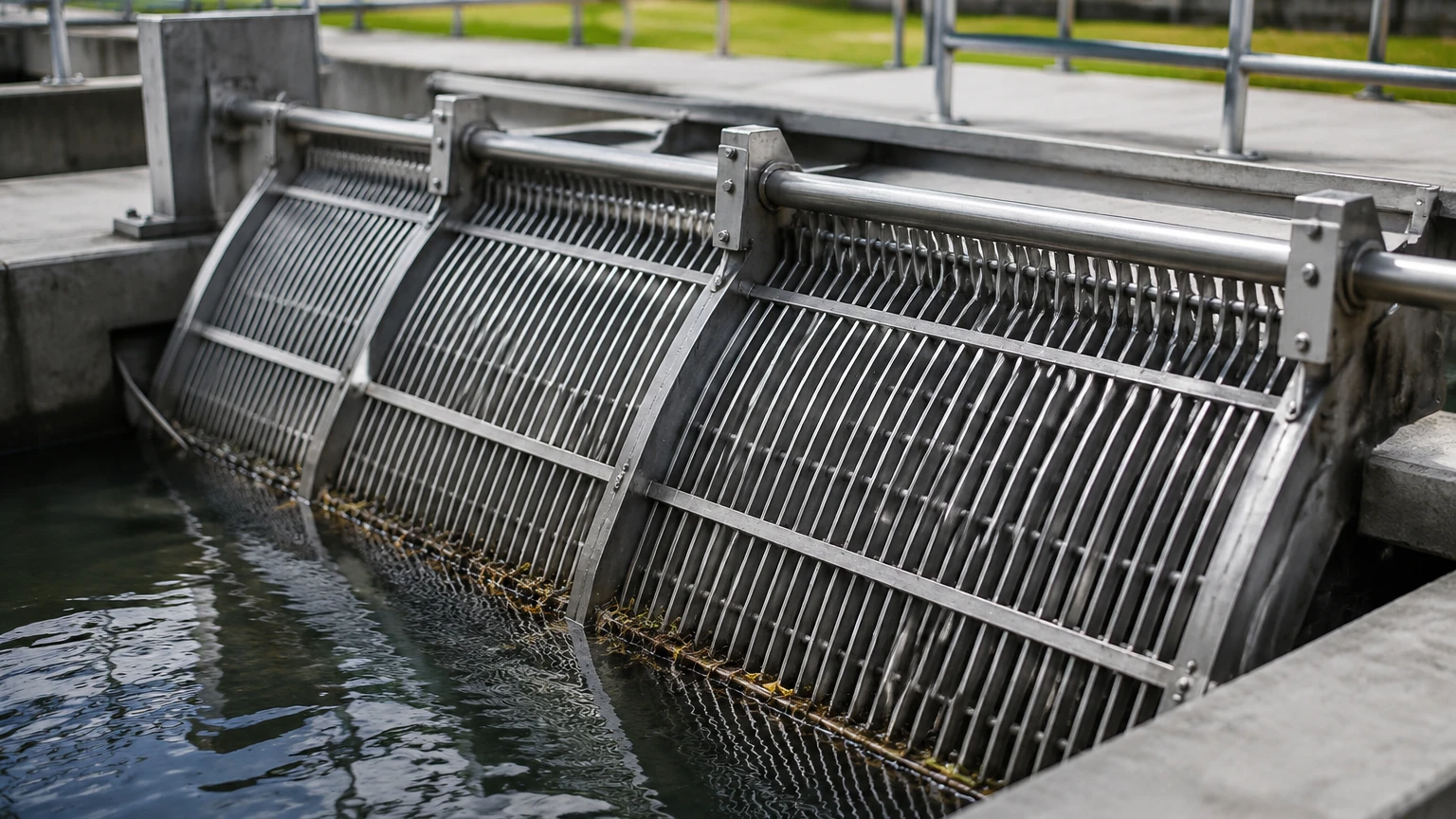
Design of Screening in Wastewater Treatment for Industrial Applications
Industrial wastewater often presents challenges that municipal systems do not, such as high temperatures, extreme pH levels, and high concentrations of oils or fats. The design must be tailored to these specific variables.
* Food and Beverage: Screening design must prioritize hygiene and ease of cleaning. Stainless steel wedge wire is often used here because its smooth surface prevents organic matter from adhering and fermenting.
* Chemical Processing: The focus shifts to chemical compatibility. Engineers must verify that the seals, gaskets, and the metal alloy itself can withstand the specific chemical makeup of the influent.
* Pulp and Paper: This industry requires the removal of large volumes of fibrous material. High-capacity drum screens with specialized backwash systems are often required to prevent the fibers from matting onto the screen surface.
Maintenance, Replacement, and Performance Evaluation
Even the best-designed screening system requires a proactive maintenance strategy. For engineers, the goal is to maximize the interval between major overhauls while ensuring consistent capture rates.
Monitoring Head Loss
Continuous monitoring of head loss via ultrasonic level sensors is the most effective way to manage cleaning cycles. If the head loss remains high even after a cleaning cycle, it indicates "blinding" of the screen media, which may require chemical cleaning or high-pressure washing.
Wear and Component Replacement
The moving parts of mechanical screens—chains, sprockets, and rake teeth—are subject to significant wear. However, the screen media itself (the bars or mesh) should last for many years if correctly specified. When replacement is necessary, it is vital to source components that match the original engineering specifications to maintain the hydraulic balance of the plant.
For those seeking technical specifications or customized components for their filtration systems, you can Review product options and application support on the Kaifil Main Page to ensure your replacement parts meet industrial quality standards.
Total Cost of Ownership (TCO)
When evaluating the design of screening in wastewater treatment, the initial capital expenditure (CAPEX) is only one part of the equation. Operating expenses (OPEX), including energy consumption, labor for screenings handling, and the cost of maintaining downstream equipment, often outweigh the initial purchase price.
A high-quality stainless steel screen might have a higher upfront cost than a lower-grade alternative, but its longevity and the protection it affords to expensive downstream pumps and membranes result in a significantly lower TCO. Furthermore, efficient screening reduces the volume of sludge produced in secondary treatment, leading to lower disposal costs.
Conclusion
The design of screening in wastewater treatment is a foundational element of successful plant operation. By carefully considering hydraulic velocities, selecting robust materials like high-grade stainless steel, and choosing the appropriate cleaning mechanism, engineers can ensure long-term reliability and efficiency. Whether designing a new facility or upgrading an existing headworks, the focus must remain on precision and durability. As industrial requirements become more stringent, partnering with experienced manufacturers who provide customized, high-performance filtration solutions becomes essential for achieving optimal environmental and operational outcomes.
Download Design of Screening in Wastewater Treatment as a PDF
