


Disc Filtering
In the landscape of industrial separation technology, disc filtering represents a critical methodology for achieving high-precision particle removal in demanding environments. Unlike disposable polymer-based filters, industrial disc filters—particularly those constructed from stainless steel and specialized alloys—offer the structural integrity required for high-pressure, high-temperature, and chemically aggressive applications. As a manufacturer specializing in custom filtration solutions, Kaifil provides engineering teams with the technical components necessary to optimize fluid purity and equipment longevity.
Understanding the nuances of disc filtering requires a deep dive into material science, fluid dynamics, and mechanical engineering. This guide explores the technical foundations of disc-based filtration systems, the criteria for material selection, and the operational considerations essential for industrial procurement.
Understanding the Fundamentals of Disc Filtering
Disc filtering is a process that utilizes circular filter media to remove solid contaminants from a liquid or gaseous stream. These discs can function as standalone elements in simple strainers or be stacked in complex housings to increase the total filtration area within a compact footprint. The primary objective of a disc filter is to provide a consistent barrier that allows the carrier fluid to pass while capturing particles larger than the specified pore size.
In industrial settings, disc filtering is categorized into two main types: surface filtration and depth filtration. Surface filtration occurs when particles are trapped on the upstream side of the filter media, typically using a single layer of woven wire mesh. Depth filtration involves a thicker medium, such as sintered metal fibers or multiple layers of mesh, where particles are trapped within the tortuous path of the material. The choice between these methods depends on the particle load, the nature of the contaminants, and the required cleaning intervals.
For engineers evaluating filtration systems, the "disc" geometry is often preferred due to its mechanical stability. Under high differential pressure, a flat or pleated disc supported by a perforated plate or a coarser mesh layer resists deformation better than many cylindrical configurations. This stability ensures that the pore structure remains consistent, preventing "bypass"—a common failure mode where particles leak through gaps created by structural stress.
Material Science in Metal Disc Filtration
Selection of the correct alloy is the most significant factor in the performance and lifespan of a disc filtering system. While various materials are available, stainless steel remains the industry standard due to its balance of mechanical strength and corrosion resistance.
304 and 316L Stainless Steel
Grade 304 stainless steel is suitable for general industrial applications where basic corrosion resistance is required. However, for more demanding environments, such as those found in chemical processing or marine applications, 316L stainless steel is the preferred choice. The addition of molybdenum in 316L provides superior resistance to pitting and crevice corrosion, particularly in chloride-rich environments. Furthermore, the "L" designation indicates a low carbon content, which minimizes carbide precipitation during welding or sintering, preserving the material's integrity.
Specialized Alloys
In extreme cases where stainless steel may succumb to chemical attack, alloys such as Hastelloy, Inconel, or Monel are employed. These materials are selected for their ability to withstand highly acidic or alkaline fluids, as well as temperatures exceeding 500°C. When designing a disc filtering solution, engineers must confirm the chemical compatibility of the filter media with both the process fluid and the cleaning agents used during maintenance cycles.
Structural Variations: Sintered vs. Woven Mesh Discs
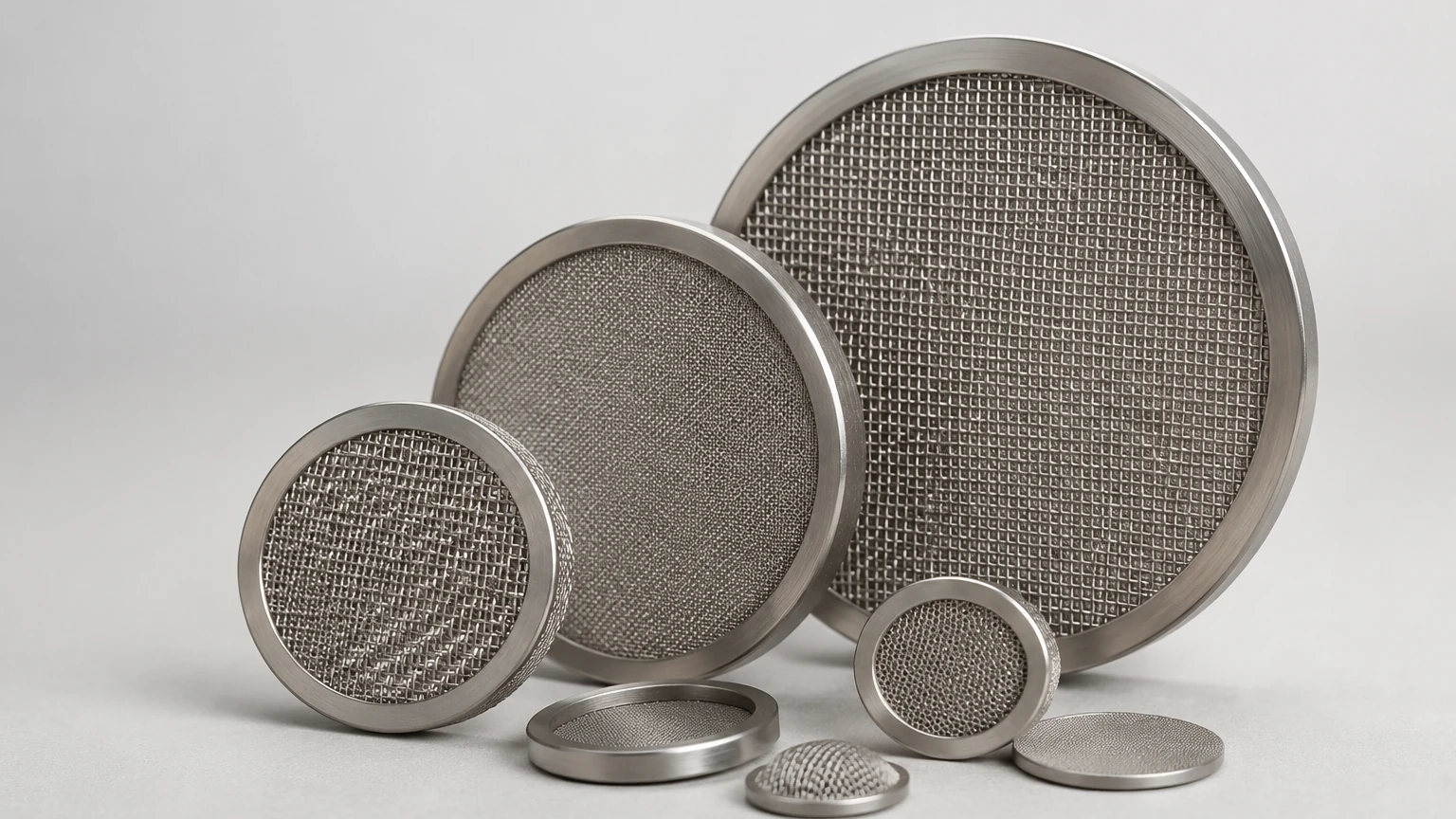
The internal structure of the filter disc determines its micron rating, flow capacity, and cleanability. There are two primary constructions used in high-performance disc filtering: woven wire mesh and sintered metal mesh.
Woven Wire Mesh Discs
Woven mesh is produced by weaving individual metal wires in various patterns, such as plain weave, twill weave, or Dutch weave. Dutch weaves, in particular, offer a very tight pore structure suitable for fine filtration. These discs are excellent for surface filtration and are relatively easy to clean via backwashing. However, they can be susceptible to "wire shifting" if not properly supported, which can alter the filtration accuracy over time.
Sintered Metal Discs
Sintering is a process where multiple layers of wire mesh (and sometimes metal fibers) are bonded together through heat and pressure without melting the wires. This creates a monolithic structure that is incredibly strong and dimensionally stable. Sintered discs offer several advantages:
1. No Media Migration: The wires are permanently bonded, ensuring no metal fragments enter the downstream flow.
2. Fixed Pore Geometry: The filtration rating remains constant even under high pressure.
3. Enhanced Depth Filtration: By combining layers of different mesh counts, a gradient pore structure can be created, significantly increasing the dirt-holding capacity.
For more information on the technical specifications of these materials and to Review product options and application support, visiting our Main Page provides a comprehensive overview of available configurations.
Critical Performance Parameters for Engineering Selection
When specifying a disc filtering component, engineers must look beyond the simple micron rating. Several interrelated factors determine the total cost of ownership and the efficiency of the filtration system.
Micron Rating: Absolute vs. Nominal
A "nominal" rating refers to the ability of the filter to retain a majority percentage (usually 60% to 90%) of particles of a certain size. An "absolute" rating, determined through rigorous testing like the bubble point test, indicates that 99.9% or more of particles above that size will be captured. For critical applications in the pharmaceutical or semiconductor industries, absolute ratings are mandatory.
Differential Pressure (ΔP)
Pressure drop is the difference in pressure between the upstream and downstream sides of the filter. A high initial pressure drop limits the flow rate and reduces the time available before the filter reaches its terminal pressure drop (the point at which it must be cleaned or replaced). Factors influencing ΔP include the fluid viscosity, flow velocity, and the open area of the disc filtering media.
Effective Filtration Area (EFA)
The EFA is the actual surface area available for fluid to pass through. In disc filtering, this can be maximized by using pleated designs. Pleating a disc increases the surface area within the same diameter, allowing for higher flow rates and longer service intervals without increasing the footprint of the filter housing.
Industrial Applications and Chemical Compatibility
Disc filtering is utilized across a diverse range of sectors, each with unique requirements for precision and durability.
Chemical and Petrochemical Processing
In these industries, filters must withstand aggressive solvents and high temperatures. Sintered stainless steel discs are frequently used to protect downstream catalysts or to clarify polymer melts. The ability of metal discs to maintain structural integrity at temperatures where polymers would liquify is essential for continuous process uptime.
Food and Beverage Industry
Filtration in this sector requires materials that are FDA-compliant and easy to sterilize. Stainless steel disc filters are used for clarifying juices, oils, and syrups. Because they can be cleaned using Steam-In-Place (SIP) or Clean-In-Place (CIP) protocols, they offer a more sustainable and hygienic alternative to disposable cartridges.
Pharmaceutical and Biotechnology
Precision is paramount in pharmaceutical manufacturing. Disc filtering is used for the recovery of expensive active pharmaceutical ingredients (APIs) and the removal of impurities. The smooth surface finish and high-grade alloys (like 316L) prevent bacterial growth and ensure that the filtration process does not introduce contaminants into the product.
Hydraulic and Lubrication Systems
Metal disc filters protect sensitive hydraulic valves and bearings from wear particles. In these high-pressure systems, the burst strength of the disc is a critical safety and performance factor. Sintered mesh discs provide the necessary robustness to handle pressure spikes without failing.
Maintenance Strategies and Service Life Extension
One of the primary advantages of stainless steel disc filtering is the ability to clean and reuse the elements. However, the cleaning method must be carefully chosen based on the type of contaminant and the filter structure.
* Backwashing: This involves reversing the flow of fluid through the disc to dislodge surface contaminants. It is most effective for woven mesh surface filters.
* Ultrasonic Cleaning: High-frequency sound waves create cavitation bubbles that penetrate deep into the pores of sintered media, removing fine particles that backwashing cannot reach.
* Chemical Cleaning: Soaking the discs in specific solvents or acids can dissolve organic or inorganic scaling. This requires careful verification of the alloy's chemical resistance.
* Thermal Cleaning: For polymer or organic buildup, controlled heating in a vacuum furnace can burn off the contaminants, leaving the metal disc clean and ready for reuse.
Establishing a regular maintenance schedule based on pressure drop monitoring can significantly extend the life of the filter and prevent unexpected system downtime.
Customization and OEM Integration
In many industrial applications, off-the-shelf filtration products do not meet the specific spatial or performance constraints of a system. Custom disc filtering solutions allow for the optimization of every variable, from the outer diameter and thickness to the specific layering of the mesh.
As a manufacturer, Kaifil works closely with OEM partners to develop components that integrate seamlessly into larger assemblies. This includes specialized edge bonding (such as welding or crimping) to ensure a leak-proof seal and the selection of support layers that can withstand specific mechanical loads. By consulting with filtration experts during the design phase, engineers can avoid common pitfalls such as undersized filtration areas or incompatible material pairings.
When evaluating a supplier for industrial filters, it is important to confirm their quality control processes. Certifications, material traceability, and performance testing (such as ISO 16889 multi-pass testing) provide the assurance that the disc filtering components will perform as expected in the field.
For technical professionals seeking to optimize their filtration processes, the transition to high-quality stainless steel discs offers a path toward greater efficiency and reduced long-term costs. For a deeper look at our manufacturing capabilities and to explore our full range of metal filter components, please visit our Main Page.
