


Donaldson Torit Company
In the landscape of industrial air quality and dust collection, the Donaldson Torit company has long been recognized as a standard-setter for filtration technology. For engineers and facility managers, understanding the role of such high-capacity systems is essential for maintaining operational efficiency, ensuring workplace safety, and meeting environmental regulations. While dust collection often focuses on airborne particulates, the broader scope of industrial filtration frequently requires a multi-faceted approach, integrating liquid filtration and precision metal components to protect sensitive equipment and maintain product purity.
Industrial filtration is not a one-size-fits-all discipline. It requires a deep understanding of particle dynamics, fluid mechanics, and material science. Whether a facility is managing wood dust, chemical vapors, or hydraulic fluids, the selection of filtration media and the design of the housing are critical factors that determine the longevity of the system and the total cost of ownership. This article explores the technical foundations of industrial filtration, the integration of specialized components, and the engineering considerations necessary for optimizing performance in demanding environments.
The Role of Industrial Filtration in Modern Manufacturing
Filtration serves as the primary defense mechanism in industrial processes. Its functions are generally categorized into three main areas: equipment protection, product quality assurance, and environmental/worker safety. In heavy industries, the presence of contaminants can lead to catastrophic mechanical failure. For example, in hydraulic systems, even microscopic metal shavings or silica dust can cause abrasive wear on pumps and valves, leading to expensive downtime.
From a product quality perspective, industries such as food and beverage or pharmaceuticals require absolute precision. A single batch of contaminated product can result in significant financial loss and damage to brand reputation. Here, filtration systems must provide consistent results, often requiring the use of stainless steel filter cartridges that can withstand rigorous cleaning cycles and high-temperature sterilization.
Environmental compliance is another driving force. Regulatory bodies like OSHA and the EPA mandate strict limits on emissions and workplace air quality. Systems developed by the Donaldson Torit company and other leaders in the field are designed to capture sub-micron particles, ensuring that exhausted air meets or exceeds safety standards. However, the efficiency of these systems often depends on the pre-filtration stages and the durability of the internal components used to manage the flow of air and liquids.
Understanding Dust Collection and Air Filtration Systems
Dust collection systems are complex engineering assemblies designed to handle large volumes of air while stripping away particulate matter. These systems typically utilize either baghouse technology or cartridge collectors. Cartridge collectors, in particular, have gained popularity due to their compact footprint and high filtration efficiency.
The efficiency of a dust collector is measured by its MERV (Minimum Efficiency Reporting Value) rating or its ability to capture particles of a specific micron size. For many industrial applications, capturing particles in the 0.3 to 10-micron range is essential. The Donaldson Torit company has pioneered several technologies in this space, focusing on surface loading media that allows for easier pulse-cleaning.
Pulse-cleaning is a critical feature in modern collectors. It involves a high-pressure blast of compressed air sent down through the filter element to dislodge the accumulated dust cake. For this process to be effective without damaging the filter, the structural integrity of the filter support—often a metal mesh or perforated core—must be exceptional. If the support structure fails, the filter media collapses, leading to immediate bypass and system failure. This is where the intersection of air filtration and precision metal manufacturing becomes evident, as high-quality stainless steel components provide the necessary reinforcement for these demanding cycles.
Integrating Stainless Steel Filtration Components
While fabric and paper-based media are common in air filtration, many industrial processes involve corrosive chemicals, high temperatures, or high-pressure fluids that would destroy standard materials. In these scenarios, stainless steel wire mesh and sintered metal filters are the preferred choice.
Stainless steel filters offer several technical advantages:
1. Thermal Stability: Unlike polymer-based filters, stainless steel can operate in environments exceeding 500°F (260°C) without losing structural integrity.
2. Chemical Compatibility: Using alloys like SS304 or SS316L allows the filters to resist corrosion from acids, alkalis, and organic solvents.
3. Cleanability: Metal filters are often permanent or semi-permanent. They can be cleaned via backwashing, ultrasonic cleaning, or chemical baths, making them more cost-effective over long durations compared to disposable elements.
4. Mechanical Strength: In high-pressure hydraulic or steam applications, the rigid structure of a stainless steel cartridge prevents media migration and maintains a consistent pore size under stress.
Engineers often look to integrate these durable components into larger systems. For instance, a facility utilizing a large-scale dust collector might also require high-precision liquid filters for its cooling water or chemical processing lines. Navigating these requirements requires a partner capable of providing customized solutions. For more information on specialized filtration components, professionals often consult the Main Page of leading manufacturers to review technical specifications and material options.
Engineering Considerations for High-Performance Filters
Selecting the right filter involves more than just matching a micron rating. Engineers must evaluate several variables to ensure the component will perform reliably in the field.
Micron Rating: Absolute vs. Nominal
One of the most common points of confusion is the distinction between absolute and nominal micron ratings. A nominal rating indicates the filter's ability to capture a percentage of particles (usually 60% to 90%) of a certain size. An absolute rating, however, implies that the filter will capture 99.9% or more of particles at that size. In critical applications, such as pharmaceutical processing or fine chemical production, absolute-rated stainless steel mesh is mandatory to prevent downstream contamination.
Pressure Drop (Delta P)
The pressure drop is the difference in pressure between the upstream and downstream sides of the filter. A high initial pressure drop indicates that the filter is either too restrictive for the flow rate or that the media is already partially blinded. Engineers must balance filtration efficiency with the energy costs required to push fluid or air through the system. Using a pleated design in stainless steel cartridges can significantly increase the surface area, thereby reducing the pressure drop and extending the time between cleaning cycles.
Flow Velocity and Residence Time
In liquid filtration, the velocity of the fluid as it passes through the mesh can affect the capture efficiency. If the velocity is too high, particles may be forced through the pores or the media may experience premature wear due to erosion. Calculating the optimal surface area ensures that the flux (flow per unit area) remains within the manufacturer’s recommended limits.
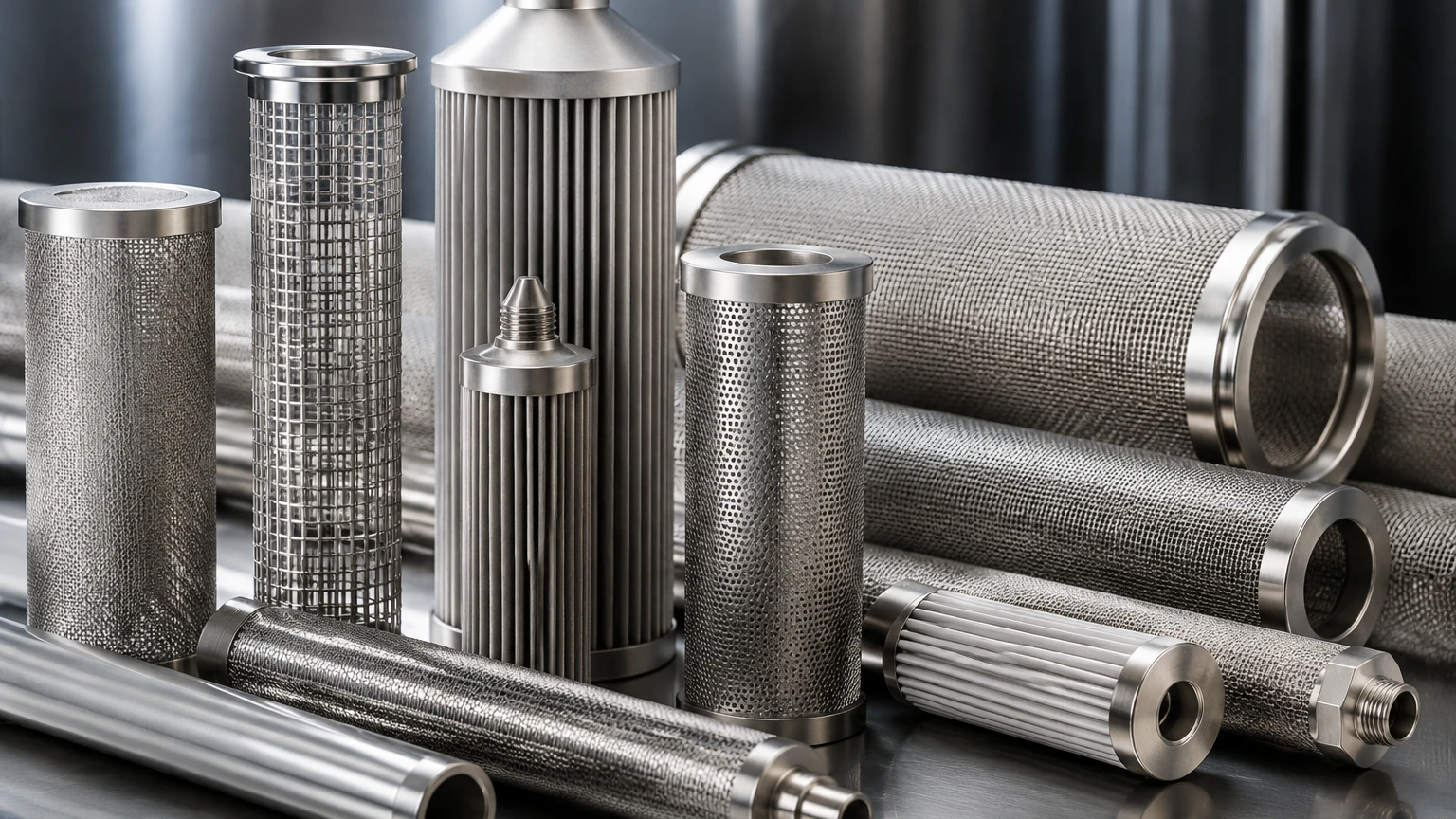
Customization and OEM Solutions for Industrial Environments
Standard, off-the-shelf filtration products are suitable for many general-purpose applications. However, many industrial OEMs (Original Equipment Manufacturers) require bespoke designs to fit unique housing geometries or to meet specific performance benchmarks.
Customization options often include:
* End Cap Configurations: Designing specific fittings (e.g., 222, 226, or NPT threads) to ensure a leak-proof seal within existing hardware.
* Multi-Layer Sintering: Combining different grades of wire mesh to create a composite filter that offers both fine filtration and high mechanical strength.
* Variable Micron Gradation: Creating depth-style filters using metal fibers to capture a wider range of particle sizes in a single pass.
When working with specialized providers, engineers can specify exact alloys and weave patterns—such as plain weave, twill weave, or dutch weave—to achieve the desired balance of flow and retention. This level of customization is particularly important for companies that may be using equipment from a variety of sources, including systems from the Donaldson Torit company or other major air filtration brands, and need compatible, high-durability replacement parts or pre-filters.
Maintenance and Total Cost of Ownership (TCO)
The initial purchase price of a filter is only a fraction of its total cost. To truly evaluate a filtration solution, one must consider the "Total Cost of Ownership," which includes energy consumption, labor for replacement, disposal costs, and the cost of potential downtime.
Stainless steel filtration solutions often have a higher upfront cost than paper or synthetic alternatives. However, their ability to be cleaned and reused multiple times significantly reduces the long-term expense. In a facility where filters must be changed weekly, the labor and disposal costs of single-use cartridges can quickly surpass the investment in a high-quality, cleanable stainless steel system.
Furthermore, monitoring the differential pressure is the most effective way to manage maintenance cycles. Modern industrial IoT (Internet of Things) sensors can now be integrated into filtration housings to provide real-time data on filter health. By replacing or cleaning filters only when they reach a specific pressure threshold, facilities can optimize their maintenance schedules and prevent unnecessary intervention.
Conclusion: Selecting the Right Filtration Partner
Navigating the complexities of industrial filtration requires a combination of high-level system knowledge and component-level expertise. While the Donaldson Torit company provides essential solutions for large-scale dust and air management, the reliability of those systems—and the liquid processes that run alongside them—often depends on the quality of the metal filtration components used.
For engineers and procurement teams, the goal is to find a partner that understands the technical nuances of material selection and precision manufacturing. Whether you are looking to optimize a chemical process, protect a high-pressure hydraulic system, or enhance the durability of an existing air filtration setup, focusing on proven engineering principles and high-quality materials is the key to long-term success. By prioritizing durability and precision, industrial operations can achieve higher efficiency, lower costs, and superior product outcomes in even the most demanding environments.
