


Drum Filters for Koi Ponds
In the realm of high-end aquaculture and ornamental pond management, mechanical filtration serves as the primary defense against water quality degradation. For koi ponds, where fish density and metabolic waste production are significantly higher than in standard water features, the drum filter—specifically the Rotary Drum Filter (RDF)—has emerged as the engineering standard. Unlike traditional settlement chambers or bead filters that require manual intervention and frequent backwashing, drum filters offer a self-cleaning, automated solution that removes suspended solids before they can undergo biological breakdown into ammonia and nitrites.
From an engineering perspective, the efficiency of a drum filter is dictated by the precision of its filtration media and the reliability of its mechanical components. This guide examines the technical considerations, material requirements, and performance expectations for drum filters in koi pond applications, providing professionals with the data needed to evaluate these systems for large-scale or high-performance projects.
Understanding Drum Filter Mechanics in Koi Pond Applications
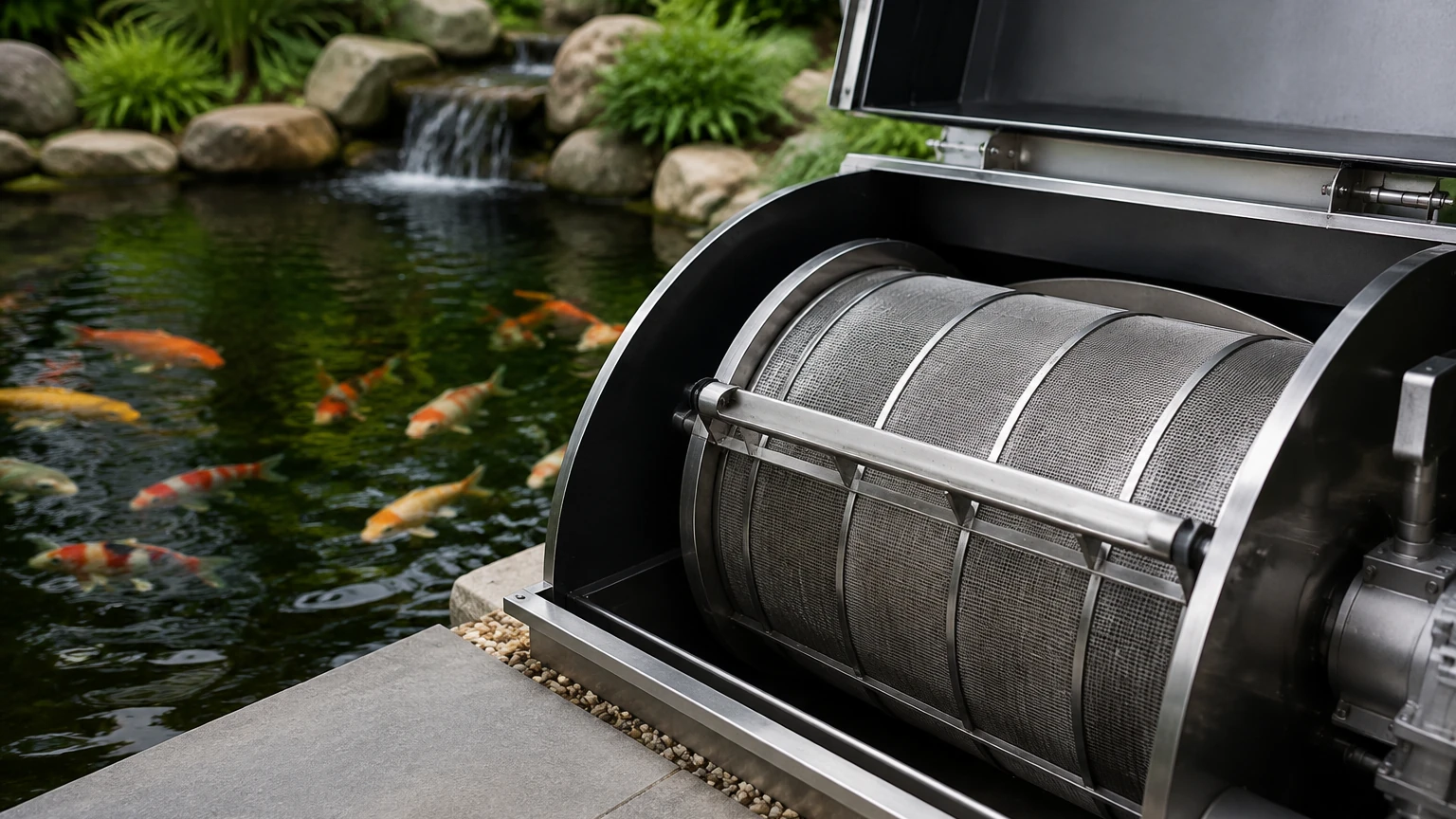
The fundamental operation of a drum filter relies on a rotating cylinder covered with a fine filtration mesh. Water from the pond enters the interior of the drum, either via gravity or a pump. As the water passes through the mesh to the exterior, suspended solids, including fish waste, uneaten food, and algae, are trapped on the inner surface of the screen.
As the trapped debris accumulates, the mesh begins to clog, causing a water level differential between the inside and outside of the drum. This differential is monitored by electronic sensors. Once a predetermined threshold is reached, the automated cleaning cycle is triggered. The drum rotates while a high-pressure spray bar located on the exterior of the drum blasts water through the mesh. This dislodges the debris into a waste trough, which then flushes the contaminants directly to a sewer or drainage system.
This process is critical because it removes organic matter from the water column entirely, rather than simply trapping it where it can continue to rot and consume oxygen. For engineers designing these systems, the choice of filtration mesh is the most critical variable in determining the unit's effective flow rate and cleaning frequency.
Selecting the Right Micron Rating for Precision Filtration
The "micron rating" refers to the size of the openings in the filter mesh. In koi pond applications, the goal is to achieve maximum water clarity without creating an excessive maintenance burden on the cleaning pump and motor.
1. 40 to 60 Microns: This is considered the gold standard for high-clarity koi ponds. At this level, the filter can remove even fine particulate matter and some types of free-floating algae. However, finer mesh requires more frequent cleaning cycles, which can increase wear on the mechanical components.
2. 70 to 100 Microns: This range is often used in larger systems or those with higher debris loads. It provides excellent clarity while allowing for higher flow rates and less frequent activation of the spray bar.
3. Above 100 Microns: Generally used as a pre-filtration stage in industrial water treatment, ratings above 100 microns are usually insufficient for the clarity expectations of a dedicated koi pond.
When evaluating mesh options, it is important to consider the open area percentage. A high-quality stainless steel wire mesh provides a greater open area compared to synthetic alternatives, allowing for higher flow rates through a smaller footprint. To explore specific mesh configurations and technical support for custom filtration components, professionals can visit the Main Page for detailed specifications.
Engineering Considerations: Material Selection and Durability
Industrial-grade drum filters must withstand constant exposure to water, biological films, and potentially corrosive pond treatments (such as salt or potassium permanganate). Therefore, material selection is paramount to the longevity of the system.
Stainless Steel Grades
Most high-performance drum filters utilize stainless steel for both the drum frame and the filtration mesh.
- AISI 304 Stainless Steel: Suitable for standard freshwater applications. It offers good corrosion resistance and structural integrity.
- AISI 316L Stainless Steel: Recommended for ponds where salt is frequently used for fish health or in coastal environments. The addition of molybdenum in 316L provides superior resistance to chloride-induced pitting and crevice corrosion.
Structural Integrity
The drum itself must be engineered to resist torque and deformation during the rotation cycle. In larger units, the mesh is often supported by a secondary, coarser stainless steel grid to prevent the fine mesh from sagging or tearing under the pressure of the spray bar. Precision welding and high-quality seals are necessary to ensure that no "bypass" occurs—where unfiltered water leaks around the edges of the drum.
Performance Expectations and Flow Rate Optimization
Determining the required flow rate for a koi pond is a function of total pond volume and the desired turnover rate. For koi ponds, a turnover rate of once every hour is typical. A 10,000-gallon pond, therefore, requires a filtration system capable of handling 10,000 gallons per hour (GPH).
However, the rated capacity of a drum filter is not a static number. It is influenced by:
- Biofilm Growth: Over time, a biological film will develop on the mesh, slightly reducing the effective open area.
- Debris Load: During peak summer months when feeding is at its highest, the solids load increases, requiring more frequent cleaning cycles to maintain the flow rate.
- Head Loss: While drum filters are low-head systems, the plumbing configuration leading to and from the unit must be optimized to prevent cavitation or reduced flow.
Engineers should specify a drum filter with a rated capacity approximately 20-30% higher than the calculated turnover requirement. This "safety margin" ensures the system can handle seasonal spikes in waste production without requiring constant cleaning cycles that could lead to premature motor failure.
Maintenance, Replacement Cycles, and Total Cost of Ownership (TCO)
While the initial capital expenditure for a drum filter is higher than for traditional systems, the total cost of ownership is often lower due to reduced labor and water savings. Traditional filters require manual backwashing, which can waste thousands of gallons of treated water monthly. A drum filter uses only a small amount of high-pressure water during its cleaning cycle, typically lasting only 10-20 seconds.
Component Longevity
- Filter Mesh: High-quality stainless steel mesh can last 5 to 10 years depending on the water chemistry and the presence of abrasive particles like sand.
- Drive Motors and Seals: These are the primary wear items. Selecting units with industrial-grade, IP65-rated motors ensures protection against the humid environment of a filter house.
- Spray Nozzles: These should be inspected periodically for mineral scaling. In hard water areas, nozzles may require descaling to maintain the correct spray pattern and pressure.
By investing in precision-manufactured components, operators can extend the intervals between major overhauls, ensuring the biological stability of the pond remains uninterrupted.
Customization Options for OEM and Large-Scale Projects
For commercial aquaculture facilities or large-scale private estates, off-the-shelf drum filters may not meet specific spatial or hydraulic requirements. Customization allows for the optimization of the filtration system to the specific environment.
Custom engineering options include:
- Variable Speed Drives (VSD): Allowing the drum rotation speed to be adjusted based on real-time water conditions.
- Integrated UV-C Sterilization: Mounting UV-C lamps directly inside the drum housing to maximize exposure to the water as it passes through the mesh, effectively controlling suspended algae and pathogens.
- Custom Inlet/Outlet Configurations: Modifying the housing to accommodate multiple bottom drains and skimmer lines, reducing the need for complex external manifolds.
- Advanced Control Systems: Integrating the filter with building management systems (BMS) or mobile apps for remote monitoring of cleaning cycles and water levels.
When sourcing components for these specialized systems, it is essential to partner with a manufacturer that understands the nuances of stainless steel filtration and can provide the necessary tolerances for industrial-grade performance.
Conclusion: The Strategic Value of High-Performance Filtration
In the context of B2B procurement and engineering design, the selection of a drum filter for koi ponds is a decision based on long-term reliability and water quality consistency. By focusing on high-quality materials like 316L stainless steel and precise micron-rated mesh, designers can provide a solution that minimizes manual labor while maximizing the health and clarity of the aquatic environment.
As the industry moves toward more automated and efficient water management practices, the role of precision-engineered filtration components becomes increasingly vital. Whether for a private collection or a commercial display, the drum filter remains the most effective tool for maintaining the rigorous standards required for koi health. For those seeking to integrate these technologies into their next project, reviewing the available technical support and product options on the Main Page is the recommended next step in the specification process.
