


Duplex Filter Housing
In industrial process engineering, the continuity of flow is often the most critical factor in maintaining operational efficiency and preventing costly downtime. For applications where a system cannot be shut down for routine maintenance or filter element replacement, the duplex filter housing provides a necessary engineering solution. By incorporating two separate filter vessels into a single integrated system, these units allow for uninterrupted filtration, ensuring that fluid processing remains constant even during cleaning or replacement cycles.
As a specialized manufacturer of stainless steel filtration solutions, Kaifil understands that selecting the correct duplex configuration involves more than just matching pipe sizes. It requires a deep understanding of fluid dynamics, material compatibility, and the specific mechanical requirements of the industrial environment. This guide explores the technical considerations, engineering principles, and selection criteria essential for technical professionals and purchasing teams evaluating duplex filtration systems.
The Functional Architecture of Duplex Filtration Systems
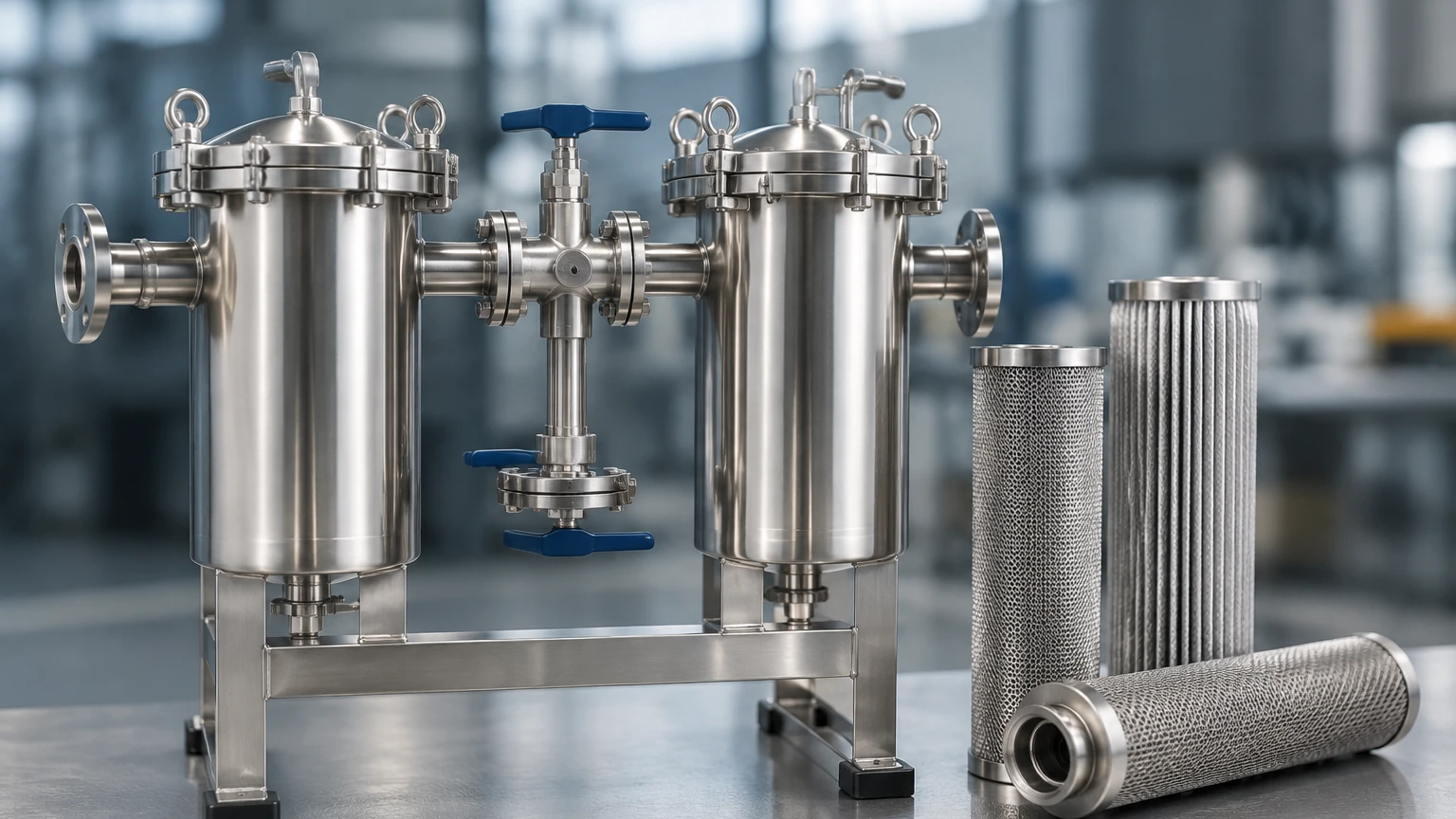
The primary design objective of a duplex filter housing is redundancy. The system consists of two identical pressure vessels connected by a common manifold and a changeover valve mechanism. Under normal operating conditions, the fluid is directed through one vessel (the "duty" filter) while the other vessel (the "standby" filter) remains isolated and clean.
Changeover Valve Mechanisms
The heart of any duplex system is the changeover valve. There are several engineering approaches to this component, each suited to different pressure and flow requirements:
1. Dual Three-Way Ball Valves: Often linked by a common handle or actuator, these valves ensure that as the inlet to one vessel closes, the inlet to the other opens simultaneously. This design is robust and provides a tight seal, making it suitable for high-pressure hydraulic and chemical applications.
2. Six-Way Plug Valves: A more compact solution that manages both the inlet and outlet flow through a single valve body. This reduces the footprint of the housing and simplifies the changeover process, though it may be limited by the maximum flow capacity of the valve bore.
3. Butterfly Valve Manifolds: For large-diameter piping and high-flow water treatment applications, a series of four butterfly valves can be used. While more complex to synchronize, they offer lower pressure drops in high-volume systems.
Pressure Equalization
A critical but often overlooked feature in duplex filter housing design is the pressure equalization line. Before switching flow to the standby vessel, it must be filled with fluid and pressurized. Without an equalization line, the sudden introduction of high-pressure fluid into an empty vessel can cause hydraulic shock (water hammer), potentially damaging the filter elements or the housing seals. Proper engineering ensures that the changeover is seamless and does not cause a dip in downstream pressure.
Material Engineering: Stainless Steel Selection and Compatibility
Industrial filtration environments are frequently corrosive or subject to strict hygienic standards. Consequently, the choice of material for the housing and internal components is paramount. Kaifil focuses on high-grade stainless steel to ensure long-term durability and resistance to chemical degradation.
Grade 304 vs. 316L Stainless Steel
* Grade 304: This is the standard choice for general industrial applications, including water treatment and many hydraulic systems. It offers excellent mechanical strength and good corrosion resistance at a lower cost point.
* Grade 316L: For more demanding environments, such as chemical processing, pharmaceutical manufacturing, or marine applications, 316L is the preferred material. The addition of molybdenum and a lower carbon content provides superior resistance to pitting and crevice corrosion, particularly in the presence of chlorides or acidic solutions.
Gaskets and Seals
The chemical compatibility of the housing is only as strong as its weakest seal. Engineers must select gasket materials based on the fluid's temperature and chemical composition. Common options include:
* Buna-N (Nitrile): Suitable for oils, water, and general hydraulic fluids.
* Viton (FKM): Preferred for high temperatures and aggressive chemicals or fuels.
* EPDM: Ideal for steam, water, and certain polar solvents, though incompatible with petroleum-based oils.
* PTFE/Teflon: Used for extreme chemical resistance, though it requires specific housing designs to account for its lack of elasticity.
Critical Design Parameters: Flow Dynamics and Pressure Ratings
When specifying a duplex filter housing, engineers must balance the required filtration accuracy with the allowable pressure drop across the system. The total pressure drop ($ΔP$) is the sum of the housing pressure drop and the clean filter element pressure drop.
Calculating Flow Velocity and Viscosity
The viscosity of the fluid significantly impacts the performance of the housing. High-viscosity fluids, such as heavy oils or resins, require larger housing sizes to maintain a low flow velocity. If the velocity is too high, the turbulence within the housing can cause premature wear and reduce the efficiency of the filter media.
Engineers should aim for a "clean pressure drop" that does not exceed 2-5 PSI (0.14-0.34 bar) for most applications. This provides sufficient "dirt-holding capacity" before the filter reaches its terminal pressure drop (the point at which the element must be changed), typically between 15-25 PSI.
Filtration Accuracy and Media Type
Duplex housings can accommodate various types of filter media, including:
* Stainless Steel Wire Mesh: Best for coarse filtration and high-temperature applications. These are often cleanable and reusable, reducing long-term waste.
* Sintered Metal Felt: Provides high porosity and excellent dirt-holding capacity for fine filtration in high-pressure environments.
* Wound or Melt-Blown Cartridges: Used for high-purity applications, though they are disposable and contribute to higher operational costs.
For technical professionals looking to explore the full range of material and media configurations, the Main Page serves as a resource for reviewing product options and application support.
Operational Protocol: Managing Changeover and Maintenance
The primary advantage of a duplex system is maintenance without interruption. However, this requires a disciplined operational protocol to ensure safety and system integrity.
The Changeover Process
1. Monitor Differential Pressure: Operators should monitor the pressure gauges on both the inlet and outlet. When the differential pressure reaches the pre-set limit, the standby vessel is prepared for service.
2. Venting and Filling: The standby vessel is vented of air and filled with the process fluid using the equalization valve.
3. The Switch: The changeover valve is actuated to divert flow. In high-quality duplex housings, this switch is designed to be "overlap-type," meaning there is never a moment where both vessels are closed, preventing a total blockage of flow.
4. Servicing the Off-line Vessel: Once isolated, the dirty vessel is drained, and the filter elements are cleaned or replaced. It is then resealed and remains in standby mode.
Safety Features and Instrumentation
To prevent operational errors, many industrial duplex housings include safety interlocks. These can prevent the opening of a vessel that is still under pressure. Additionally, differential pressure switches can be integrated into the plant's control system (SCADA) to provide automated alerts when a filter change is required, moving away from manual inspection and reducing the risk of element collapse.
Customization and OEM Integration for Specialized Environments
Standard duplex filter housings may not meet the specific geometric or regulatory requirements of every facility. Customization is often necessary to integrate the filtration system into existing piping layouts or to meet industry-specific standards.
Sanitary and High-Purity Designs
In the food, beverage, and pharmaceutical industries, the internal surfaces of the duplex filter housing must be free of pits, crevices, and dead zones where bacteria could proliferate. This requires:
* Electropolishing: Achieving a surface finish of Ra < 0.8 μm or better.
* Tri-Clamp Connections: Facilitating easy disassembly for Clean-in-Place (CIP) or Sterilize-in-Place (SIP) procedures.
* Self-Draining Geometry: Ensuring no residual fluid remains in the housing after a cycle.
Industrial and Heavy-Duty Configurations
For hydraulic systems or large-scale water treatment, the focus shifts to pressure vessel codes (such as ASME Section VIII or the EU Pressure Equipment Directive) and high-strength construction. Custom inlet/outlet orientations, specialized mounting brackets, and the inclusion of heating jackets (for maintaining the flow of temperature-sensitive fluids like wax or heavy fuel oil) are common OEM requirements that Kaifil supports.
Economic Impact: Evaluating Total Cost of Ownership
While the initial capital expenditure (CAPEX) for a duplex filter housing is higher than that of a simplex housing, the Total Cost of Ownership (TCO) is often significantly lower when considering the broader industrial context.
Avoiding Downtime Costs
In many continuous processes, even an hour of downtime can result in thousands of dollars in lost production, labor costs for restarting equipment, and potential product spoilage. A duplex system effectively eliminates the filtration-related component of this downtime risk.
Element Longevity and Waste Reduction
By allowing for more precise control over the timing of filter changes, duplex systems ensure that filter elements are used to their full capacity. Furthermore, when paired with cleanable stainless steel wire mesh elements, the ongoing operational expenditure (OPEX) related to purchasing and disposing of single-use cartridges is drastically reduced.
Long-Term Durability
A well-engineered stainless steel duplex housing is a long-term asset. Unlike plastic or lower-grade metal housings that may suffer from fatigue, UV degradation, or chemical embrittlement, a high-quality stainless steel unit provides decades of service life with minimal maintenance beyond seal replacements.
Conclusion
The selection of a duplex filter housing is a critical decision for any engineer tasked with maintaining the reliability of a continuous process. By understanding the nuances of valve design, material selection, and flow dynamics, technical teams can specify a system that not only protects downstream equipment but also optimizes the efficiency of the entire operation.
Whether the application involves high-pressure hydraulics, sensitive pharmaceutical fluids, or large-scale industrial water treatment, the fundamental principles of redundancy and robust construction remain the same. For detailed technical specifications and support in selecting the right filtration components for your specific industrial requirements, visit the Main Page to consult with filtration experts and explore customized OEM solutions.
